Updated August 2, 2026. Adults can start a Social Security disability application through the official SSA online disability page. Prepare details about every condition that limits work, treatment providers, medicines, tests, recent jobs, education, and other benefits before beginning. Complete the benefit application, disability report, and medical release steps that SSA presents.
This independent website cannot submit, view, or speed up a disability claim. Never send it a Social Security number, medical record, bank number, application re-entry number, or SSA/Login.gov credential. Eligibility and medical decisions are account-specific, and no diagnosis, form, representative, or article can guarantee approval.
Quick Answer: Start at SSA.gov
Use ssa.gov/applyfordisability or begin at ssa.gov/apply and select Disability. Review SSA's Adult Disability Checklist first, gather your notes, and use only the secure application reached from the official page. Filing an application with SSA is free.
| Application component | What it generally covers | What it is not |
|---|---|---|
| Disability Benefit Application | Personal, family, work, and benefit claim information | A medical approval |
| Adult Disability Report | Conditions, treatment, medicine, tests, jobs, education, and limitations | A doctor's guarantee of benefits |
| Medical Release Form | Authorization that helps SSA request relevant records | The complete application by itself |
| Starter Kit and checklist | Preparation aids | A filed claim or approval packet |
SSDI, SSI, or Both?
“Social Security disability” can refer to two programs. Social Security Disability Insurance (SSDI) is tied to insured status from work covered by Social Security. Supplemental Security Income (SSI) is needs-based and has income, resource, living-arrangement, citizenship/status, and other nonmedical rules in addition to its disability standard.
An adult may be screened for one or both programs in the official process. Some adults can start SSI through the online disability path, while SSA may still need a phone interview or other follow-up for the SSI portion. Do not decide from the program name alone. Use SSA's official selector and answer its questions accurately.
This guide is focused on adult applications. A child disability claim uses a different report and school/function evidence, while survivor and retirement claims follow other paths.
Who Can Use the Adult Online Application?
SSA lists four conditions for using its current online adult process:
- You are age 18 or older.
- You are not currently receiving benefits on your own Social Security record.
- You cannot work because of a medical condition expected to last at least 12 months or result in death.
- You have not been denied disability benefits within the last 60 days.
If you were recently denied for medical reasons, SSA directs you to the Internet Appeal process as a starting point. Filing another new application can put an appeal deadline at risk. Read the denial notice and use the official appeal route or obtain qualified help.
Meeting these conditions only identifies the online route. It does not establish SSDI insured status, SSI financial eligibility, or medical disability.
The Online Forms and What They Do
Disability Benefit Application
This portion asks for basic identity, family, work, other-benefit, and payment information. Answer based on records rather than estimates. The exact screen labels can change, so follow the current secure flow instead of downloading a third-party copy.
Adult Disability Report
The report, commonly associated with Form SSA-3368 and its internet version, describes the conditions that limit work, treatment sources, medicines, tests, education, and work history. It gives Disability Determination Services (DDS) the roadmap needed to request and evaluate evidence.
Medical Release Form
Form SSA-827 authorizes disclosure of relevant information to SSA. It helps the agency request records; it is not a doctor's endorsement and is not the complete application by itself. Sign or complete it only through instructions provided by SSA.
Starter Kit, Checklist, and Worksheet
SSA's Disability Starter Kits include a fact sheet, checklist, and worksheet. They organize the application but do not start a claim. The Adult Disability Interview Checklist and Worksheet likewise says it is not the application.
Medical Evidence Checklist
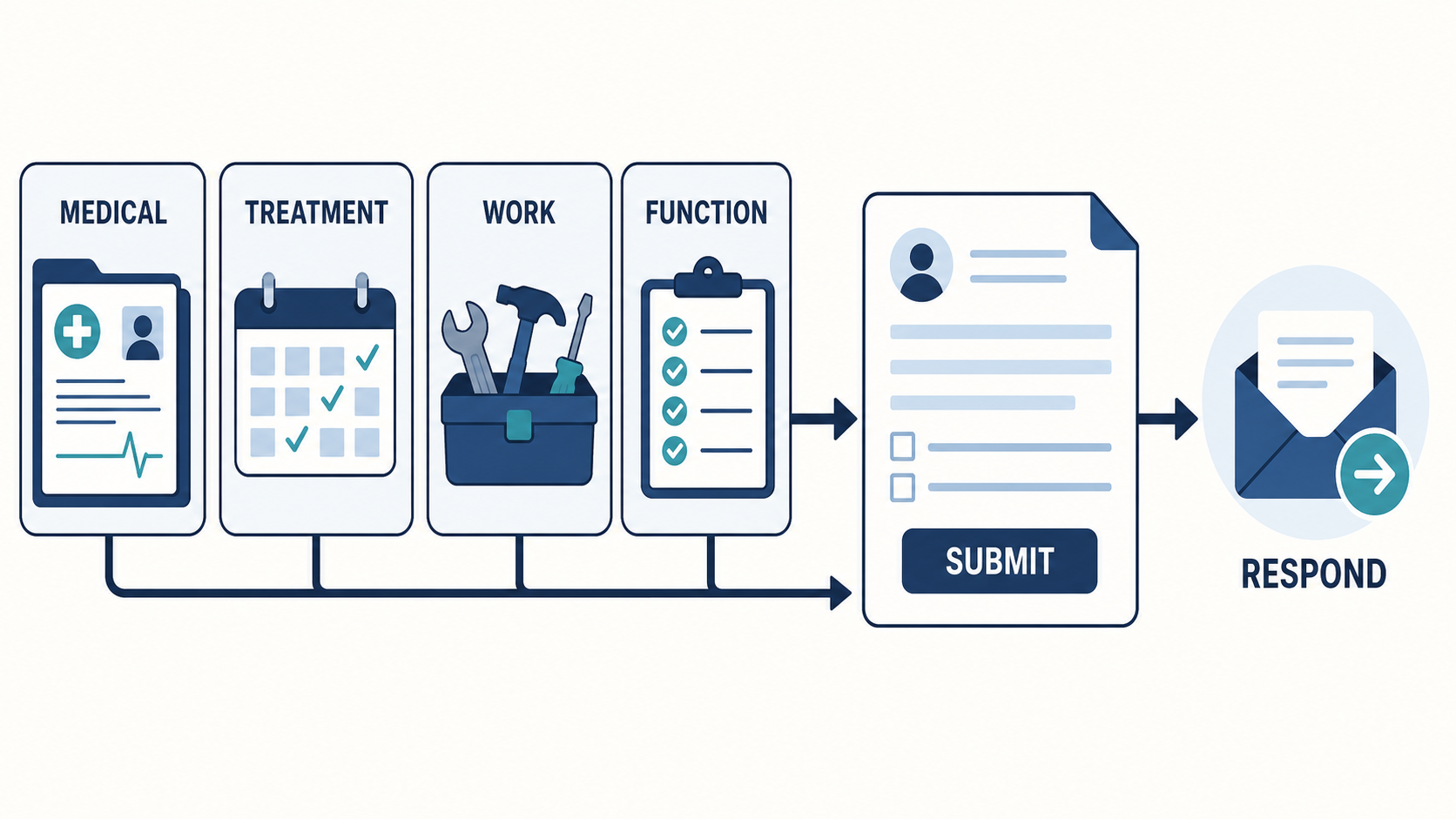
Complete provider details are often more useful than a large unsorted file. Prepare this information for every physical and mental condition that affects work:
- condition names and when they began affecting the ability to work;
- doctors, therapists, clinics, hospitals, emergency departments, rehabilitation providers, and other sources;
- addresses, phone numbers, and approximate first and last treatment dates;
- medication names, prescribers, purposes, and side effects when asked;
- laboratory work, imaging, psychological testing, procedures, and dates/locations;
- medical records, reports, and recent test results already in your possession; and
- a contact person who knows about your conditions and can help SSA reach you.
List every relevant provider, not only the doctor you like best. DDS ordinarily requests records from the sources named in the application. A wrong address, incomplete clinic name, or missing treatment period can make evidence harder to obtain.
Medical evidence should explain more than a diagnosis. SSA evaluates how medically determinable conditions affect work-related functioning and whether the duration requirement is met. Describe facts consistently: treatment, symptoms, observed findings, and concrete limits. Do not exaggerate, minimize, or copy language that does not match your records.
Work, Education, and Daily-Function Checklist
Disability review combines medical and vocational information. Gather job titles, employer names, dates, hours, pay, tools, physical demands, decision-making, supervision, and the tasks you actually performed. Job title alone may not show whether work required lifting, standing, concentration, public interaction, or complex instructions.
Also prepare education, training, certificates, and special vocational services. SSA may ask about workers' compensation, public disability payments, military disability, or similar benefits. Keep award letters or settlement information available if they apply.
Later forms may request details about daily activities and function. Use specific, ordinary examples: how long an activity can be sustained, what help is needed, what happens afterward, and how frequently a limitation occurs. A factual answer is stronger than a slogan such as “I cannot do anything.”
Step-by-Step Online Disability Application
- Review the official criteria. Confirm that the adult online path fits and that a recent denial does not require an appeal instead.
- Download the official checklist. Use it as a private worksheet, not as a substitute application.
- Open SSA's official application. Sign in or create an account only through pages reached from SSA.gov.
- Complete the benefit application. Enter personal, family, work, and other-benefit information carefully.
- Complete the disability report. Use your provider, treatment, medicine, test, education, and job notes.
- Authorize record requests as directed. Complete the medical release inside the official process.
- Review and submit. Check names, dates, providers, jobs, and the alleged onset information for consistency, then save the confirmation privately.
- Respond after filing. Read SSA/DDS mail, attend a requested examination, return forms, and provide new evidence through the stated official channel.
If you pause, keep the re-entry number secure. SSA's saved-application page explains how to continue a disability or SSI application. Do not share the number with an unsolicited “case assistant.”
Should You Upload Medical Records Yourself?
SSA says the state DDS routinely requests records from the doctors and hospitals identified in an application. That makes an accurate provider list essential. If you already have relevant records, SSA also permits submission through instructed channels; do not delay filing merely to assemble a perfect set.
A January 13, 2026 SSA Upload Documents FAQ says each submission can contain up to 50 files and each file can be up to 25 MB. Those are dynamic technical limits. Follow the live portal's file-type and size instructions rather than relying on an old screenshot.
Upload relevant, readable material and avoid sending the same record repeatedly. Keep a private log of what you submitted and when. Never upload medical evidence to this site or email it to an address that was not provided through an official SSA/DDS notice.
What Happens After Submission?
An SSA field office generally reviews the nonmedical requirements and sends the medical portion to the state Disability Determination Services agency. DDS develops and reviews medical and vocational evidence under SSA rules. It may contact providers, send additional forms, ask for clarification, or schedule a consultative examination when the existing evidence is insufficient.
A consultative examination is evidence development, not a signal that the claim will be approved or denied. Attend as instructed or promptly explain a serious scheduling problem through the contact on the notice.
Decision time varies by state, evidence availability, requested examinations, quality review, and claim complexity. Use SSA's current estimator and your official account rather than a third party's promised date. The article What Does Social Security Disability Pending Mean? explains field-office and DDS stages, while Check Your Social Security, SSI or SSDI Application Status shows safe status-check routes.
Mistakes to Avoid
- Using an unofficial application site. Begin at SSA.gov and do not pay merely to file.
- Leaving out a condition or provider. DDS needs a complete source map, including mental and physical treatment.
- Giving only job titles. Explain actual duties and demands so reviewers can evaluate past work.
- Using inconsistent dates. Review treatment, work-stop, and condition dates before submitting.
- Waiting for every record. SSA says not to delay solely because documents are missing.
- Ignoring correspondence. A follow-up form, exam, or evidence request may have a deadline.
- Starting over after a denial. Review appeal rights first; a recent medical denial usually calls for the appeal route.
A treating professional can provide valuable observations and records, but a statement that a person is “disabled” does not bind SSA. Evidence about diagnosis, treatment, clinical findings, prognosis, and specific work-related limits is more informative than a conclusion alone.
Frequently Asked Questions
Can I apply before I have all my medical records?
Yes. SSA says not to delay an application simply because all records are unavailable. Provide complete provider details, submit relevant records you already have through official channels, and respond to later requests.
Is Form SSA-827 the disability application?
No. SSA-827 is a medical release authorization. The disability application also includes benefit-claim information and a detailed disability report.
Can I apply for SSI disability entirely online?
Some adults can start SSI through the online disability process. SSI has additional financial and living-arrangement questions, and SSA may require follow-up. Let the current official selector determine the available route.
What if I cannot use the online application?
Contact SSA through its official phone or appointment channels. The guide to the Social Security phone number and hours can help you prepare without sharing private data here. SSA also provides free interpreter service on request.
Does submitting medical records guarantee approval?
No. SSA evaluates the complete record under its medical and vocational rules. Records must show relevant findings and functional effects; the decision also depends on nonmedical program requirements.
Can I check the result immediately after submission?
The confirmation shows that SSA received the application, not that a decision has been made. Status information updates as the claim moves through review. Check through your official account and read all notices.
Official Sources
- SSA: Apply Online for Disability Benefits
- SSA Disability Starter Kits
- SSA Checklist for Online Adult Disability Application
- SSA: Uploading Medical Records Electronically
- SSA: SSI Application Process
Bottom line: prepare a complete list of conditions, providers, treatment, work, and functional limits; apply only through SSA.gov; and respond promptly to SSA or DDS. A clear application helps the reviewer find the evidence, but only SSA can decide eligibility.
Loading comments...