
Updated August 12, 2026. An SSI back pay calculator can help you organize the months and amounts that may be due after approval, but it cannot reproduce Social Security Administration records. The result is a planning estimate—not an award, payment trace, legal opinion, or promise that money will arrive on a particular date.
What an SSI back pay calculator can and cannot estimate
A useful estimate answers a narrow question: based on the dates and monthly SSI rates you enter, what is the rough total for potentially payable months before documented deductions or offsets? It should show the math so you can compare it with an SSA notice. It should never ask for your Social Security number, claim number, bank details, Direct Express PIN, or SSA sign-in credentials.
The basic idea looks simple—eligible months multiplied by a monthly amount—but SSI is calculated month by month. Your rate may change because of countable earned or unearned income, a change in living arrangements, an eligible spouse, a state supplement, or an annual cost-of-living adjustment. SSA may also apply interim-assistance reimbursement, representative fees, an earlier overpayment, or a concurrent Social Security benefit calculation before releasing the net past-due amount.
For SSI, do not automatically start counting from the date a medical condition began. SSA explains that the earliest payment is generally for the month after the application filing date, or the month after all eligibility requirements are first met, whichever is later. That is a major difference from some SSDI retroactive-benefit discussions found online.
Practical rule: treat your SSA award notice as the official calculation. Use this worksheet to spot which dates, rates, income entries, or deductions you may need SSA to explain.
If you are still waiting for a decision rather than calculating an approved period, use the site’s guide to checking an SSI or SSDI application status. A status screen can describe the stage of a claim, but it still may not show a final back-pay calculation.
Use this SSI back pay estimate formula
Build the estimate one calendar month at a time:
Estimated past-due SSI = sum of each potentially payable month’s SSI amount − known deductions and offsets.
Step 1: identify the potentially payable months
- Write down the SSI application filing date shown in your SSA records.
- Write down the date SSA says you first met every eligibility requirement.
- Begin with the month after the later of those two points, subject to the details in your notice.
- Stop at the month before regular current payments begin, or at the last month SSA says you were eligible.
Partial-month multiplication is usually the wrong shortcut. SSI eligibility and payment calculations follow monthly rules, so list actual calendar months rather than dividing a monthly rate into daily amounts.
Step 2: enter the rate for every month
The 2026 federal maximum is $994 for an eligible individual and $1,491 for an eligible couple. Those figures are ceilings before relevant reductions, not automatic awards. A person’s amount can be lower, and a federally administered state supplement may make the combined payment different.
| Month | Federal/state rate before reductions | Income or living-arrangement reduction | Estimated amount due |
|---|---|---|---|
| Month 1 | Enter applicable rate | Enter documented reduction | Rate minus reduction |
| Month 2 | Enter applicable rate | Enter documented reduction | Rate minus reduction |
| Continue for each month | Update when the rate changes | Do not guess | Add monthly results |
Use the 2026 SSI and Social Security benefit amounts chart to confirm the annual federal figures, then use your SSA records for the amount that applied to you. If the period crosses January, do not apply the newest annual rate backward to earlier months.
Worked examples: estimate the amount without pretending it is final
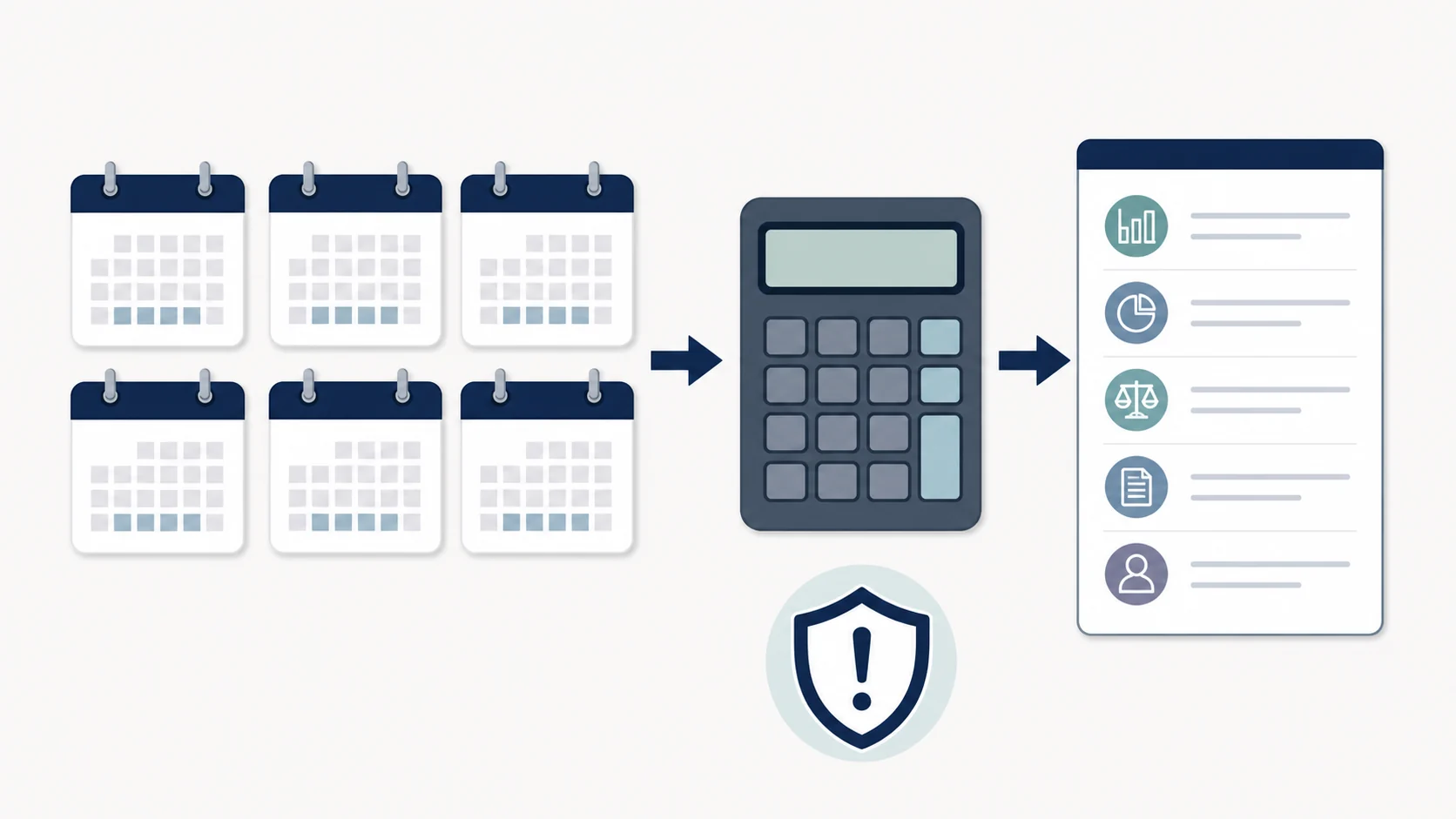
Example A: the same estimated amount for six months
Assume an adult’s notice ultimately identifies six potentially payable months in 2026. For this illustration only, suppose the estimated SSI amount is $800 in every month after countable-income and living-arrangement rules. The preliminary arithmetic is:
6 months × $800 = $4,800 estimated gross past-due SSI.
That $4,800 is not necessarily the deposit. SSA could calculate different monthly amounts or subtract items that the worksheet does not yet include. The net amount could also be subject to the large-payment installment rules discussed in a separate guide.
Example B: the monthly amount changes
Now assume eight potentially payable months. For four months, the estimated amount is $700. For the next four, a verified change in income or household circumstances raises the estimated amount to $850:
- Four months at $700 = $2,800.
- Four months at $850 = $3,400.
- Preliminary total = $6,200.
This is why “number of months × today’s maximum SSI rate” often fails. It ignores changes that SSA evaluates for specific months. The worksheet should preserve the reason for each rate—such as wages, other benefits, help with shelter, or a state supplement—so you can ask a precise question if SSA’s number differs.
These examples also assume that every listed month remains eligible. They do not decide disability onset, citizenship or qualifying noncitizen status, residence, resources, income deeming, or whether a couple rate applies. Only SSA can make those findings.
Why your SSA award may be lower—or simply different
Monthly income and living-arrangement adjustments
SSI is not a fixed insurance benefit. SSA considers countable earned income, unearned income such as another benefit, and certain income attributed from a spouse or parent. Living arrangements can also matter. If someone else provides shelter or you do not pay your share of household costs, SSA may calculate a lower amount under the rules that applied during that month.
Do not convert every dollar received into a dollar-for-dollar reduction yourself. SSI has exclusions and special treatments. Instead, record the gross income, source, date, and the monthly SSI amount shown by SSA. If your wages changed during the past-due period, keep pay stubs and note which pay dates fall in each month.
Offsets and amounts paid before you receive the balance
A gross estimate can also differ from the net amount released because SSA may account for:
- Interim assistance reimbursement: in participating arrangements, a state may be reimbursed for qualifying assistance paid while SSI was pending.
- Representative fees: an authorized fee may be paid from past-due benefits when the applicable requirements are met.
- Prior overpayments: SSA may recover an established debt according to applicable notice and recovery rules.
- Windfall offset: when SSI and Social Security benefits are retroactively payable for overlapping months, SSA can adjust the totals to avoid paying more than would have been due if Social Security had been paid on time.
- State supplementation: a federally administered supplement can affect both monthly past-due benefits and the installment calculation.
Create a reconciliation line for each item shown in the award notice: gross past-due SSI, each stated withholding or offset, and the net payable balance. If an item is unfamiliar, ask SSA what period and rule it reflects. Do not send financial records or identifiers to this website; use official SSA channels.
Compare the estimate with your SSA award notice
When SSA issues the formal payment explanation, compare it in this order:
- Program: confirm the notice is calculating SSI, SSDI, or both. The programs use different back-pay rules.
- Eligibility period: compare the first and last months with your worksheet.
- Monthly amounts: identify any month where SSA used a different rate.
- Adjustments: match stated income, living-arrangement, spouse/parent deeming, or state-supplement decisions.
- Deductions and offsets: reconcile any interim assistance, representative fee, overpayment, or concurrent-benefit adjustment.
- Release method: determine whether the notice describes one payment or installments.
A calculated award and a bank deposit are not the same event. SSA may finish the amount determination before a payment is released, and a financial institution controls when an incoming federal deposit posts. If the notice describes installments, the estimate of total entitlement should not be mistaken for the first deposit amount.
For an account-specific update, sign in only through SSA.gov, review notices, or contact SSA. The online application-status service may show the claim stage, but a generic status message is not a final payment accounting. If a released payment is missing, start with the site’s missing payment checklist, including checking the official scheduled date and financial institution.
SSA has limited expedited-payment provisions for some people facing a qualifying financial emergency, but those rules are fact-specific. Financial hardship does not make every pending back-pay estimate immediately payable. Explain the emergency and essential need directly to SSA and ask which official provision, if any, applies.
SSI back pay calculator questions
How many months of SSI back pay can I estimate?
Count only the months SSA could recognize under SSI rules, beginning no earlier than the month after the filing date or the month after all eligibility requirements are met, whichever is later. There is no responsible one-number answer without the filing date and SSA’s eligibility findings. Do not borrow SSDI’s pre-application retroactive-benefit rules.
Should I use $994 for every month in 2026?
No. $994 is the 2026 federal maximum for an eligible individual, not everyone’s payment. Use the actual rate for each month after countable income and other applicable rules. An eligible couple has a different maximum, and state supplementation can also change the amount.
Will SSA pay the whole estimate at once?
Not always. Federal rules generally require installments when the net past-due amount reaches the applicable large-payment threshold, unless an exception applies. The first deposit can therefore be much smaller than the total shown by a gross worksheet. Review the latest SSA notice and use the site’s official-status channel guide for account-specific follow-up.
Does SSI back pay immediately make me ineligible because of the resource limit?
SSA rules provide a time-limited exclusion for certain retroactive SSI and Social Security benefits when resources are counted. The details matter: keep the award notice and deposit records, avoid mixing the payment with unclear funds when recordkeeping would become difficult, and ask SSA how the exclusion applies to your review period. This article does not provide individualized benefits or financial advice.
What if my calculation is higher than SSA’s?
First compare months, monthly rates, income, living arrangement, offsets, fees, and overpayment recovery. Ask SSA for an explanation of any unmatched line. If you disagree with a formal determination, follow the appeal rights and deadline in the notice; a third-party worksheet does not extend that deadline.
Can this page check my SSI back pay status?
No. It has no access to SSA or Treasury systems. Use your official notice, a secure my Social Security account reached through SSA.gov, or SSA contact channels. Never give a third-party calculator an SSN, bank account number, card PIN, or account password.
Official sources and final reminder
- SSA: How much you could get from SSI
- SSA: Documents and earliest-payment rule
- 20 CFR 416.545: installment payments
- SSA POMS: large past-due SSI payments
Independent-site disclaimer: SocialSecurityPayment.net is not affiliated with or endorsed by the Social Security Administration. This guide explains public rules for general education. It cannot determine eligibility, calculate an official award, access a claim, or replace SSA instructions or qualified legal advice.
Loading comments...