
Updated August 12, 2026. SSI back pay does not follow one universal “paid within X days after approval” rule. Two different clocks may be involved: the time SSA needs to finish the nonmedical and payment calculations, and—if the net past-due amount is large enough—the federal installment schedule that spaces payments about six months apart.
SSI back pay processing time is not the same as the installment schedule
Approval can mean that SSA has decided the medical issue, but it does not always mean every payment calculation is finished. For SSI, SSA may still need to verify income, resources, living arrangements, marital or household facts, and other eligibility details for the relevant months. A favorable appeal decision can also require the local office or another SSA component to complete effectuation steps.
Once SSA calculates net past-due SSI, the amount helps determine whether it can be released as one payment or must generally be divided. Official SSA guidance says large remaining past-due benefits are paid in no more than three installments at six-month intervals. That six-month rule describes spacing after the installment process starts; it is not a promise that the first installment will arrive six months after approval.
No public article can see whether a specific case is waiting for financial development, representative-fee action, an interim-assistance reimbursement calculation, an overpayment offset, a concurrent SSDI calculation, or payment authorization. Treat any website claiming that every claimant is paid in 30, 60, or 90 days as a general anecdote, not an SSA deadline.
Bottom line: use the award notice for the amount and release explanation. Use official SSA channels for the current case status. Use the installment rules below to understand why later payments may be intentionally spaced.
When SSI back pay is one payment or installments
Federal regulation generally requires installments when the remaining past-due SSI amount reaches the statutory threshold. In simplified terms, the comparison uses three times the applicable maximum monthly federal benefit rate, plus any federally administered state supplementation. SSA operational instructions apply the test after certain amounts—such as qualifying interim-assistance reimbursement and directly paid representative fees—have been handled.
This creates three important cautions:
- The rule is not simply “more than three months of your personal SSI check.” Your own reduced monthly rate is not necessarily the threshold base.
- The gross amount first calculated for all months may not be the net amount used for installment testing.
- An eligible individual, eligible couple, and person receiving a federally administered state supplement may not have identical comparisons.
Why a smaller balance may arrive in one release
If the net past-due amount does not meet the installment threshold, the large-payment rule does not require it to be divided under that provision. Other processing issues can still affect when a release happens. “Lump sum” describes the payment form, not a guarantee of same-day payment after the decision.
Why the estimate and deposit may not match
A worksheet may estimate gross entitlement by adding monthly SSI amounts. SSA’s release may reflect adjustments for countable income, living arrangements, state interim assistance, representative fees, overpayments, or overlapping Social Security benefits. Use the current SSI federal amount reference only as a starting point; the award notice remains the controlling explanation for the individual case.
How the three-payment SSI back pay schedule works
First installment
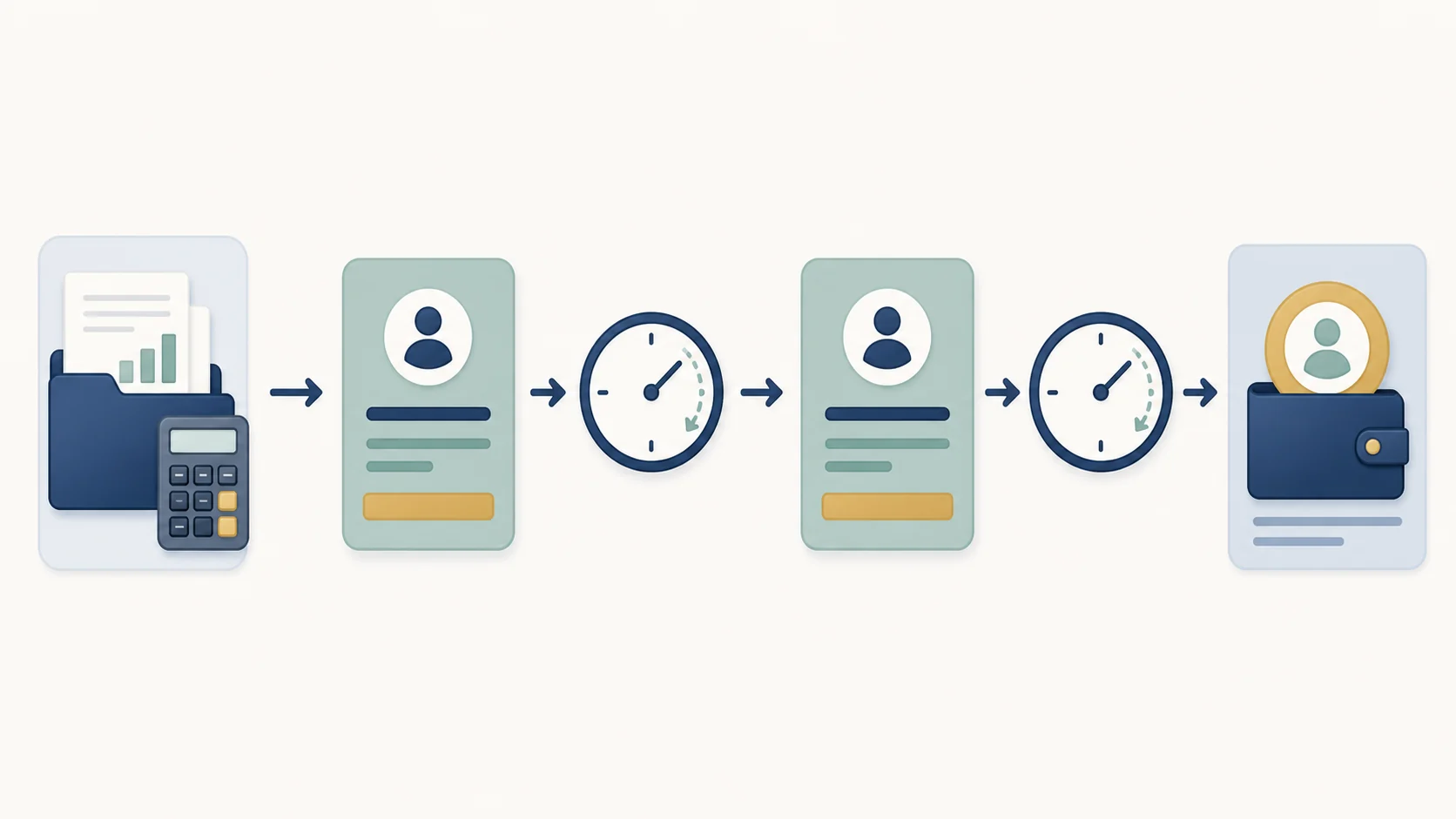
After SSA finishes the relevant calculation and authorization, the first installment is generally limited by a formula tied to three times the applicable maximum monthly benefit rate and any federally administered state supplement. The exact released amount can be affected by case facts and permitted increases. It may arrive separately from the first regular monthly SSI payment.
Second installment
The second installment is generally scheduled six months after the first and is subject to a similar cap. The interval is not a new eligibility waiting period, and it does not mean SSA is awarding additional months. It is a staged release of a past-due balance already determined, subject to later corrections or eligibility changes.
Third and final installment
The third installment, generally another six months later, pays the remaining balance. Because it is the balance rather than another identically capped slice, it may differ substantially from the first two. A new underpayment that arises while installments are underway can also require case-specific handling under SSA instructions.
| Stage | General rule | What to verify |
|---|---|---|
| First release | After calculation; capped unless an increase/exception applies | Notice amount, deductions, release date |
| Second release | Generally six months after first; capped | Whether facts or eligibility changed |
| Final release | Generally six months after second; remaining balance | Final accounting and any correction |
“Six months” should be anchored to SSA’s prior installment release, not guessed from the hearing date, favorable-decision date, or first regular monthly deposit. Keep each notice and bank record so you can identify the actual anchor date.
Exceptions and special SSI back pay cases
Increased early installments for qualifying needs
Federal rules allow an installment to be increased in certain circumstances involving debts or current expenses for food, clothing, shelter, or medically necessary services, supplies, equipment, or medicine. This is not an automatic hardship bonus. SSA can require evidence of the qualifying debt or expense and determines how the rule applies.
If you need to ask, prepare a short factual list: the provider or creditor, the essential item or service, amount due, deadline, and documents such as a bill, lease notice, prescription-related invoice, or treatment estimate. Contact SSA through an official channel and ask whether an increased installment is available under the large past-due SSI rules. Do not send those records to an unaffiliated website.
Release of the remaining balance in limited cases
SSA instructions describe circumstances in which remaining installments can be released, including when a person becomes ineligible and is likely to remain ineligible for at least 12 months, or when a medical condition is expected to result in death within 12 months and the applicable request and finding are made. These are specific exceptions, not a general way to opt out of installments.
Past-due SSI for a child
When a recipient under age 18 has a representative payee and the past-due amount meets the applicable large-payment formula, special dedicated-account rules may apply. The payee generally must keep those funds separate and use them only for permitted disability-related expenses, subject to SSA reporting and recordkeeping requirements. That structure is different from an adult’s ordinary checking account and from the standard installment discussion alone.
Parents and payees should follow the dedicated-account notice precisely and ask SSA before moving or spending funds if the permitted use is unclear. This article does not replace fiduciary instructions given to a representative payee.
Why SSI back pay can take time after approval
A delay does not identify one cause. Before releasing past-due SSI, SSA may need to complete or reconcile several parts of the record:
- Nonmedical eligibility review: income, resources, residence, household support, marital facts, and living arrangements may need to be verified for multiple past months.
- Post-entitlement or pre-effectuation interview: SSA may request updated evidence before finalizing the payable rate.
- Month-by-month computation: wages, other benefits, a state supplement, or household changes can produce different rates across the period.
- Concurrent SSI and SSDI action: overlapping retroactive benefits can require a windfall-offset calculation.
- Interim assistance: SSA may need to determine a participating state’s reimbursement before calculating the residual amount.
- Representative fee: an authorized fee action may affect the amount released directly.
- Overpayment or prior debt: a valid recovery action may alter the net balance.
- Payment information or authorization: direct-deposit details, representative-payee development, or additional review may still be pending.
These are possibilities, not a diagnosis of your case. A call-center representative or online status page may see only part of the workflow. Ask a focused question: “Has my SSI payment computation been completed, and is anything needed from me?” If SSA requests documents, record the notice date, what was requested, how you submitted it, and any receipt or confirmation.
Do not assume that receiving the first regular monthly SSI payment means the back-pay calculation has been lost. Current monthly benefits and past-due benefits can be processed or released separately. Likewise, an award letter may arrive before or after a deposit, depending on the individual sequence.
How to check SSI back pay status
- Read the latest notice completely. Identify the program, approved period, gross and net amount, installment language, and any request for evidence.
- Check only through SSA.gov. A personal my Social Security account can provide official application or appeal information. Do not follow login links from unsolicited texts or emails.
- Confirm whether the calculation is complete. If the status only says the claim was approved, ask whether nonmedical SSI development and payment computation are finished.
- Ask whether action is required from you. Missing wage records, resource statements, household information, payee information, or direct-deposit verification can prevent completion.
- For a scheduled installment, identify the anchor. Ask for the date SSA released the prior installment; count the general six-month interval from that actual event, not the decision date.
- For a released but missing electronic payment, contact the bank or card provider. Ask whether a federal deposit is pending, rejected, or returned before treating it as an unreleased SSA payment.
If you cannot check online, SSA’s official application-status FAQ lists 1-800-772-1213 (TTY 1-800-325-0778), Monday through Friday, 8:00 a.m. to 7:00 p.m., or the local Social Security office. Contact information can change, so confirm it on SSA.gov. The site also has a guide to Social Security phone numbers, hours, and status help.
Keep a simple contact log: date and time, channel, representative name or reference if provided, the exact question, the response, documents requested, and promised follow-up. Do not record your full SSN in a document that others can easily access.
If a deposit SSA says it released is still absent, use the missing payment checklist. That path is different from asking when an uncalculated back-pay award will be authorized.
SSI back pay schedule FAQs
Is SSI back pay always paid six months apart?
No. The six-month interval generally applies when the net past-due amount meets the large-payment installment rule. A smaller net amount may be released as one payment, and federal rules allow particular increases or exceptions. Your notice should explain the method used.
Are the first two installments always identical?
Not necessarily. Both are generally subject to formula-based caps, but case changes, an approved increase for qualifying needs, newly discovered underpayments, deductions, or the remaining balance can affect releases. The third payment is generally the balance, so it commonly differs.
Can SSA release back pay early because I have an emergency?
There are limited rules for increasing an installment for qualifying essential debts or expenses, and SSA has separate expedited-payment provisions in defined situations. Neither creates an automatic right to all back pay immediately. Contact SSA with documentation and ask which provision may apply.
Does the payment center have a public number?
Do not rely on unofficial numbers claiming direct access to an internal payment center. Use SSA’s national number, your local office, your official account, and contact information printed on SSA notices. A representative can determine the appropriate internal inquiry.
What should I do with a large deposit?
Keep the notice and deposit record, understand any dedicated-account instructions, and learn how the time-limited exclusion for retroactive benefits applies to SSI resources. Report required changes and seek qualified benefits, legal, tax, or financial advice for personal decisions. This site cannot advise how you should spend or hold an award.
Official sources
- SSA SSI general information
- 20 CFR 416.545 installment rules
- SSA POMS large past-due SSI instructions
- SSA dedicated accounts for children
Independent-site disclaimer: SocialSecurityPayment.net is not SSA and cannot access, accelerate, calculate, or trace an individual payment. This article summarizes public rules for general education and does not replace an SSA notice or individualized legal, financial, or benefits advice.
Loading comments...