
Updated August 12, 2026. The 2026 SSI income limit is not one number for everyone. SSA's federal screening figures are less than $2,073 a month for an individual with only wages and less than $1,014 with only unearned income. For an eligible couple, the comparable figures are less than $3,067 with only wages and less than $1,511 with only unearned income. Mixed income, state supplements, family deeming, and work incentives can produce a different result.
The maximum 2026 federal SSI payment is $994 for one eligible person and $1,491 for an eligible couple. Income normally lowers those amounts after exclusions; our 2026 COLA and benefit amounts chart puts those federal rates in context. This independent guide demonstrates public formulas; it cannot calculate an official payment or access an SSA record. Report all income and use the SSA notice as the final account-specific answer.
2026 SSI income limits at a glance
| 2026 federal screening scenario | Individual | Eligible couple |
|---|---|---|
| Only wages or self-employment income | Less than $2,073/month | Less than $3,067/month |
| Only pensions, Social Security, gifts, or other unearned income | Less than $1,014/month | Less than $1,511/month |
| Maximum federal SSI payment before reductions | $994/month | $1,491/month |
These numbers describe simple federal scenarios. They work because earned income receives larger exclusions than unearned income. They do not directly answer a case with both wages and SSDI, a spouse who works, free shelter, a state supplement, an eligible student exclusion, or approved work expenses.
“Less than” also matters. The amounts are break-even points: at or above the applicable point, countable income can equal the federal benefit rate, leaving no federal SSI cash payment in that basic scenario. A small state supplement or another exclusion may change the result, and working recipients may retain Medicaid under separate section 1619(b) rules after the cash payment reaches zero.
Do not substitute the 2026 retirement earnings-test limit of $24,480 per year or the non-blind SGA amount of $1,690 per month. Those figures answer different Social Security questions. SSI payment calculations use countable income month by month.
What SSI counts as earned, unearned, in-kind, and deemed income
Earned income comes from work. It includes wages, net earnings from self-employment, certain royalties or honoraria, and sheltered-workshop payments. SSA uses gross wages before payroll deductions, while self-employment generally starts with net earnings under program rules. Pay dates and special wage payments can affect the month of counting.
Unearned income is not payment for current work. Common examples are Social Security retirement or SSDI, pensions, unemployment compensation, workers' compensation, some veterans benefits, interest, dividends, rent, annuities, and cash gifts. A payment can be taxable yet excluded from SSI, or nontaxable yet count for SSI; federal income-tax treatment does not decide the SSI category.
In-kind support and maintenance is shelter another person provides free or for less than fair value. Since September 30, 2024, SSA no longer includes food in the ISM calculation. That does not mean every food-related transfer disappears: cash or a gift card someone gives you may still be unearned income because it can be used for food or shelter. Living-arrangement facts matter.
Deemed income is income SSA treats as available from another person under specific relationships. It may include part of an ineligible spouse's income when spouses live together, part of a parent's income for a child under 18 living at home, or sponsor income for some noncitizens. SSA applies allocations and exclusions; it does not necessarily count the other person's entire gross income.
Income is not the same as a resource. A wage or gift may be income when received and money retained into the next month may become a resource. This article focuses on income; cash, accounts, and property also must fit SSI's separate resource rules.
How earned income reduces SSI: a 2026 example
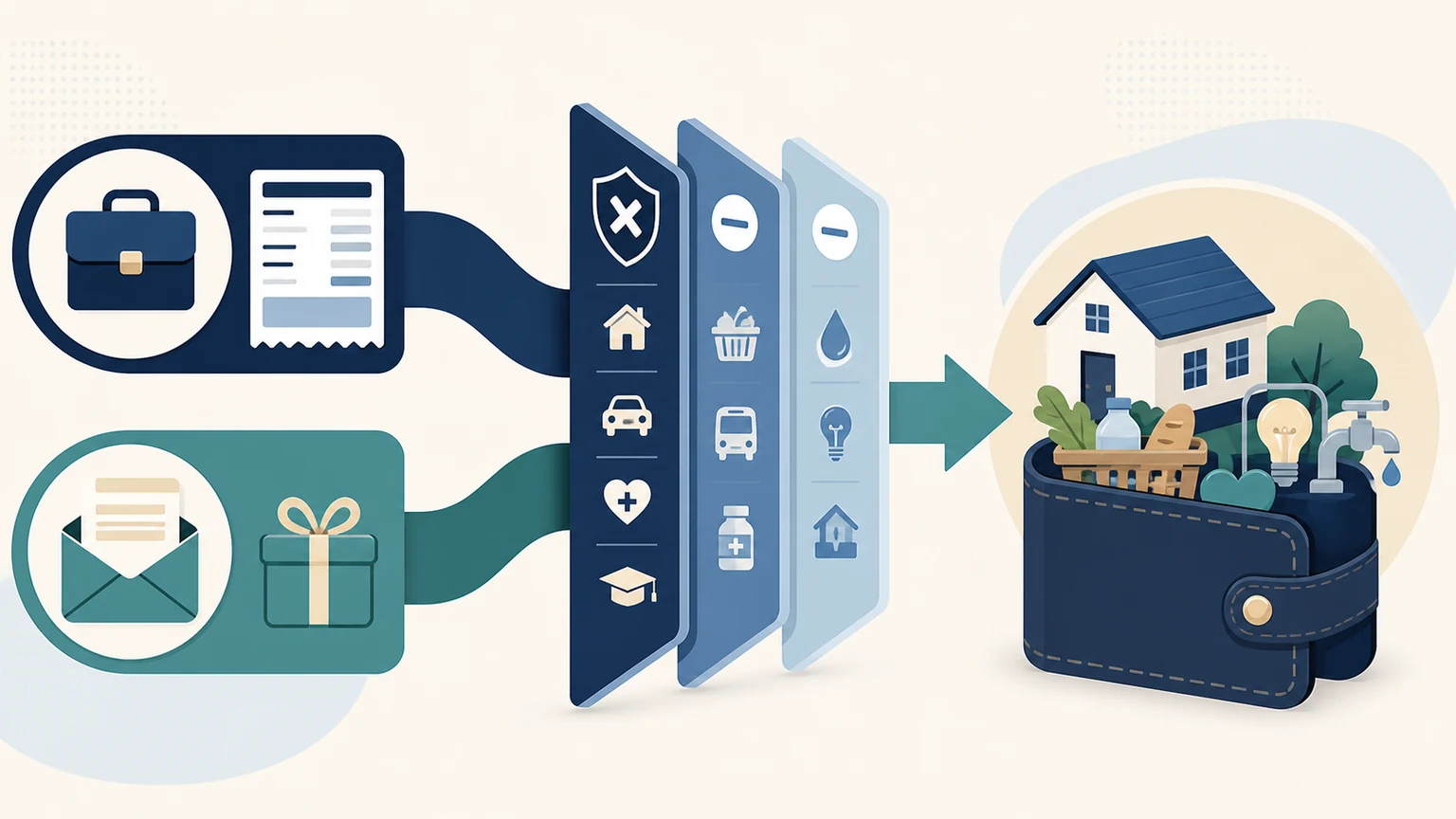
Assume one person has $1,000 in gross monthly wages, no unearned income, no spouse deeming, no state supplement, and no special work exclusion. The simplified 2026 federal calculation is:
- $1,000 gross wages minus the unused $20 general income exclusion equals $980.
- $980 minus the $65 earned income exclusion equals $915.
- Half of $915 is excluded, leaving $457.50 countable earned income.
- $994 federal benefit rate minus $457.50 produces an illustrative $536.50 federal SSI payment.
This example shows why the payment generally falls by about $1 for every $2 of wages after the initial exclusions. It also explains the $2,073 earned-only break-even: when the same formula reaches $994 of countable income, the federal cash payment reaches zero.
Real cases can differ. A qualifying student under age 22 may use the student earned income exclusion before the regular earned-income exclusion. In 2026, SEIE can exclude as much as $2,410 in a month, up to $9,730 for the calendar year. An adult with a disability may have reasonable, unreimbursed impairment-related work expenses; a blind recipient has separate blind work expense rules. SSA must approve and apply those exclusions.
For self-employment, do not plug gross business receipts into this wage example. SSA determines net earnings and may allocate them under self-employment rules. Keep records of receipts, ordinary business expenses, work hours, and any disability-related costs, and report the activity even when the business has not yet produced a profit.
Unearned and mixed income use a different calculation
Unearned income usually reduces SSI dollar for dollar after applicable exclusions. If one person receives $600 in a pension and has no other income, the basic calculation would exclude $20, count $580, and subtract that from the $994 federal rate. The illustrative result would be $414 before living-arrangement, state, or other adjustments.
When both kinds of income exist, SSA generally uses the $20 general exclusion against unearned income first. Consider one person with $400 in SSDI and $600 in gross wages:
- $400 SSDI minus the $20 general exclusion leaves $380 countable unearned income.
- The general exclusion has been used, so $600 wages minus the $65 earned exclusion leaves $535.
- Half of $535 is excluded, leaving $267.50 countable earned income.
- $380 plus $267.50 equals $647.50 total countable income.
- $994 minus $647.50 produces an illustrative federal SSI payment of $346.50.
The published $1,014 unearned-only limit and $2,073 earned-only limit cannot be combined into a larger cap. The mixed-income formula integrates both streams. Social Security benefits also may create concurrent SSI/SSDI back-pay offset issues not shown in a one-month example.
Not all receipts count. Examples that may be excluded include SNAP, certain housing assistance, income-tax refunds, qualifying needs-based state/local assistance, certain education grants used for approved expenses, valid loans that must be repaid, and money another person pays for a non-food, non-shelter expense such as a medical bill. Every exclusion has definitions and documentation rules, so report the receipt rather than omitting it based on a list.
Spouse deeming and free shelter can change the income result
An applicant who lives with a spouse cannot always test eligibility using only the applicant's own income. If the spouse is not eligible for SSI, SSA may deem part of that spouse's income to the applicant. It first accounts for specified exclusions and allocations, including amounts for ineligible children in the home when applicable. The result—not the spouse's entire paycheck—is added to the applicant's other countable income. Similar but distinct rules can deem parental income to a child under 18 who lives at home, and sponsor income to certain noncitizens.
Deeming does not mean that two adults who merely share an address are treated as spouses. SSA examines the legal and household relationship. It can also stop or change when household composition changes. Because the worksheet requires details about both people, the simple individual and eligible-couple limits in the opening table cannot predict an ineligible-spouse case.
Shelter help is another separate adjustment. If someone pays your rent, mortgage, electricity, heating fuel, or other countable shelter cost, SSA may treat the help as in-kind support and maintenance. In 2026, the presumed maximum value is $351.33. When the $20 general exclusion is available, the resulting SSI reduction is generally capped at $331.33, although lower actual support can be proved. Food provided in kind no longer creates ISM after September 30, 2024; cash or gift cards can still be unearned income.
Keep leases, rent receipts, utility bills, household contribution records, and proof of any bona fide loan. Paying a fair share of shelter costs may avoid an ISM reduction, while calling a gift “rent” does not establish a payment. For the official rules and examples, see SSA's 2026 living-arrangement guide.
Work incentives can extend eligibility beyond a simple wage limit
The $1,690 non-blind SGA figure for 2026 is not a monthly SSI payment cutoff after approval. SSA considers substantial gainful activity when deciding whether an adult is disabled at application. Once a person receives SSI and starts or continues work, SSA calculates countable income and checks whether the disability and other eligibility rules still apply. Section 1619(a) can allow some recipients to keep SSI cash payments and Medicaid while working at or above SGA.
Several exclusions may lower countable earnings. Impairment-related work expenses can include reasonable, unreimbursed costs for disability-related items or services needed for work. Blind work expenses use a broader but differently ordered deduction. A Plan to Achieve Self-Support can exclude approved income or resources set aside for a work goal, and the student exclusion can protect qualifying earnings for a student under 22. These are documentation-based rules, not automatic deductions from every paycheck.
If countable earnings reduce federal SSI cash to zero, section 1619(b) may preserve Medicaid. A worker generally must remain blind or disabled, meet SSI rules other than the earnings amount, have received an SSI cash payment for at least one month, have had Medicaid in the preceding eligibility month, need Medicaid to work, and remain below a state threshold. SSA publishes 2026 state 1619(b) thresholds; an individualized threshold may apply for high medical, attendant-care, IRWE, BWE, or PASS costs.
Therefore, “my wages exceed $2,073” does not by itself answer whether Medicaid ends or whether another work incentive applies. Ask SSA or a qualified benefits planner for a calculation before reducing hours or leaving a job. Keep pay stubs and receipts so an exclusion or individualized threshold can be supported.
Report income on time and avoid these common mistakes
Report gross wages every month by the sixth day of the following month. Depending on eligibility, SSA offers an online wage-reporting tool in a my Social Security account, a mobile wage-reporting app, or automated phone reporting. A new job, stopped job, changed hours, pay-rate change, or income that cannot be submitted through an automated channel should be reported to SSA directly. Self-employment estimates and other income changes generally must be reported promptly and no later than the tenth day of the following month.
- Do not report net take-home pay. SSI normally starts with gross wages before taxes and deductions.
- Do not wait for a tax return. Wage reporting is monthly; self-employment requires current estimates and later verification.
- Do not omit irregular money. Bonuses, tips, cash work, gifts, pensions, unemployment, and changes in support may matter even when they occur once.
- Do not claim exclusions without evidence. Save receipts for IRWE/BWE, school records for SEIE, and an approved PASS.
- Do not overlook another person's reportable income. Spouse or parental earnings can matter in a deeming case.
Save pay stubs and screenshots, confirmation numbers, upload receipts, names of representatives, and dates of calls. Compare the next SSI notice with what was reported. If SSA used the wrong wage month or missed an exclusion, contact the agency promptly and preserve the appeal deadline printed on the notice. If a claim is still pending, use our guide to checking an SSI or SSDI application status. Ignoring an apparent overpayment can increase the amount later sought.
SSA's wage-reporting page gives current channels. The broader rule is to report changes as soon as possible and no later than ten days after the end of the month in which they happened.
SSI income limit FAQs
Can I work and still receive SSI in 2026?
Yes. In a basic earned-only case, the first $85 of monthly wages is excluded when the $20 general exclusion is unused, and only half the remainder counts. Additional work incentives may apply. Eligibility still depends on disability, resources, living arrangements, and other program rules.
Does SSDI count toward the SSI income limit?
Usually, SSDI is unearned income for SSI. The first $20 of most income may be excluded, then countable SSDI generally reduces SSI dollar for dollar. A person can receive both programs when the SSDI amount is low enough and all SSI requirements are met.
Do gifts and help from family count?
Cash and many gift cards can be unearned income. Direct payment of shelter can be ISM, while food provided in kind no longer counts as ISM. A valid loan, repayment, or payment of a non-shelter item may be treated differently, so retain evidence and report the transaction.
What if my income is above the published 2026 number?
Do not assume the application or coverage is impossible. The published figures cover only simple earned-only or unearned-only federal cases. Deeming allocations, state supplements, SEIE, work expenses, PASS, 1619(b), and other exclusions can change the outcome. Apply or request an official computation if the facts are close.
What should I bring to an income review?
Bring recent pay stubs, pension or benefit letters, bank statements showing deposits, self-employment records, spouse or parent income records when relevant, and proof of claimed work expenses. Include leases and shelter-payment evidence if someone helps with housing.
Bottom line: use $2,073/$1,014 for an individual's simple 2026 screening scenarios and $3,067/$1,511 for an eligible couple's, but calculate countable income before drawing a conclusion. This article is general educational information, not legal, tax, or benefits advice. SSA determines eligibility and payment from the evidence in each record.
Loading comments...