
Updated August 12, 2026. A spouse's income and resources can reduce or stop Supplemental Security Income because SSI is a needs-based program. Marriage does not create one simple gross-income cutoff. SSA must first decide whether couple or spouse-deeming rules apply, then classify income, apply exclusions and household allocations, and compare countable resources with the correct limit.
This guide explains the 2026 numbers, what people call the SSI “marriage penalty,” and why an online spouse calculator can only screen a simple scenario. It does not determine anyone's marital status, eligibility, or payment. Use an SSA notice and an account-specific calculation for the final answer.
The 2026 SSI Couple Numbers at a Glance
The maximum federal SSI payment in 2026 is $994 per month for one eligible individual and $1,491 for an eligible couple. Two separate individual maximums would total $1,988. The eligible-couple maximum is therefore $497 lower before either person's countable income, living arrangement, or state supplement is considered.
The resource limits show a similar difference. One SSI applicant or recipient can have up to $2,000 in countable resources. A married couple living together is generally limited to $3,000 combined, while two unmarried individuals separately using the individual limit could have $4,000 in total. These comparisons are commonly called the SSI marriage penalty.
They do not prove that every marriage reduces a payment by $497 or exactly $1,000 of resource capacity. If only one spouse receives SSI, SSA may deem some income from the spouse who is not eligible. If both spouses are eligible, the couple rate and their combined countable income generally matter. State supplements and living arrangements can also change the total.
The federal maximum is a starting point, not an average or guaranteed amount. A married recipient's notice may show a lower federal payment because of countable wages, Social Security benefits, pensions, support, or other income. Conversely, the total can include a state supplement. Always compare like with like: federal rate to federal rate, and the same benefit month to the same benefit month.
Who Counts as a Spouse for SSI?
Legal marriage is the clearest case, but SSI marital status is not limited to a marriage certificate. SSA's handbook says a person can be treated as married if the couple is legally married, if one member is entitled to certain Social Security spouse benefits on the other's record, or if the two live in the same household and hold themselves out to the community as a married couple.
“Holding out” is a program term, not a rule that every roommate or unmarried couple is automatically married. SSA may consider how the people introduce one another, how household and financial documents describe the relationship, and what they say about their relationship. When information conflicts, SSA can request evidence and use a marital-relationship questionnaire.
Do not change truthful answers, titles, or documents merely to obtain a preferred benefit result. Give SSA accurate information about the legal relationship, household, finances, and how the relationship is represented. An independent calculator cannot decide whether the holding-out rule applies, and a social-media opinion is not a binding marital-status determination.
This SSI concept also should not be imported into every Social Security program. SSDI is based on an insured worker's record, while spouse, survivor, and disabled-adult-child benefits have their own marriage rules. A marriage can affect more than one benefit in different ways, so tell SSA every benefit each person receives and ask for a program-by-program explanation.
Marriage and moving in are separate events. A legally married spouse living outside the household may be treated differently for deeming than a spouse living with the recipient. Temporary absences and separation facts can require development. Report the actual dates and living arrangement instead of assuming the wedding date alone controls every payment month.
Eligible Couple Rules and Ineligible-Spouse Deeming Are Different
An eligible couple generally means both spouses meet SSI's basic eligibility conditions. SSA uses the couple federal benefit rate, combines countable income under the couple computation, and applies the couple resource limit. The payment belongs to the eligible couple framework even if SSA sends funds in a way described in the notice.
An eligible individual with an ineligible spouse is different. Only one spouse qualifies for SSI, but SSA may deem part of the other spouse's income and resources to the recipient when they live in the same household. “Ineligible” in this context does not necessarily mean the spouse applied and was denied; it can simply mean the spouse is not an SSI-eligible member of the payment unit.
Deeming is not a direct transfer of every dollar. SSA first determines the spouse's earned and unearned income, applies exclusions allowed by SSI rules, and may subtract allocations for ineligible children in the home. Depending on the remaining amount, SSA either continues to treat the recipient under an individual computation or uses a couple-based computation to determine eligibility and payment.
The distinction matters when using examples. A table showing the $1,491 eligible-couple maximum does not by itself tell a one-recipient household how much of the working spouse's wages will count. Likewise, a one-spouse deeming example cannot be used to calculate two eligible spouses' payment.
SSA's rules also prevent deeming from increasing a recipient's payment above what would be payable without deeming. The official notice should identify the income used and the payment amount. If the household includes children, mixed income, self-employment, or a state supplement, request the detailed calculation rather than relying on a one-line estimator.
How SSA Calculates Income From an Ineligible Spouse
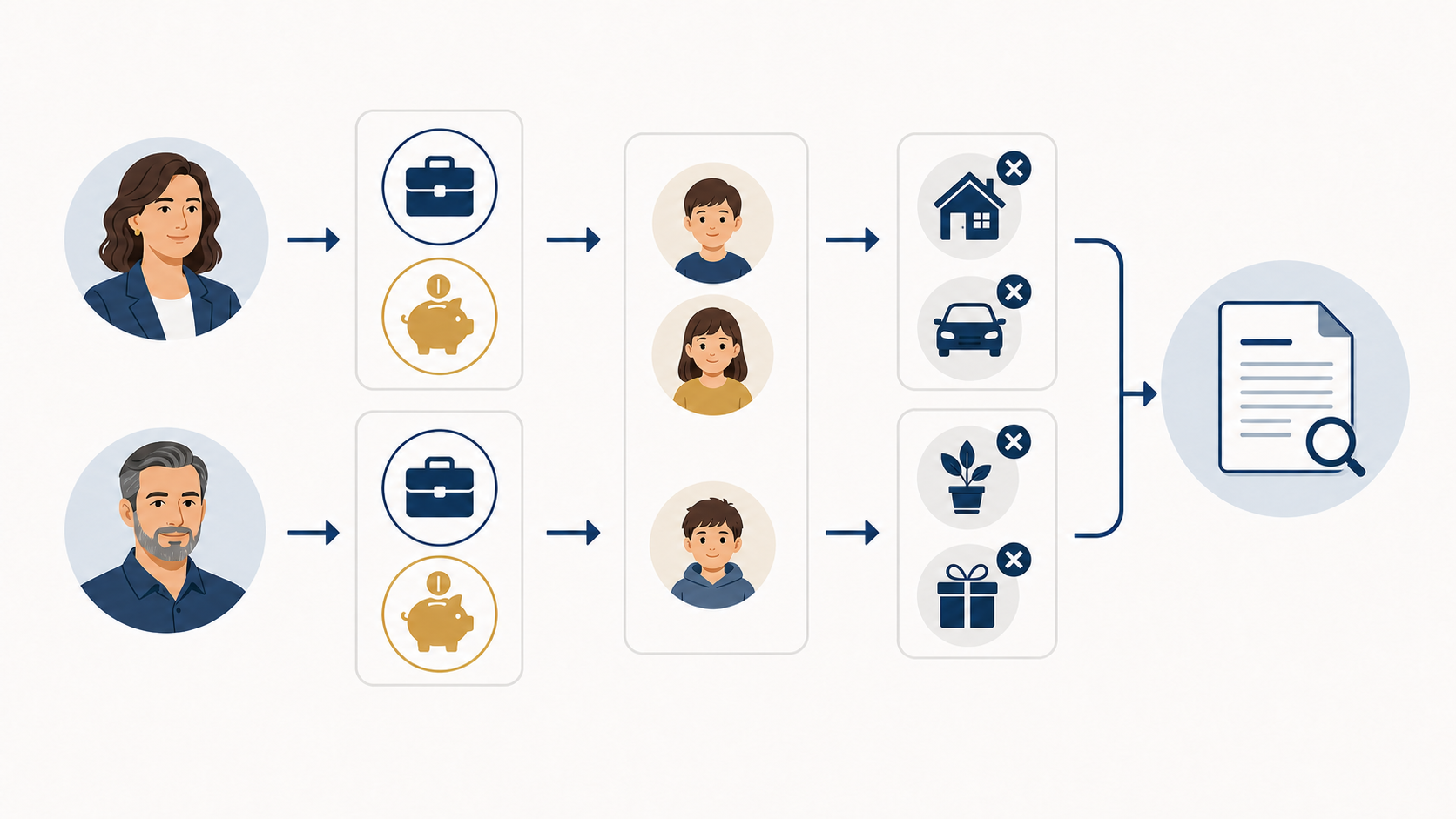
The federal regulation establishes an order, which is why subtracting a spouse's gross paycheck from $994 gives the wrong answer. A useful conceptual map is:
- Identify income. Separate the ineligible spouse's earned income—such as wages or net self-employment earnings—from unearned income such as a pension or Social Security benefit.
- Apply exclusions. Some income is excluded entirely, while earned and unearned income have different general exclusions.
- Allocate for ineligible children. SSA may subtract an allocation for qualifying children in the household, reduced by the child's own countable income.
- Test the remaining spouse income. The rules compare the remainder with the difference between the couple and individual federal benefit rates for the relevant computation.
- Combine and compute when required. SSA can combine the recipient's and spouse's income, apply the exclusions in the required order, and compare the result with the couple rate.
- Apply the payment rule. The payable amount is limited so deeming cannot produce more SSI than the recipient could receive without deeming.
In 2026, the difference between the federal couple rate ($1,491) and individual rate ($994) is $497. That number appears in parts of the deeming framework, but it is not the spouse's universal income allowance. Child allocations, the income type, the recipient's own income, and the budgeting month can all change the computation.
Self-employment requires net earnings rather than a simple gross-receipts figure. Irregular wages, bonuses, retroactive benefits, tax refunds, support payments, and needs-based assistance may have special rules. A reliable screening tool would need to ask about all of those items, not just monthly take-home pay.
When reviewing an SSA notice, compare the wages or benefits SSA used with pay stubs and award records for the same period. If a figure appears wrong, report the discrepancy through an official SSA channel and keep proof of the correction. Do not post household income documents publicly.
Why There Is No Single SSI Spouse Income Limit
A search for “SSI spouse income limit 2026” suggests there should be one gross monthly number. SSI does not work that way. The same gross income can produce different countable income depending on its source. After applicable exclusions, earned income is generally reduced differently from unearned income, so $1,000 of wages is not necessarily treated like a $1,000 pension.
Household structure changes the result too. An allocation for an ineligible child can reduce income available for deeming, but the child's own income can reduce that allocation. The SSI recipient's own wages or unearned income must then enter the computation. A state supplement may use additional categories, and help with food or shelter can affect the payment through living-arrangement rules.
A calculator can be useful only if it labels its assumptions. Before trusting an estimate, check whether it asks:
- whether one or both spouses are SSI-eligible;
- whether the spouses live together for the month at issue;
- each person's earned and unearned income separately;
- self-employment net earnings rather than gross business receipts;
- the number and income of ineligible children in the household;
- the recipient's living arrangement and state supplement;
- the correct benefit and budgeting month.
If the tool requests an SSN, bank login, SSA password, or full account number, do not use it. Those details are not needed for a public estimate. Even a carefully designed calculator cannot verify marital status, exclusions, resource ownership, or SSA's official wage records.
The safest output is a range or screening result followed by “confirm with SSA.” A result showing possible ineligibility is not a denial, and a positive estimate is not an approval. The official notice controls the payment.
How Marriage Affects the SSI Resource Limit
SSI counts resources separately from monthly income. Resources are things a person owns and can use for support, such as cash, nonexcluded bank balances, stocks, bonds, and some property. In 2026, the countable limit remains $2,000 for an individual and $3,000 for a couple.
The $3,000 figure is not a limit on everything a couple owns. SSA excludes the home the recipient lives in and the land it is on, household goods and personal effects, and one vehicle used by the recipient or a household member for transportation. Certain life insurance, burial spaces, burial funds, property needed for self-support, and other items can be excluded when their conditions are met.
For an eligible person living with an ineligible spouse, SSA can consider the spouse's resources under deeming rules. The title on an account is important evidence but may not settle whether funds are available. Joint accounts, recently added names, business accounts, trusts, retirement funds, and jointly owned property can require closer review.
Do not give away money or transfer property for less than fair value simply to get below the limit. SSA says such a transfer can cause SSI ineligibility for up to 36 months, subject to exceptions. Moving funds between accounts also does not make the underlying resource disappear.
A practical monthly review lists the balance and ownership of each account, vehicles, real property, investments, cash-value insurance, burial arrangements, and recently transferred assets. Then mark possible exclusions and bring supporting documents to SSA. This is safer than assuming every joint dollar counts or, at the opposite extreme, assuming a spouse's separately titled property can never count.
Marriage, Separation and Income Changes Must Be Reported
SSA's 2026 reporting guidance requires SSI recipients to report changes that may affect eligibility or payment. Relevant events include marriage, divorce, separation, a spouse moving into or out of the household, changes in wages or self-employment, new pensions or benefits, and changes in either spouse's resources.
Report the event promptly through an official method and retain the date, confirmation, and documents submitted. For wages, preserve pay stubs and identify the pay period and payment date. For self-employment, keep business income and expense records. For a move or separation, provide the actual date and new living arrangements rather than only a mailing-address change.
The spouse-deeming regulation generally stops deeming an ineligible spouse's income beginning with the first month after the spouses separate or divorce. That sentence is not a do-it-yourself payment date. SSA must decide whether the separation is real under program rules, determine the relevant month, and apply its budgeting rules to the payment.
A late report can lead to an overpayment if SSA continued paying an amount based on outdated facts. It can also leave a recipient underpaid if a spouse's income fell or deeming should have stopped. Read the recalculation notice and compare its household dates and income with the records submitted.
If the notice is wrong, contact SSA and follow the appeal or reconsideration instructions and deadline printed on it. For current contact channels, use the site's SSA phone and status guide. Do not send marriage certificates, tax returns, pay stubs, or bank statements to this independent site.
Before Estimating SSI as a Couple, Gather These Facts
- List every benefit. Identify SSI, SSDI, retirement, survivor, spouse, veterans, pension, and other payments for both people.
- Define the household month. Record marriage, move-in, separation, or move-out dates and temporary absences.
- Separate income types. Do not combine gross wages, net self-employment, and unearned income into one figure.
- Include the recipient's income. A spouse's wages are not the only input in a deeming computation.
- Identify children. Record ineligible children in the home and their income because allocations may apply.
- Inventory resources. List ownership, balances, exclusions, joint accounts, transfers, and property for the relevant month.
- Check the state and living arrangement. A state supplement or help with shelter may change the payment.
- Request the official calculation. Compare the SSA notice with the documents used and correct errors promptly.
The term “marriage penalty” describes a real structural difference between the SSI individual and couple rules. It does not tell a couple whether to marry or predict the exact financial effect. Marriage can affect health coverage, taxes, housing, other benefit programs, estate rights, and legal responsibilities outside SSI. Consider qualified benefits and legal counseling for those broader questions.
Payment dates do not change the deeming formula. Once eligibility and the amount are established, use the 2026 SSI payment calendar to understand first-of-month and holiday timing. An early deposit is not an extra monthly benefit.
This independent guide is not affiliated with SSA and is not individualized legal, financial, or benefits advice. It cannot determine marital status, calculate an official deemed amount, or access an SSA account. Confirm the result with SSA and the written notice.
Official sources
Loading comments...