
Updated July 26, 2026. You cannot track a Social Security or SSI payment through a public map or parcel-style live tracker. You can, however, follow an official evidence trail: confirm the scheduled date, review SSA payment information, check the receiving bank or Direct Express account, and ask SSA to investigate if the payment is still missing.
SocialSecurityPayment.net cannot see whether SSA sent your payment and cannot access Treasury, bank, credit-union or Direct Express records. You never need to enter an SSN, claim number, bank account number, card PIN or SSA login here to use the public payment calendar.
Can You Track a Social Security or SSI Payment?
SSA offers a personal service for viewing upcoming and past payment timing, and its automated phone assistance can provide payment-delivery information. These services help establish what SSA shows. They do not provide a minute-by-minute view of a deposit moving through Treasury and a bank.
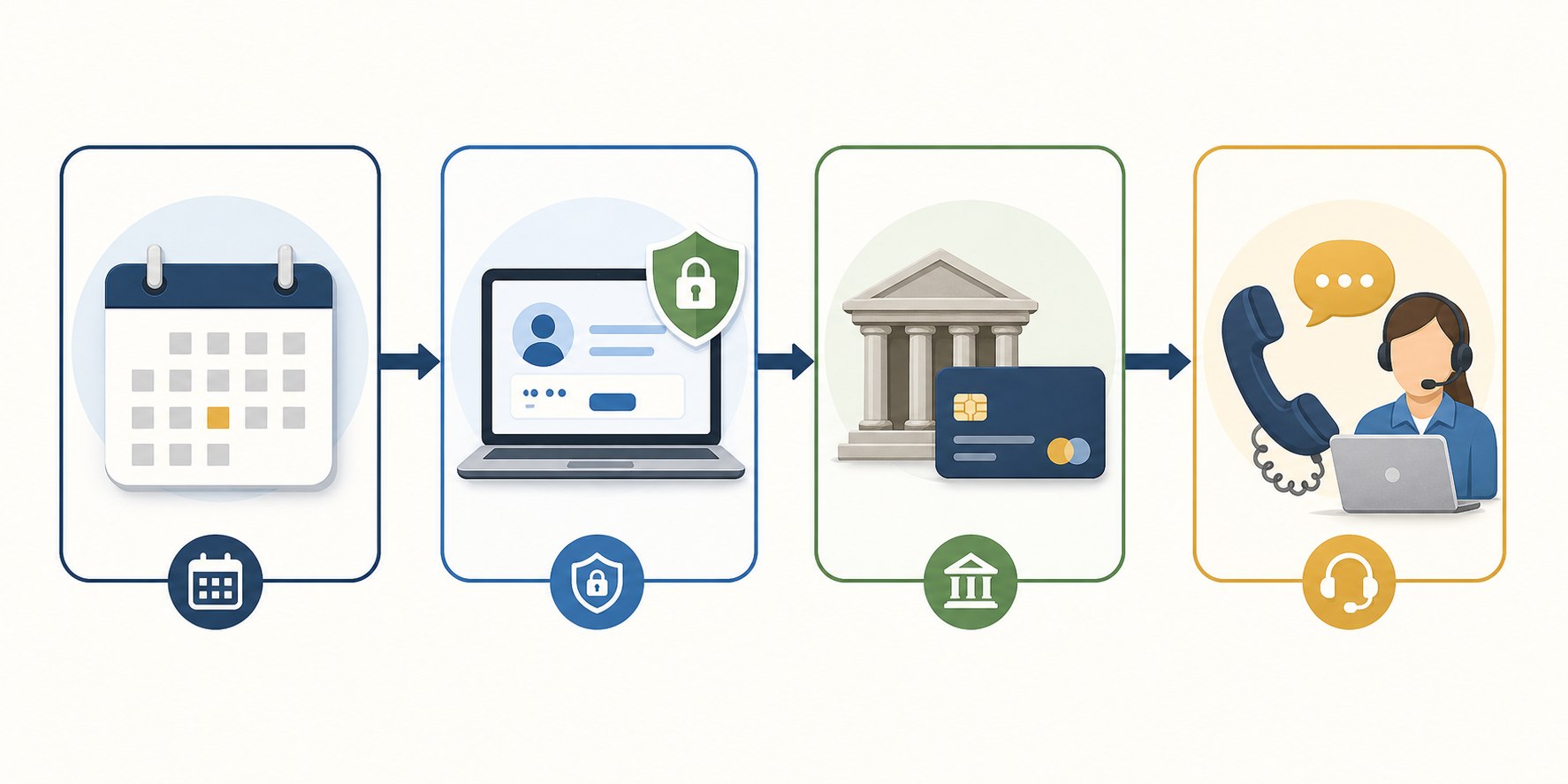
Think of ?tracking? as four separate questions:
- When was the payment scheduled? Use the correct Social Security, SSDI or SSI schedule.
- What does SSA show? Review official payment information through a personal account or SSA phone service.
- Did the receiving account post it? Check the bank, credit union or Direct Express account.
- Does SSA need to investigate? Report a payment that remains missing after the receiving institution is checked.
Step 1: Confirm the Correct Scheduled Date
A deposit is not late until the correct schedule says it is due. Social Security retirement, SSDI and survivor benefits commonly use the second, third or fourth Wednesday based on the birthday associated with the worker's record. SSI usually follows the first of the month. People who started Social Security before May 1997 and some people receiving both SSI and Social Security may follow separate first- and third-of-month rules.
Weekends and federal holidays can move a payment earlier. An SSI deposit at the end of one month may be the next month's benefit paid early, not an extra payment. That is why the benefit month matters as much as the bank-posting date.
Use the site's payment-date calculator, 2026 Social Security payment schedule or 2026 SSI payment schedule to find the public date. Then confirm any special account rule in the SSA award notice or personal account.
Step 2: Check Official SSA Payment Information
SSA's View benefit payment schedule service says a signed-in user can see upcoming and past payments. The date depends on the birthday and benefit type.
If you cannot use the online service, SSA currently offers automated phone assistance at 1-800-772-1213 around the clock in English and Spanish for the payment-schedule task. Its current instruction says to respond ?check delivery? when asked how the system can help. Menu wording can change, so follow the current official prompts.
A personal my Social Security account can also show benefit information and support direct-deposit management. It is not the same as a receiving bank's transaction ledger. If SSA shows an expected or past payment but the account balance has not changed, the next check is with the receiving institution.
Do not confuse application status with payment status
An approved or pending application status does not prove that a specific deposit has posted. The award notice identifies entitlement and expected payment information. For a decision-stage question, use the guide to checking an application or appeal status. For a deposit question, continue with the financial institution and payment steps below.
Step 3: Check the Bank or Credit Union
SSA's official missing-payment FAQ says that if an electronic payment is not received on the scheduled pay date, contact the bank or financial institution first. The institution may be experiencing a delay in posting the payment.
Ask whether a federal benefit deposit is:
- posted but not visible in the channel you are checking;
- pending for the account;
- rejected because the account is closed or the information does not match;
- returned to the sender;
- affected by an institution-wide posting problem.
There is no universal ?Social Security deposit time.? SSA publishes payment dates, while each bank or credit union controls how and when its customer-facing system displays a transaction. A claim that every deposit arrives at midnight, 3 a.m. or another exact hour is not a reliable nationwide rule.
Step 4: Check Direct Express Through the Official Card Channel
Direct Express is a Treasury-sponsored way to receive federal benefits without a bank account. Treasury says the money is automatically deposited into the card account on the payment date. Cardholders can check the balance, receive deposit alerts and review card-account information through official Direct Express channels.
For a card, balance, unauthorized transaction or access problem, Treasury advises using the customer-service number on the back of the current card. This matters because current card ranges can have different service numbers. Do not call a number from an unsolicited message claiming that a deposit is pending.
Direct Express and SSA have different roles:
- Direct Express: card access, balance, transaction display, lost/stolen card and card-account support.
- SSA: benefit entitlement, payment issuance, benefit amount and investigation of a missing federal benefit.
Step 5: Report a Payment That Is Still Missing
After checking the financial institution, call SSA at 1-800-772-1213, use TTY 1-800-325-0778, or contact a local Social Security office. SSA says it will review the case and replace a payment if the payment is due.
Use the site's missing payment checklist for a short action sequence. When speaking with SSA, keep the scheduled payment date and the financial institution's response available. Do not publish those details in a public comment.
Only SSA can determine from official records whether the payment was issued, returned, intercepted, withheld or eligible for replacement. Avoid websites or callers that promise an instant trace or a faster replacement for a fee.
Benefit Month and Deposit Month Can Be Different
Payment language can create confusion even when a deposit is on time. Social Security retirement and survivor benefits are generally paid in the month after the month for which they are due. A benefit due for June, for example, is ordinarily paid during July. A news headline that says ?July Social Security payment? may instead mean a deposit distributed in July.
SSI uses a different structure. It is generally scheduled for the first of the benefit month, and a weekend or federal holiday can move the deposit to the previous business day. As a result, an SSI payment belonging to August can appear in a card or bank account at the end of July.
When tracing a payment, record both the benefit month and the scheduled deposit date. This prevents an early SSI payment from being mistaken for extra money and prevents a prior-month Social Security benefit from being mislabeled as missing.
What Common Payment Situations May Mean
| What you see | Useful first check | What not to assume |
|---|---|---|
| The calendar date has not arrived | Confirm benefit type and special schedule | The payment is not necessarily late. |
| SSA shows a payment, but the bank does not | Contact the bank or credit union first | Do not assume SSA failed to send it or that the bank lost it. |
| Direct Express has no visible deposit | Use the official card channel | Do not rely on social-media reports about another cardholder. |
| The receiving account was closed | Ask the institution whether funds were rejected or returned, then contact SSA | Do not assume reissuance will occur on a fixed date. |
| An application was approved | Read the award notice and first-payment details | Approval date and deposit date are not the same. |
| A payment came at the end of the prior month | Check the SSI benefit month and holiday/weekend rule | An early payment is not automatically an extra benefit. |
What if the Deposit Went to the Wrong or Closed Account?
Contact the financial institution to learn whether the deposit was posted, rejected or returned. Then contact SSA through an official channel to confirm the direct-deposit record and next step. A returned payment does not create a universal reissue timeline.
Use only SSA.gov to manage Social Security direct deposit. For SSI, the available change process can differ from the process for Social Security benefits. If account information may have been changed without authorization, tell SSA and the financial institution promptly and follow their fraud instructions.
Electronic Benefit Payments in 2026
SSA announced on June 2, 2026 that Treasury is phasing out paper checks and that Social Security plans to complete its transition to electronic payments during 2026. The announcement encourages beneficiaries who still receive paper checks to move to direct deposit.
Treasury describes two common electronic choices: direct deposit to a bank or credit-union account, or Direct Express for someone without a bank account. Official exceptions and implementation instructions control individual cases, so a person still receiving a paper check should follow SSA and Treasury guidance rather than assuming the check has already been canceled.
Protect Yourself From Fake Payment Trackers
A third-party site can display the public calendar without sensitive information. It cannot access your personal SSA payment record. Leave immediately if a ?tracker? asks for:
- a Social Security number or claim number;
- an SSA.gov, Login.gov or ID.me password;
- a bank account number or online-banking login;
- a Direct Express card number or PIN;
- a fee, gift card, cryptocurrency or money transfer to release a payment.
Navigate directly to SSA.gov, your financial institution's official site or app, or the official Direct Express channel. Caller ID, search ads and copied government branding are not proof that a service is legitimate.
Keep a Simple Payment-Trace Record
A short private record can make conversations with a bank, Direct Express or SSA clearer. Record:
- the benefit type and benefit month;
- the official scheduled payment date;
- what the personal SSA account or notice shows;
- when you contacted the bank or card service and its response;
- when you contacted SSA and what next step SSA provided.
Do not keep a full SSN, card PIN or login password in an unsecured note. The purpose of the record is to preserve dates and instructions, not to duplicate sensitive credentials. A well-kept record does not guarantee a replacement or timing, but it helps each organization understand what has already been checked.
Payment Tracking Decision Guide
- Need the expected date? Use the maintained payment calculator and official schedule.
- Need SSA's upcoming or past payment information? Use a personal my Social Security account or official automated phone assistance.
- Need bank posting status? Contact the bank or credit union.
- Need Direct Express balance or transaction help? Use the number on the back of the current card.
- Payment still missing? Contact SSA after checking the receiving institution.
- Need an application decision status? Use the application-status workflow, not the payment schedule.
This independent guide cannot track, accelerate or replace a federal payment. Your SSA record, SSA notices and the receiving financial institution provide the account-specific answer.
Loading comments...