
Updated September 19, 2026. Delayed retirement credits can make a Social Security retirement benefit larger when a worker waits beyond full retirement age to start benefits. The part that often surprises new claimants is timing: every credit earned before filing may not be visible in the first award amount, and an increase that is effective for January is normally paid in February because Social Security pays retirement benefits one month after the month for which they are due.
This guide explains the timing rules in plain English. It covers credits earned before the first month of entitlement, credits earned during the calendar year benefits start, and the separate rule for the year a claimant reaches age 70. The examples are illustrations, not estimates of anyone's personal benefit. Your SSA award notice, earnings record, and personal my Social Security account remain the sources for your actual amount.
The short answer: when delayed retirement credits reach your payment
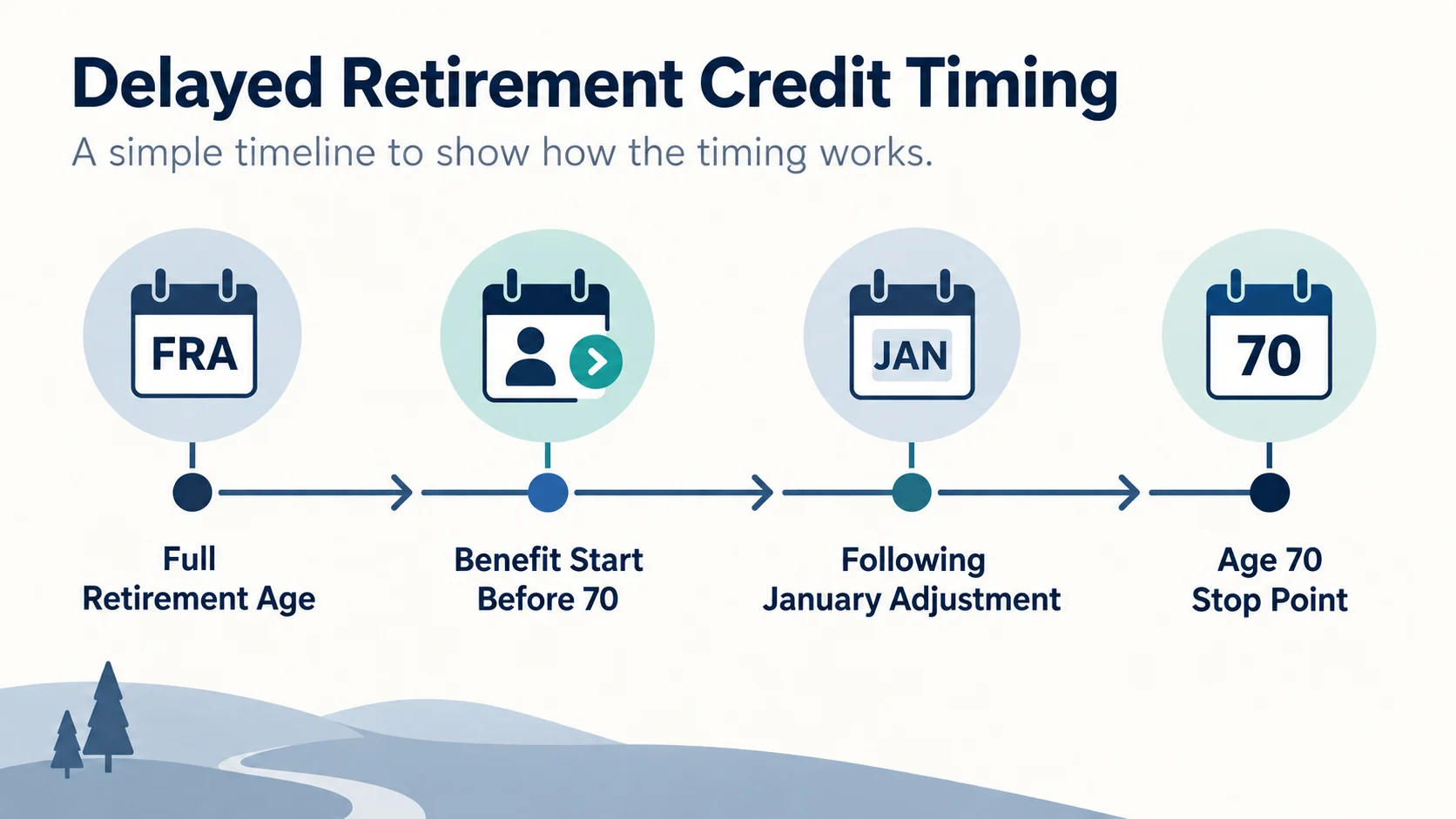
If you first claim retirement benefits after full retirement age, delayed retirement credits earned through the end of the previous calendar year are generally included in your initial benefit computation. Credits earned during the same calendar year in which you start benefits before age 70 may be added later. SSA explains that some of those same-year credits will not be applied until January after you start receiving benefits.
That January date describes the month for which the higher benefit is effective. Social Security retirement benefits are ordinarily paid one month after they are due. As a result, an increase effective for January would ordinarily be reflected in the payment received in February. It should not be confused with the weekday on which a bank posts the deposit; the site's 2026 Social Security payment schedule covers ordinary deposit dates.
The year a person reaches age 70 has a separate rule. Credits earned in that calendar year are effective with the month the person reaches 70. The governing regulation also distinguishes credits earned before entitlement from credits earned after entitlement, which is why two people who file at similar ages can see different sequences in their first award and later adjustment.
The safest concise answer is therefore: prior-year credits usually enter the initial amount, some filing-year credits may produce a later January-effective adjustment, and age-70-year credits are effective in the month age 70 is attained. SSA's Delayed Retirement Credits page and 20 CFR ?404.313 provide the controlling framework. The date on which an individual account finishes processing can vary, so this rule should not be read as a guaranteed administrative posting date.
The three timing rules SSA uses
The official rule becomes easier to follow when the credits are placed into three timing buckets. The key terms are entitlement, the month for which a person has elected retirement benefits, and effective month, the month from which an increase legally applies. Neither term necessarily identifies the day an adjustment finishes processing.
Credits earned before you first claim benefits
Suppose a worker passes full retirement age, remains eligible, and does not claim retirement benefits. Under 20 CFR ?404.313, delayed retirement credits earned through the end of the calendar year before the filing year are included when SSA computes the initial benefit. Those credits do not have to wait for a later annual adjustment because they belong to completed prior years and SSA can include them in the first calculation.
This is why someone who waits several full calendar years after full retirement age can see most of the delayed-credit increase in the initial award. The exact number of credit months still depends on the person's full retirement age, chosen entitlement month, and whether any retirement benefits were received or voluntarily suspended during the period. A personalized estimate from a my Social Security account can help with planning, as explained in the site's guide to finding an estimated Social Security benefit online.
Credits earned during the year you start benefits before age 70
The filing year creates the familiar January issue. SSA's public explanation says that when a person starts benefits before 70, the initial amount can reflect credits earned through the year before the relevant birthday or filing year, while credits earned during the current calendar year may not be applied until the following January. The regulation similarly provides for qualifying after-entitlement credit months to increase the benefit effective in January after the year those credits were earned.
A claimant should separate that legal effective date from the processing sequence. An adjustment may be calculated after the first payment has already arrived. If SSA later implements an increase that was effective for January, the account may require a correction for months already paid at the earlier rate. Whether a particular record needs such a correction, and when it is processed, can only be confirmed from SSA's notice and account history.
Credits earned in the year you reach age 70
Age 70 is treated differently because delayed retirement credits stop accumulating at that point. For a person entitled to benefits in the month age 70 is attained, the regulation makes additional credits earned in that calendar year effective with the month the person reaches 70. The claimant does not have to wait for the next January to establish the legal effective month for those final credits.
Age 70 is also the ceiling, not another full year of credit. Waiting beyond 70 does not create additional delayed retirement credits. A person approaching that milestone should identify the intended benefit month carefully and remember that the related payment usually arrives the next month. The site's guide to applying for retirement benefits online explains the application process, while SSA remains the final source for the entitlement month recorded on an individual claim.
A month-by-month example of the January adjustment
Consider a hypothetical worker born after 1943 who reaches full retirement age in March 2025 and chooses July 2026 as the first month of retirement entitlement. Assume a $2,000 monthly amount at full retirement age only to make the percentages visible. This is not a benefit estimate. It ignores COLA increases, SSA rounding, Medicare premiums, later earnings, and every account-specific factor.
What can appear in the first benefit amount
The worker has ten potential credit months in the completed 2025 calendar year, from March through December, assuming SSA treats each as an eligible month with no retirement benefit received. For someone born in 1943 or later, each month is worth two-thirds of 1%, so ten months represent approximately 6.67% of the full-retirement-age amount.
On the simplified $2,000 base, 6.67% is about $133. The initial gross amount would therefore be roughly $2,133 before applicable COLAs, statutory rounding, Medicare deductions, or other adjustments. The point is not the dollar result. It is that the completed prior-year credit months can already be present in the initial calculation.
What the later adjustment can add
The same worker also waited through six months in 2026 before July entitlement: January through June. At two-thirds of 1% per month, those six potential credit months equal another 4% of the hypothetical base amount. Four percent of $2,000 is $80. Under the simplified illustration, the fully credited amount would be about $2,213 before the adjustments excluded above.
Because those six months occurred in the filing year and the claimant started before age 70, they may not all appear in the first award. The increase attributable to them can be effective for January 2027, with the January benefit ordinarily paid in February 2027. If the administrative update completes later, SSA may need to correct the months affected by that legal effective date. Readers should not infer that every record will display a changed amount on January 1 or receive a separate ?bonus? deposit.
| Part of the example | Potential credit months | Simplified increase | Timing concept |
|---|---|---|---|
| March?December 2025 | 10 | About 6.67% | Completed prior-year credits can enter the initial amount |
| January?June 2026 | 6 | 4% | Filing-year credits can produce a January 2027-effective adjustment |
Different full retirement ages, entitlement months, suspensions, or benefit histories change the count. Use an official estimate or the tools compared in the site's SSA calculator guide instead of treating this illustration as a personal projection.
What delayed retirement credits change?and what they do not
A higher payment can have several causes. Delayed retirement credits are tied to qualifying months after full retirement age in which retirement benefits were not received. They are separate from inflation adjustments and from recalculations based on additional earnings. That distinction matters when a beneficiary tries to explain a change shown in a notice.
The monthly credit rate and the age 70 stopping point
For workers born in 1943 or later, the delayed retirement credit rate is two-thirds of 1% for each qualifying month, or 8% for 12 months. Earlier birth cohorts have different rates. The credits are based on individual months, so waiting seven qualifying months is not treated as if a person waited a complete year.
Credits are available only from full retirement age through the month before age 70 under the modern rules. Continuing to delay a retirement application after 70 does not keep adding 8% per year. The broader effect of claiming at different ages is illustrated in the site's benefits-by-age pay chart, but that comparison should not be used to infer the timing of a particular recomputation.
Delayed credits versus the annual COLA
A cost-of-living adjustment is an inflation adjustment applied under a different rule. SSA bases the annual COLA on changes in the CPI-W. A beneficiary can receive both a COLA and delayed retirement credits, but the two increases answer different questions: COLA changes benefit levels for inflation, while DRC rewards qualifying months of delayed retirement after full retirement age.
The payment language can make them look similar. Under the current COLA schedule, an annual COLA is effective for December benefits that beneficiaries receive in January. A filing-year delayed-credit increase before age 70 can instead be effective for January, with that month's retirement benefit ordinarily received in February. Reading the effective month on the notice prevents an apparent one-month contradiction.
Delayed credits versus an earnings recomputation
Continuing to work can produce another kind of increase. Social Security generally calculates retirement benefits from a worker's highest 35 years of indexed covered earnings. If later covered earnings replace a lower year in that record, SSA can recompute the primary insurance amount. SSA Handbook ?721 describes this as an automatic recomputation and says an increase based on a particular earnings year is effective the following January.
That is not a delayed retirement credit. A worker may earn additional covered wages while also delaying retirement, so both mechanisms can affect the eventual benefit. A notice may also reflect a COLA. Instead of assuming every January-related change is a DRC update, compare the notice's stated reason, the entitlement month, the earnings record, and the number of delayed-credit months.
How to verify the increase on your own record
No public calculator can confirm how SSA actually coded an individual award. Verification starts with the documents attached to the claim and the current benefit information held by SSA. Keep the comparison focused on months and effective dates before trying to reverse-engineer the deposit amount.
Check your award notice and my Social Security account
Start with the retirement award notice. Identify the first month of entitlement, the gross monthly benefit before deductions, and the date from which SSA says that amount is effective. Save later notices that change the amount. A later notice may reflect delayed credits, COLA, an earnings recomputation, or another correction, so the explanation matters as much as the new total.
A personal my Social Security account can provide current benefit and payment information, a benefit verification letter, and available notices in the Message Center. It can also help the worker check the earnings record. A benefit verification letter confirms the current amount but may not provide a month-by-month DRC worksheet. Compare it with the award and adjustment notices rather than relying on a bank deposit alone.
- Confirm the full retirement age and the recorded entitlement month.
- Count only months after full retirement age and before age 70 in which retirement benefits were not received.
- Separate months completed in prior calendar years from months in the filing year.
- Compare the legal effective month with the following month's normal payment.
- Check whether the notice also identifies COLA, earnings, Medicare, tax withholding, or another deduction.
What to do if the expected adjustment is missing
If the amount still appears inconsistent, contact SSA through an official channel and have the notices available. Ask which delayed-credit months were used, what effective month SSA recorded, and whether a later recomputation is pending or already completed. The official national number is 1-800-772-1213, generally staffed from 8 a.m. to 7 p.m. local time Monday through Friday; TTY users can call 1-800-325-0778. The site's SSA phone and status guide lists the official contact routes.
If a notice says how to challenge a determination, follow the instructions and deadline printed on that notice. Keep copies of the notice and any documents submitted. This independent site cannot view an SSA record or correct a benefit, and readers should never send it a Social Security number, claim number, bank information, or account credentials.
Planning details that can affect the outcome
The January adjustment is only one part of a claiming decision. Retroactive entitlement, Medicare enrollment, and potential survivor protection can all change the practical result. These subjects depend heavily on personal circumstances, so the rules below are checkpoints for a discussion with SSA or a qualified adviser rather than a filing recommendation.
Retroactive benefits can replace months of delayed credits
A person who applies after full retirement age may be able to choose an entitlement month before the application month, generally no more than six months earlier and never before full retirement age for this retirement rule. That can produce a useful lump sum of past-due monthly benefits. It can also move the entitlement date backward.
The trade-off is direct: a month paid as a retirement benefit is not also a month for which the worker delayed receiving that benefit. Accepting six months of retroactive retirement payments can therefore give up six potential delayed-credit months and leave a lower ongoing monthly amount than choosing no retroactivity. SSA's operating instructions include an example of a claimant restricting retroactivity to preserve delayed retirement credits. The better choice depends on health, cash needs, survivor considerations, taxes, and other facts beyond this article.
Delaying retirement benefits does not automatically delay Medicare
Retirement claiming age and Medicare enrollment are separate decisions. SSA warns people who delay retirement to address Medicare at age 65. Most people enroll in Part A and Part B when first eligible. Someone covered by an employer group health plan based on current employment may qualify to delay Part B and use a Special Enrollment Period, but retiree coverage and COBRA do not receive the same treatment.
Another timing issue is that premium-free Part A can begin up to six months before the application month for someone applying after 65, but not before age 65. That retroactive coverage can affect Health Savings Account contribution eligibility. Anyone working past 65 should review the official Medicare enrollment timing guidance and, where relevant, obtain employer-plan and tax guidance before choosing dates.
Delayed credits can matter for a surviving spouse
Delayed retirement credits attach primarily to the worker's retirement benefit, but they can also affect protection for a surviving spouse. The federal regulation says SSA computes a surviving spouse's or surviving divorced spouse's benefit using the worker's regular primary insurance amount plus applicable delayed retirement credits. Qualifying credits earned in the year of the worker's death can also be considered beginning with the month of death.
That survivor rule does not mean every family benefit rises with the worker's DRC. The regulation specifically distinguishes other family members, whose auxiliary benefits generally are not increased by those credits. Survivor eligibility, claiming age, family-maximum rules, and other benefits can still change the payable amount. A couple evaluating delayed retirement should therefore compare both the worker's lifetime payment path and the possible survivor benefit rather than treating 8% per year as an isolated investment return.
Key takeaways
- Completed prior-calendar-year delayed retirement credits are generally included when SSA computes the initial benefit for a person first claiming after full retirement age.
- When benefits start before age 70, qualifying credits from the start year may become effective the following January instead of appearing in the initial award.
- An increase effective for January is ordinarily part of the retirement benefit paid in February because Social Security pays benefits one month after they are due.
- Credits earned in the year age 70 is attained are governed by a separate rule and are effective with the month age 70 is attained. Credits stop accruing at 70.
- COLA, later covered earnings, Medicare deductions, and other changes can alter the payment independently of delayed retirement credits.
- Retroactive retirement benefits can trade current lump-sum payments for fewer delayed-credit months, while delayed claiming also requires separate Medicare planning.
Use the award notice, later adjustment notices, and a personal my Social Security account to verify the recorded entitlement month and current benefit. If the result still appears inconsistent, contact SSA through an official channel and ask which credit months and effective date were used. No independent website can see or change an individual Social Security record.
Loading comments...