
Updated August 2, 2026. No diagnosis by itself guarantees a Social Security disability payment. Some well-documented conditions clearly meet Social Security's medical standard and may be identified for faster handling through Compassionate Allowances. Other applicants may meet or medically equal a Listing of Impairments, or qualify after Social Security evaluates what work they can still do. Every path still requires an application, adequate evidence, and the applicable SSDI or SSI nonmedical rules.
Short answer: “Automatically qualify” is misleading. The closest category is a properly documented Compassionate Allowance condition, but expedited identification is not an automatic deposit or a waiver of technical eligibility.
Why a diagnosis does not automatically approve disability
Social Security uses a specific statutory definition of disability. For an adult, the condition generally must prevent substantial work and must have lasted, or be expected to last, at least 12 months or result in death. The decision depends on medical findings, functional effects, duration, work activity, and program-specific nonmedical requirements.
An SSA factsheet answers a common question directly: a doctor's statement that a patient is disabled is not enough by itself. Doctors and other medical sources provide essential evidence, but Social Security or the state Disability Determination Services agency makes the program decision.
This distinction matters because the same diagnosis can affect two people very differently. Treatment response, complications, objective findings, symptom persistence, and the ability to perform work activities can produce different outcomes. Conversely, a person may qualify based on severe combined limitations even when no single diagnosis appears as a neat entry in the Blue Book.
How SSA evaluates an adult disability claim
SSA generally follows a five-step sequence:
- Current work: Is the applicant doing substantial gainful activity?
- Severity: Is there a medically determinable impairment, or combination of impairments, that significantly limits basic work activities?
- Listings: Does the impairment meet or medically equal the criteria of a listed impairment?
- Past work: Considering residual functional capacity, can the applicant perform relevant past work?
- Other work: Can the applicant adjust to other work considering RFC and vocational factors?
A favorable finding at the listing step can end the medical sequence without the later vocational steps. But “my condition is listed” is incomplete: the documented findings must satisfy the listing's specific criteria or be medically equivalent in severity.
Current work is a separate threshold question. SSA publishes a substantial gainful activity amount each year and applies additional rules to work activity, impairment-related expenses, subsidies, unsuccessful work attempts, and self-employment. A paycheck above or below a number should not be used by itself to predict a decision. Use the current official rule and let SSA evaluate the actual work circumstances.
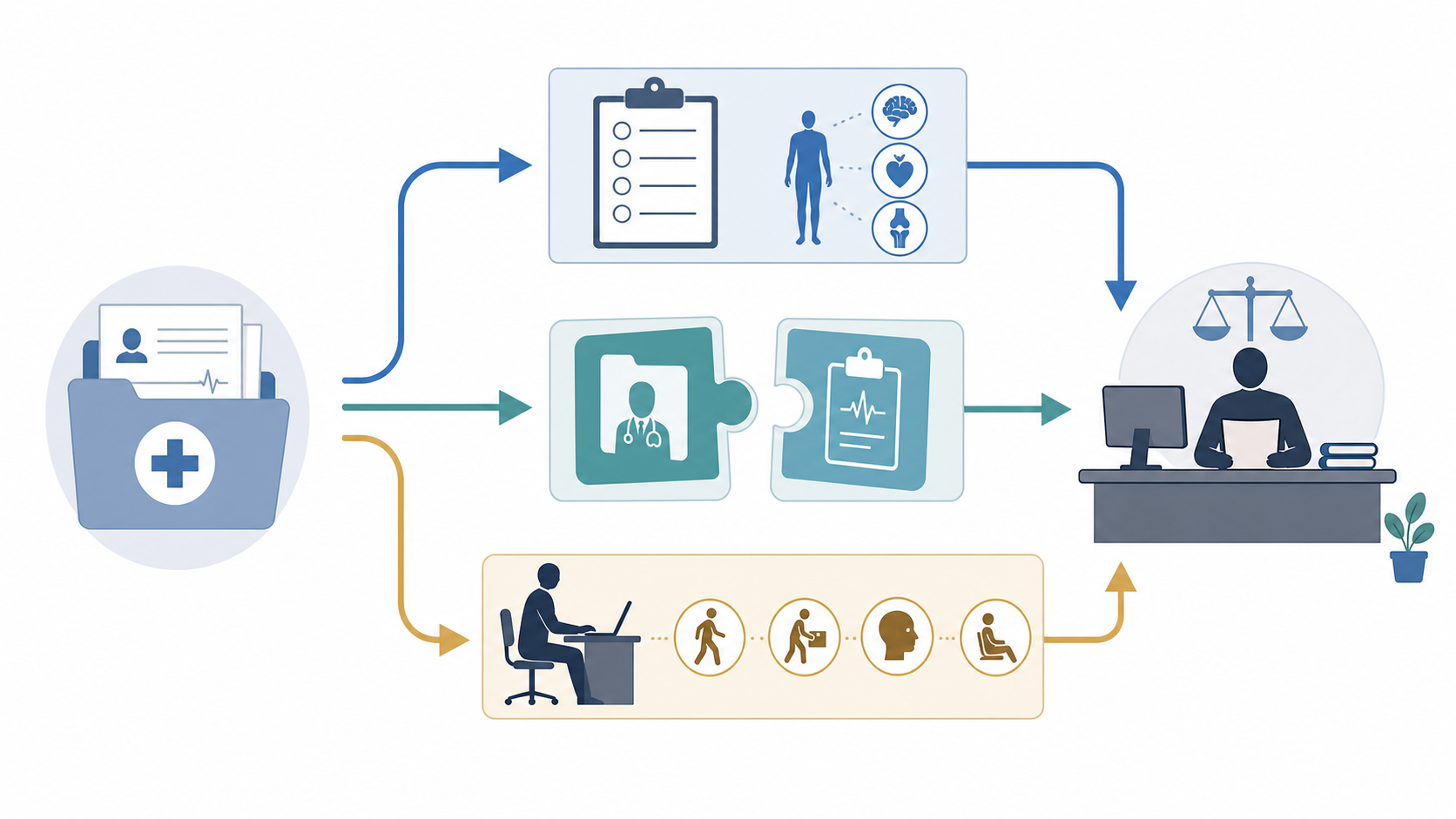
Path 1: meeting a Listing of Impairments
The SSA Listing of Impairments, often called the Blue Book, organizes adult medical criteria into body systems. These include musculoskeletal disorders, special senses and speech, respiratory disorders, cardiovascular disorders, digestive disorders, genitourinary disorders, hematological disorders, skin disorders, endocrine disorders, congenital disorders affecting multiple systems, neurological disorders, mental disorders, cancer, and immune-system disorders.
The headings are not automatic-approval lists. Each section contains detailed severity and evidence requirements. A cancer listing may depend on type, stage, recurrence, metastasis, operability, treatment, or timing. A neurological or mental listing may require specified clinical findings plus defined limitations. A familiar diagnosis name does not substitute for the full criteria.
SSA may find that an impairment meets a listing when the medical evidence documents all required criteria. This is an account-specific medical finding. A third-party list, symptom quiz, or diagnosis code cannot make it.
Path 2: medically equaling a listing
An impairment may not match every element of one listing yet still be medically equivalent in severity and duration. Medical equivalence can involve an unlisted impairment, different findings that are of equal medical significance, or the combined effect of multiple impairments.
Medical equivalence is not a looser “close enough” rule. SSA evaluates the medical evidence under its regulations and policies. Applicants should identify all treatment sources and impairments accurately rather than trying to select a listing on their own. The decision-maker determines whether the evidence meets or equals a listing.
Compassionate Allowances: faster identification, not automatic payment
The Compassionate Allowances program identifies claims involving diseases and conditions that clearly meet Social Security's statutory disability standard. SSA uses the same medical-identification process for CAL conditions in SSDI and SSI claims, allowing especially serious cases to be recognized and handled quickly.
The official list changes. The current POMS index available during this review was revised April 23, 2026. It includes conditions such as adult amyotrophic lateral sclerosis, pancreatic cancer, young-onset Alzheimer's disease, and specifically defined metastatic, inoperable, unresectable, or recurrent cancers. Those qualifying words are important. “Cancer,” for example, is not one blanket CAL category.
CAL does not mean that a person can skip the application, medical documentation, identity checks, or program requirements. An SSDI claimant still needs insured status based on covered work. An SSI claimant still must satisfy SSI's income, resource, citizenship or qualifying-status, and living-arrangement rules. A CAL flag also should not be read as a guaranteed payment date.
Other expedited processes can be confused with CAL. SSA may flag certain terminal-illness cases for special handling, and other agency procedures may prioritize particular claims. The processing label does not change the underlying disability standard or prove entitlement. Applicants should describe the condition and prognosis accurately rather than choosing an expedited label themselves.
Use SSA's live CAL condition list instead of copied lists that may omit qualifiers or later additions. In August 2025, for example, SSA announced 13 newly added conditions—evidence that a static article can become outdated.
If your condition is not in the Blue Book
An unlisted diagnosis can still support a disability finding. If a claimant does not meet or equal a listing, SSA assesses residual functional capacity, or RFC: the most the person can still do in a work setting despite documented limitations.
Symptoms do not have to come from one perfectly named disorder, but SSA first needs objective medical evidence establishing at least one medically determinable impairment. After that, the agency evaluates the intensity, persistence, and limiting effects of symptoms against the complete record. This is why treatment notes and functional evidence matter even when imaging or laboratory findings do not measure every reported difficulty directly.
For physical impairments, relevant functions may include sitting, standing, walking, lifting, carrying, pushing, pulling, reaching, handling, or tolerating environmental conditions. For mental impairments, the record may address understanding and remembering, maintaining attention and pace, interacting with others, and adapting to workplace demands.
SSA then compares RFC with past relevant work and, if necessary, other work. Age, education, and work experience may enter the vocational analysis. The process considers the combined effect of medically determinable impairments, so applicants should report all conditions and treatment sources accurately, not only the diagnosis they consider most serious.
What medical evidence can establish
Objective medical evidence from an acceptable medical source is needed to establish a medically determinable impairment. After that foundation exists, SSA considers medical and nonmedical evidence about severity, duration, symptoms, and functioning.
Useful records can include clinical examinations, laboratory findings, imaging, mental-status findings, treatment history, medication effects, response to therapy, prognosis, and observations about specific work-related abilities. Longitudinal notes can show whether limitations persist despite treatment and whether reported symptoms are consistent with the overall record.
A medical source can explain what a patient can still do and identify supported limitations. The source is not expected to decide whether the patient satisfies Social Security law. Our guide to SSA-827, medical records, and RFC evidence explains the roles of the common forms and reports.
SSDI and SSI use the same medical standard but different nonmedical rules
| Program | Medical question | Additional eligibility focus |
|---|---|---|
| SSDI | SSA adult disability standard | Work credits and current insured status |
| SSI | SSA disability standard for the applicant's age | Income, resources, living arrangements, and other nonmedical rules |
A person can meet the medical standard yet fail the nonmedical rules for one program. Someone may also have both claims evaluated. For SSDI work coverage, see our 2026 work-credit and recent-work guide. Do not assume a CAL condition supplies missing work credits or bypasses SSI financial review.
Children applying for SSI are evaluated under different childhood disability rules, including child listings and functional-equivalence standards. The adult Blue Book discussion in this guide should not be used as a checklist for a child's claim. Likewise, veterans' disability ratings, workers' compensation findings, private long-term-disability decisions, and state disability determinations use different laws; they may contribute evidence but do not automatically control SSA.
How to check a condition without relying on a misleading list
- Start with SSA's current pages. Search the Adult Listings and current CAL list, not a copied article that may be outdated.
- Read the exact condition name and qualifiers. Stage, subtype, recurrence, age of onset, test result, or treatment status may be part of the title or criteria.
- Do not stop if the diagnosis is absent. Medical equivalence and RFC evaluation may still apply.
- Identify every relevant medical source. Complete source details help DDS request a longitudinal record.
- Follow claim-specific notices. Evidence requests, examination appointments, and deadlines come from SSA or DDS.
This independent website cannot review medical records or tell a reader whether a condition meets a listing. Never post an SSN, claim number, medical record, or SSA login credential in a comment or message. Use SSA's secure channels and the contact information on the official notice.
Common myths about automatic qualification
“My diagnosis is in the Blue Book, so I am approved”
The listing contains criteria, not diagnosis-only promises. The evidence must establish the required severity and duration. If it does not, SSA may continue to RFC and vocational steps rather than automatically deny solely because the listing is unmet.
“A Compassionate Allowance skips every rule”
CAL helps SSA identify and expedite claims whose documented conditions clearly meet the medical standard. It does not eliminate the application or SSDI/SSI technical requirements.
“My doctor's disabled note controls SSA”
No. SSA considers medical-source evidence, but the ultimate program decision belongs to SSA. Specific findings and functional explanations are more informative than a one-line conclusion.
“A condition not listed can never qualify”
False. SSA may find medical equivalence or determine through RFC and vocational analysis that the documented limitations prevent qualifying work.
Frequently asked questions
Does cancer automatically qualify?
Not every cancer diagnosis automatically qualifies. SSA's cancer listings and CAL entries frequently specify type, stage, spread, recurrence, operability, treatment, or other criteria. Read the exact current entry and let SSA evaluate the evidence.
Can a mental health condition qualify?
Yes, if the evidence satisfies Social Security's rules. The adult listings include mental disorders, and an RFC evaluation can consider documented mental limitations when a listing is not met. A diagnosis alone remains insufficient.
Can several conditions qualify together?
SSA considers the combined effects of medically determinable impairments. Combined findings may be relevant to medical equivalence, severity, and RFC even when each impairment alone would not satisfy a listing.
How do I know whether SSA flagged my claim for CAL?
Use SSA or the contact details on a DDS notice for claim-specific information. Our application-status guide explains official ways to check a pending claim, but a status label is not a final eligibility prediction.
Official sources
- SSA: Compassionate Allowances
- SSA POMS: Current CAL Conditions
- SSA: Adult Listing of Impairments
- SSA: What You Should Know Before Applying
- SSA: 2025 CAL Additions
Editorial note: This article provides general educational information, not a medical diagnosis, legal opinion, or prediction of an individual Social Security decision.
Loading comments...