
Updated August 2, 2026. There is no single Social Security form that a doctor fills out to “approve” a patient's disability claim. Form SSA-827 is primarily an authorization signed by the claimant so Social Security and the state Disability Determination Services agency can request medical and other records. Doctors, psychologists, hospitals, clinics, and other sources provide records and reports; SSA or DDS evaluates the evidence and makes the disability decision.
Quick answer: SSA-827 releases information. Medical records document the condition and treatment. A medical-source statement can explain supported functional limits. The formal residual functional capacity finding belongs to the decision-maker, not the treating clinician.
A practical map of disability forms and evidence
The phrase “doctor disability form” often mixes several documents with different purposes. Understanding who completes each item can prevent delays and unrealistic expectations.
| Document or evidence | Who usually provides it | What it does |
|---|---|---|
| SSA-827 authorization | Claimant or proper applicant signs through SSA's accepted process | Allows specified sources to disclose information to SSA/DDS |
| Application and disability report information | Claimant, with help if needed | Identifies conditions, work, treatment sources, medications, tests, and other claim facts |
| Treatment records and medical report | Doctor, psychologist, clinic, hospital, or other source | Documents history, findings, tests, treatment, response, prognosis, and functioning |
| Medical-source statement | Qualified treating or evaluating source | Provides an evidence-based opinion about specific abilities and limitations |
| RFC assessment | SSA/DDS adjudicative team | Finds the most a claimant can still do based on the entire record |
| Consultative-examination report | Examiner arranged by DDS | Supplies additional findings when the existing record is insufficient |
The exact paperwork and submission instructions depend on the claim stage. Use the barcode, address, upload option, or other channel shown on the SSA or DDS notice. Do not send a medical record or signed form to SocialSecurityPayment.net; this independent site cannot add evidence to a claim.
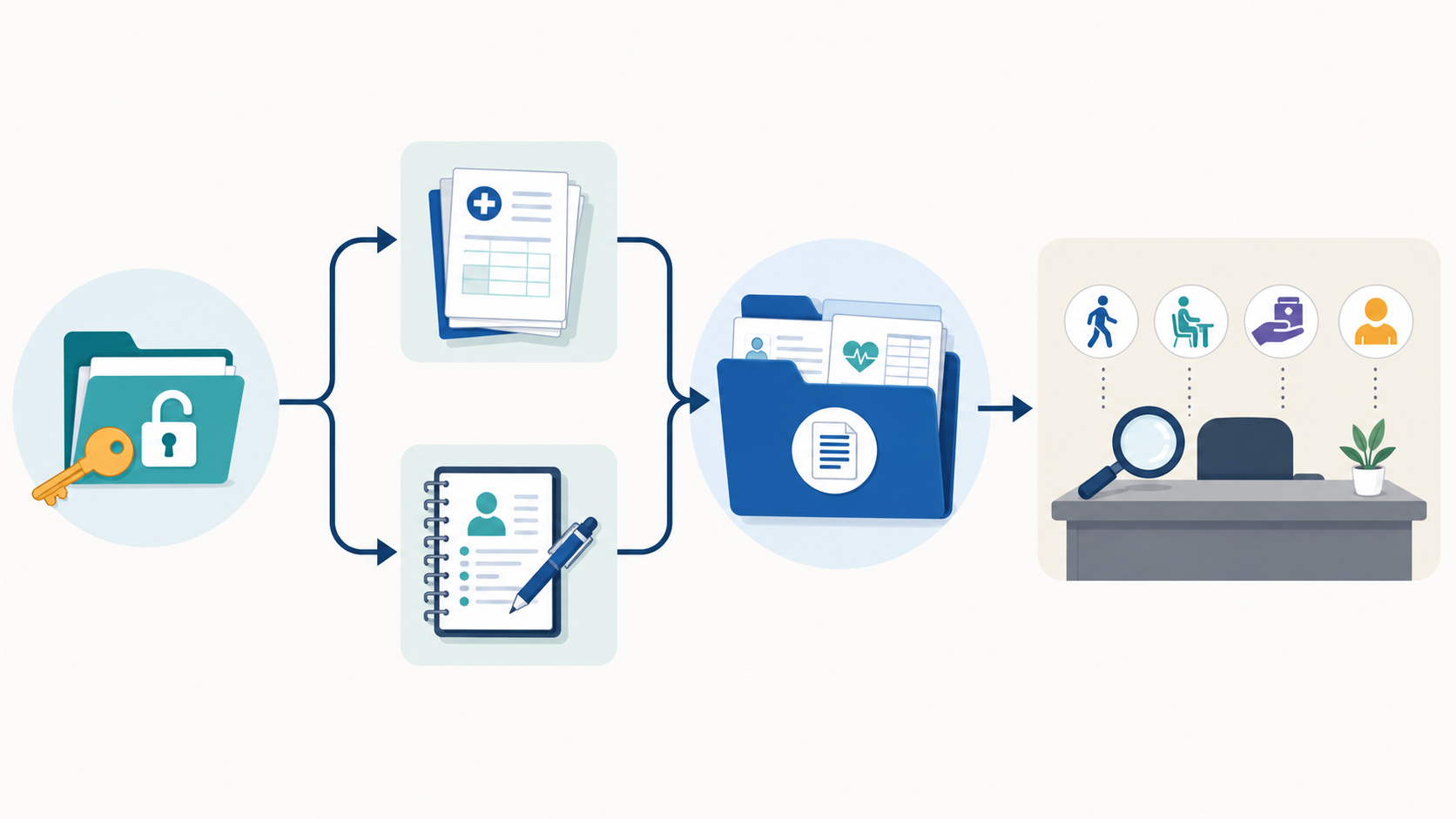
What Form SSA-827 does
The official title is Authorization to Disclose Information to the Social Security Administration. SSA and affiliated state DDS agencies use it to obtain medical and other information needed to determine whether a claimant is disabled. A signed authorization commonly accompanies SSA's requests to doctors, hospitals, clinics, laboratories, schools, employers, insurers, rehabilitation counselors, and other sources covered by the authorization.
SSA developed the form to contain the elements and statements needed for informed authorization under applicable privacy rules. The form identifies the kinds of information that may be disclosed, the classes of sources, the recipients, purposes, expiration, and the individual's rights. SSA provides electronic-signature and employee-attestation processes in qualifying application channels as well as a paper form.
SSA-827 is not the disability application, an RFC decision, or a doctor's promise that the claimant cannot work. A medical provider normally receives the authorization as part of a request and then responds with the relevant records or report. Applicants should use the version and process SSA supplies rather than downloading an unofficial, altered copy.
Who signs SSA-827?
The claimant or other proper applicant authorizes the disclosure through an SSA-accepted signature process. A provider does not sign the claimant's authorization as a substitute for the claimant. Special signature situations have separate SSA procedures, so follow the instructions from SSA rather than guessing.
What about privacy?
The SSA explanation of the authorization describes how SSA-827 addresses HIPAA-related requirements and other protected information. It also explains that a covered entity may not condition treatment, payment, enrollment, or eligibility for benefits on whether an individual signs this particular authorization.
Read the current form before signing. It explains disclosure scope, expiration, revocation, and the handling of information after SSA receives it. Questions about a claim-specific authorization should go to SSA or the office named on the notice, not to an unrelated website.
What SSA asks medical sources to provide
SSA's professional guidance says medical evidence is central to both SSDI and SSI disability determinations. A useful medical report generally includes:
- medical history and relevant onset information;
- clinical findings from physical or mental-status examinations;
- laboratory findings, imaging, and other test results;
- diagnoses supported by the source's findings;
- treatment prescribed, response, side effects, and prognosis; and
- a supported statement about what the patient can still do despite the impairments.
Complete and timely longitudinal records can show changes over time and may reduce the need for SSA to seek clarification or arrange additional testing. A one-page diagnosis list generally cannot show the same detail as examination findings, treatment notes, test results, medication history, and specific functional observations.
SSA helps obtain records from sources identified by the claimant after authorization is provided. The claimant still has responsibility for supplying evidence showing the existence and severity of an impairment. Accurate provider names, addresses, dates of treatment, and test locations help DDS request the correct records.
What an RFC form is—and what it is not
Residual functional capacity is the most a person can still do in a work setting despite limitations caused by medically determinable impairments. SSA assesses RFC only when needed in the sequential evaluation, after considering the entire record.
People often find private “physical RFC” or “mental RFC” checklists online and ask a doctor to complete one. A clinician's supported medical-source statement can be relevant evidence, but a private checklist is not a universal SSA application requirement and does not bind the decision-maker. SSA/DDS makes the formal RFC finding.
For physical function, evidence may address how long a person can sit, stand, or walk; how much the person can lift or carry; use of hands; postural activities; and environmental restrictions. Mental-function evidence may address understanding and memory, sustained concentration and pace, social interaction, and adaptation. The useful question is not simply “Can this patient work?” It is what specific activities the evidence supports, how often they can be performed, and whether limitations persist through a normal work schedule.
What makes a medical-source opinion useful
Connect limitations to findings
An opinion is easier to evaluate when it cites examinations, tests, observed behavior, treatment history, and clinical reasoning. For example, a limitation in handling may be connected to documented strength, sensation, range of motion, imaging, and treatment response. A mental limitation may be explained with longitudinal mental-status findings, symptom course, therapy notes, and medication effects.
Use specific function and frequency
Specific descriptions are more informative than labels. Records can describe duration, frequency, recovery time, treatment interruptions, symptom variation, and the conditions under which a limitation occurs. The source should state only what can be supported from evaluation and treatment, not adopt language chosen to force a legal result.
Address treatment response and inconsistencies
SSA considers the effects of treatment, including improvement, residual symptoms, side effects, and limitations caused by the treatment schedule. If test results, observed function, and reported symptoms appear inconsistent, a medical explanation can help the reviewer understand the record.
Avoid a conclusion without evidence
A letter that says only “my patient is permanently disabled” does not decide the Social Security question. SSA's own pre-application factsheet says a doctor's statement alone is not enough. A supported description of diagnosis, course, findings, treatment, prognosis, and work-related function gives the adjudicator evidence to evaluate.
Medical records versus medical-source statements
Routine treatment records and a medical-source statement complement one another. Treatment notes show what happened during ongoing care: symptoms, examinations, tests, clinical judgments, treatment, and response. A source statement can synthesize that record into an opinion about specific remaining abilities and limitations.
Neither item should be manufactured only to obtain a benefit. Accurate contemporaneous records are important because the reviewer compares opinions with other evidence. Evidence from other sources—such as employers, teachers, caregivers, or rehabilitation programs—may also help describe function after objective medical evidence establishes an impairment.
If the central question is whether a diagnosis itself guarantees a result, review our explanation of Listings, Compassionate Allowances, and RFC pathways. Even a serious diagnosis must be documented, and a claimant must meet the applicable program rules.
How records get to Social Security or DDS
- Identify every relevant source. Give SSA accurate provider, facility, treatment-date, medication, and test information in the application or disability report.
- Complete the authorization through SSA. SSA-827 allows SSA/DDS to request covered records from identified sources.
- Watch for evidence requests. A provider may receive a request directly. The claimant may receive a letter asking for missing information or action by a deadline.
- Submit new evidence through an official channel. Follow the destination and barcode on the notice or the secure online option available for the claim.
- Keep copies and confirm receipt. Save a copy of material sent and use SSA's official status tools or the contact on the notice to check account-specific receipt questions.
An SSA FAQ updated January 13, 2026 says the agency's Upload Documents service can accept additional medical records. At that time, each submission was limited to 50 files and each file to 25MB. Those technical limits can change, so verify the current instructions on SSA's Upload Documents FAQ before relying on them.
When DDS may order a consultative examination
If the existing evidence is insufficient or requires clarification, DDS may arrange and pay for a consultative examination. SSA generally considers the claimant's own medical source as a preferred option when that source is qualified, equipped, and willing to perform the needed examination, but DDS controls the development process.
A consultative examination is not, by itself, a sign of approval or denial. It is an evidence-development step. Follow the appointment notice carefully, bring requested identification or information, and contact the number on the notice promptly if a legitimate scheduling problem occurs.
A claimant's checklist before talking with a doctor
- Bring an accurate list of conditions, medications, specialists, tests, and treatment dates for care—not a script asking the clinician to guarantee approval.
- Describe symptoms and daily function accurately, including variation, without exaggerating or minimizing.
- Ask whether the office received an SSA/DDS records request and whether it needs a current authorization.
- If requesting a statement, ask for the clinician's own supported observations about specific function, treatment response, and prognosis.
- Keep the SSA/DDS deadline and destination with the request so the office knows where and when to respond.
- Do not email unencrypted records to unknown addresses or pay an unofficial site to “file” a doctor form.
Frequently asked questions
Does my doctor fill out SSA-827?
SSA-827 is the authorization made by the claimant or proper applicant through an accepted signature process. The provider uses the authorization when disclosing requested information; it is not the provider's disability decision.
Must my doctor complete an RFC form?
There is no universal claimant-supplied RFC form that every doctor must complete. SSA may request records or a report. A supported medical-source statement can be considered, but SSA/DDS makes the formal RFC assessment from all relevant evidence.
Is a diagnosis letter enough?
Usually not. SSA needs evidence of a medically determinable impairment and evaluates severity, duration, treatment, symptoms, and function. A diagnosis is one part of that record.
What if DDS did not receive a record?
Use the contact information on the notice or an official SSA channel. Ask the provider when and how it responded, retain proof if available, and follow the notice-specific process for resubmitting. Our application-status guide explains general official status options.
Do mental-health providers use different evidence?
The core principles are the same, although clinical findings and relevant functions differ. Longitudinal mental-status findings, therapy and medication history, response, side effects, crisis care, and supported limitations in understanding, pace, interaction, and adaptation may be relevant.
Official sources
- SSA: Information on Form SSA-827
- SSA: Official Form SSA-827 PDF
- SSA: How SSA-827 Meets Authorization Requirements
- SSA: Medical Evidence Requirements
- SSA: Role of the Health and Medical Professional
- SSA: Uploading Medical Records
Privacy and editorial note: Do not send this site medical records, signatures, SSNs, claim numbers, notice barcodes, or login credentials. This is general information, not medical or legal advice, and it cannot replace instructions from SSA or DDS.
Loading comments...