
Updated August 1, 2026. You will usually receive Social Security on the 3rd of the month if benefits on the earnings record began before May 1, 1997, or if the record is assigned to the 3rd because you also receive Supplemental Security Income (SSI). Several less-common official exceptions can also place a record on the 3rd.
Your birthday alone cannot confirm the answer. Social Security assigns a payment day to an earnings record, and people receiving benefits on that record generally share the assigned day. Check your SSA notice or personal my Social Security account for the date that applies to you. This site cannot see your SSA record, and you should never enter an SSN, bank information or SSA login credentials here.
Quick Answer: Who Gets Social Security on the 3rd?
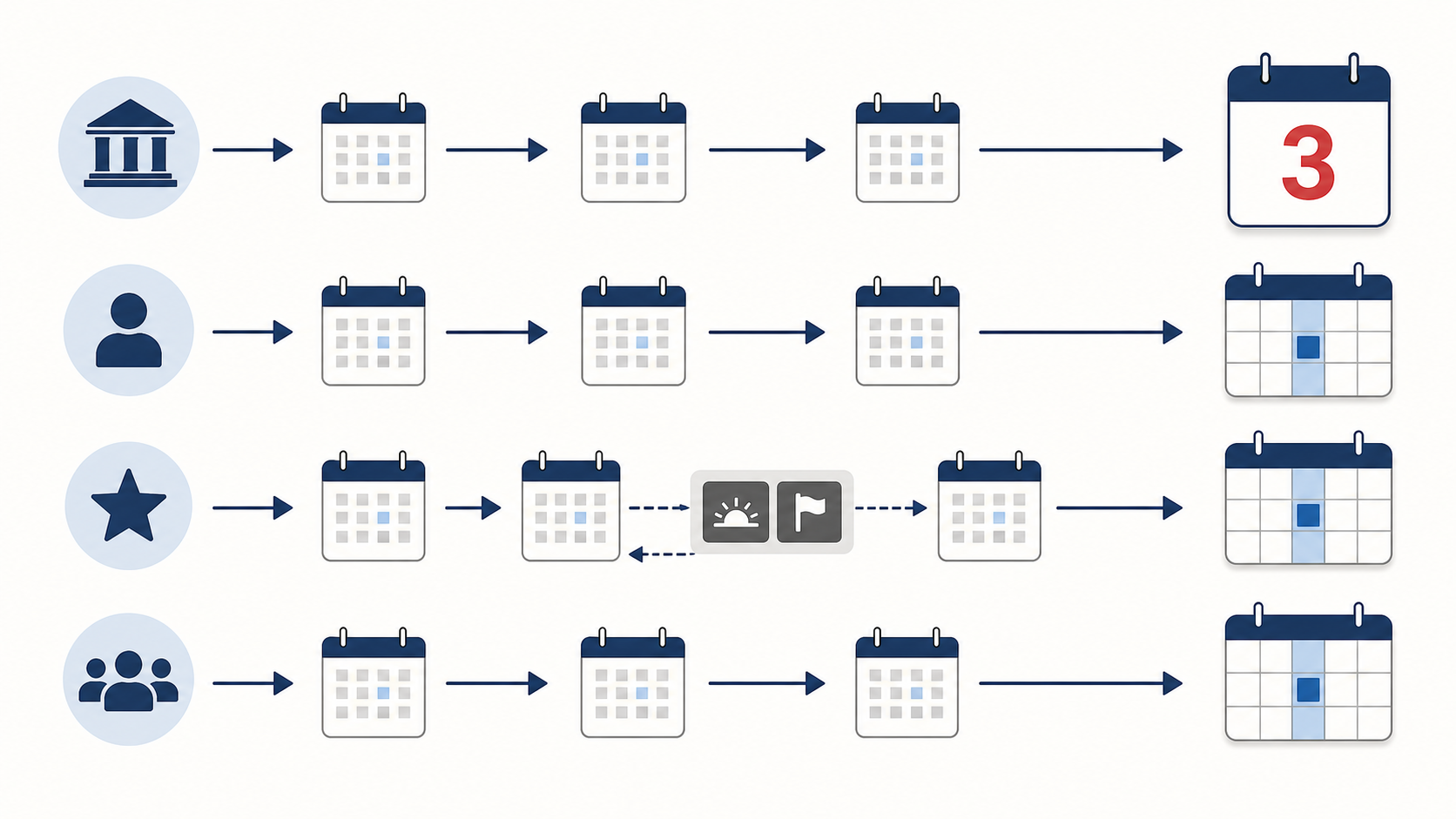
The 3rd-of-month schedule most commonly applies in these situations:
- Benefits on the earnings record were established from an application filed before May 1, 1997. That record generally stayed on the older 3rd-of-month cycle.
- You receive both SSI and Social Security. SSI is normally scheduled for the 1st, while the Social Security benefit is normally scheduled for the 3rd.
- Someone else on the same earnings record falls under a 3rd-of-month exception. The payment-day assignment can apply across the insured worker's record.
- Another official exception applies. Examples include certain beneficiaries living outside the United States and some people whose state pays their Medicare premiums.
| What describes the record? | Likely public schedule | Best confirmation |
|---|---|---|
| Application tied to the record was filed before May 1, 1997 | Usually the 3rd | SSA notice or personal account |
| Both SSI and Social Security are paid | SSI usually on the 1st; Social Security usually on the 3rd | Confirm each benefit separately |
| Post-April 1997 case with no exception | Usually a birthday-based Wednesday | Use the insured worker's birthday group |
| Unusual or recently changed payment day | Cannot be determined from birthday alone | Read the SSA notice or contact SSA |
The governing rule appears in 20 CFR § 404.1807. SSA also summarizes the reader-facing exceptions in Social Security Handbook § 121.
The 3rd of the Month Is Not the Third Wednesday
These phrases sound similar but identify different payment cycles. The 3rd means the third calendar day of the month, subject to an earlier date when that day is a weekend or federal holiday. The third Wednesday changes from month to month and is normally the birthday group for an insured worker born from the 11th through the 20th.
| Payment cycle | Who normally uses it | Does the date move? |
|---|---|---|
| 3rd of the month | Pre-May 1997 records and official exception groups | Earlier if the 3rd is a weekend or federal holiday |
| Second Wednesday | Insured worker's birthday is the 1st–10th | The calendar date changes each month |
| Third Wednesday | Insured worker's birthday is the 11th–20th | The calendar date changes each month |
| Fourth Wednesday | Insured worker's birthday is the 21st–31st | The calendar date changes each month |
For a retirement benefit on your own work record, your own birthday normally determines the Wednesday group. If you receive a spousal or survivor benefit, SSA generally uses the birthday of the worker whose earnings record supports the benefit. The complete 2026 Social Security payment schedule shows all four cycles month by month.
Why Pre-May 1997 and Combined SSI Cases Use the 3rd
SSA introduced birthday-based payment cycling for many applications filed on or after May 1, 1997. A record already established under an earlier application generally remained on the 3rd instead of moving to a Wednesday. The rule works at the earnings-record level: a spouse, survivor or other family beneficiary who later becomes entitled on that same record can also be assigned to the 3rd.
The other common path is receiving both SSI and Social Security. In that situation, SSA's public guidance normally shows two separate payment days:
- SSI: usually the 1st of the month.
- Social Security retirement, disability or survivor benefit: usually the 3rd of the month.
SSI means Supplemental Security Income. It is a separate needs-based program, not another name for Social Security retirement or SSDI. If the 1st or the 3rd falls on a weekend or federal holiday, the affected payment is scheduled earlier. That can place both deposits very close together, but it does not create an extra benefit month. Use the 2026 SSI payment schedule to identify the benefit month attached to an early SSI deposit.
Other Reasons SSA May Assign the 3rd
Filing before May 1997 and receiving SSI are not the only possibilities. SSA's regulation and handbook identify other exceptions that may keep or move an earnings record to the 3rd:
- income is deemed to an SSI recipient under SSA rules;
- a state pays the beneficiary's Medicare premiums under an applicable state buy-in arrangement;
- the beneficiary lives in a foreign country;
- the beneficiary was already paid on the 3rd on one record and becomes entitled on another record without a break;
- another beneficiary on the same insured worker's earnings record falls under an exception;
- certain garnishment, tax-levy or critical-payment-system situations apply.
These categories are not a do-it-yourself eligibility test. For example, having Medicare does not by itself mean the state pays your premium, and living abroad can involve separate rules about whether U.S. benefits may be paid in a particular country. If your payment day changed, use the reason in the written SSA notice or ask SSA which record-level exception applies.
2026 Payments Scheduled for the 3rd
If your record uses the 3rd-of-month cycle, four 2026 payments are scheduled before the 3rd. SSA moves a payment to the first preceding day that is not a Saturday, Sunday or federal holiday.
| Payment month | 2026 scheduled date | Why it is not always the 3rd |
|---|---|---|
| January | Friday, January 2 | January 3 is Saturday |
| February | Tuesday, February 3 | Regular 3rd-of-month date |
| March | Tuesday, March 3 | Regular 3rd-of-month date |
| April | Friday, April 3 | Regular 3rd-of-month date |
| May | Friday, May 1 | May 3 is Sunday |
| June | Wednesday, June 3 | Regular 3rd-of-month date |
| July | Thursday, July 2 | July 3 is the observed Independence Day federal holiday |
| August | Monday, August 3 | Regular 3rd-of-month date |
| September | Thursday, September 3 | Regular 3rd-of-month date |
| October | Friday, October 2 | October 3 is Saturday |
| November | Tuesday, November 3 | Regular 3rd-of-month date |
| December | Thursday, December 3 | Regular 3rd-of-month date |
One timing detail matters for budgeting: Social Security benefits are generally paid in the month after the month for which they are due. For example, the payment received on August 3 normally represents the July benefit. An earlier scheduled date is not an extra check and does not change the benefit month.
The date table comes from SSA's official 2026 payment calendar. If you use another payment cycle, open the site's full 2026 schedule instead of assuming these dates apply to you.
Why a Direct Deposit May Appear Before the SSA Date
The SSA date is the scheduled payment date. A bank, credit union or card provider controls when an incoming electronic payment becomes visible and available in an individual account. Some institutions may provide access before the official date, while others post on the scheduled date or after their own processing completes.
Do not use an early deposit from one month as proof that every future payment will arrive early. It does not move your SSA cycle from the 3rd, and a financial institution's policy can change. Budget around the official date shown by SSA and treat earlier access as account-specific.
If the deposit is not present on the scheduled date, SSA says to contact the bank or financial institution first. For a step-by-step evidence path covering a bank, Direct Express and SSA, use the guide to track a Social Security or SSI payment.
Can Your Payment Day Change?
A payment day is an SSA record assignment, not a date you change through your bank. The federal regulation says an assigned day generally remains in place, although listed exceptions can move an earnings record to the 3rd. SSA says it provides written notice when certain rule-based changes occur.
SSA Handbook § 121.4 also describes a voluntary move from the 3rd to a birthday-based cycle when all beneficiaries receiving benefits on the earnings record agree. The handbook says that decision is permanent. This is not presented as a self-service account feature, so contact SSA before relying on it as an option and ask how it would affect every person paid on the record.
If a payment suddenly appears on a different day, first rule out a weekend or federal holiday. Then read any SSA notice. A one-time retroactive payment, correction or expedited payment may arrive outside the recurring cycle and does not necessarily mean the regular payment day changed.
How to Confirm Your Personal Payment Date
- Read your most recent SSA notice. Look for the assigned recurring payment day and the benefit type.
- Use SSA's official account. The benefit payment schedule service lets signed-in users check upcoming and past payments.
- Compare the public calendar. Use the site's payment date calculator or annual schedule to understand the public rule, not to replace the personal record.
- Check your financial institution. On the due date, review bank or Direct Express posting information through its official channel.
- Report a payment that remains missing. After checking the financial institution, use the site's missing-payment checklist and contact SSA through an official route.
SSA's automated phone assistance is available at 1-800-772-1213; the agency's payment-schedule page says callers can say “check delivery.” TTY users can call 1-800-325-0778. Never give an unsolicited caller your SSN, bank login, Direct Express PIN or SSA account password.
Quick Answers About the 3rd-of-Month Schedule
Does SSDI always pay on the 3rd?
No. SSDI can use the 3rd or a birthday-based Wednesday. The filing history and exceptions tied to the insured worker's earnings record matter; disability status by itself does not identify the payment day.
If the 3rd is Sunday, when will Social Security pay?
SSA schedules the payment for the first preceding day that is not a Saturday, Sunday or federal holiday. In May 2026, for example, May 3 is Sunday, so the 3rd-cycle payment is scheduled for Friday, May 1.
Is the third Wednesday the same as the 3rd?
No. The 3rd is a calendar date. The third Wednesday is a birthday-based cycle normally used when the insured worker was born from the 11th through the 20th.
Does receiving SSI create an extra Social Security payment?
No. SSI and Social Security are separate benefits with separate timing. An early weekend- or holiday-adjusted deposit still belongs to its stated benefit month.
Can my bank release Social Security before the 3rd?
A financial institution may make an incoming deposit available earlier under its own policy, but SSA does not promise that early-access date. Confirm the official schedule and do not plan on an early bank release.
Official Sources
- SSA Handbook § 121: Payment Dates
- 20 CFR § 404.1807: Monthly Payment Day
- SSA Schedule of Social Security Benefit Payments 2026
- SSA: What You Need to Know When You Get Retirement or Survivors Benefits
- SSA: How Do I Report a Missing Payment?
Bottom line: A check on the 3rd usually reflects an older pre-May 1997 earnings record or an official exception such as receiving both SSI and Social Security. It is not the same as the third Wednesday. Use the public schedule to understand the rule, then confirm the assigned day in your SSA notice or official account.
Loading comments...