
Updated September 19, 2026
SSA's 2026 disability upgrades add deeper Hearings and Appeals milestones, three online adjudication forms, secure proffer letters, and 26 more hearing-related notices inside my Social Security. They can reduce uncertainty, but a tracker label is not a decision and an estimate is not a deadline.
This guide explains what the new tools show, how to use them as part of a case routine, and when the official notice or hearing office still controls. It covers both SSDI and disability-related SSI cases where the feature is available.
What changed in the disability claim tracker in 2026
SSA announced the expanded online tools on July 21, 2026, then published claimant and advocate explanations in August and September. The update does more than display a generic “processing” label: it gives a person at certain appeal stages a view of the case's movement through the hearing office and Appeals Council.
The new detail centers on Hearings and Appeals
The published milestones include the hearing office's receipt of a Request for Hearing, review and preparation for the hearing, issuance of a hearing decision, and the Appeals Council's receipt and completion of action on a Request for Review. SSA also says the tracker can show processing-time estimates and key milestones at each of those adjudication levels.
That scope matters. SSA has long offered a general online application and appeal status task, but the richer 2026 feature is explicitly described at the Hearings and Appeals levels. A person at the initial Disability Determination Services review or reconsideration stage should not expect every hearing milestone to appear. Use the information shown for the case rather than comparing screens with someone at a different level.
Who may see a pending or recently decided case
SSA describes access for people with a pending disability claim, pending appeal, or recently adjudicated claim. The feature sits inside a personal my Social Security account. Sign in from SSA.gov and open the status area; do not follow an unsolicited “claim update” link that asks for credentials.
A case can be real even when a status card is missing or slow to change. Account matching, the adjudication level, and how recently SSA transferred or decided the case can affect what appears. Start by confirming that the name and account belong to the claimant and that the case is at the stage you expect. If the account remains inconsistent with a mailed receipt or hearing-office confirmation, contact SSA rather than filing the same appeal again.
How to read the tracker without overreading it
A status label describes an administrative step. It rarely answers the bigger question—whether SSA will find the claimant disabled. Separate the milestone you can verify from the conclusion you hope or fear it represents.
Receipt and case-preparation milestones
A “received” milestone is valuable because it shows that the hearing office received the Request for Hearing. Save the date and compare it with the appeal receipt. It does not mean the office has a complete medical record, accepted late evidence, or scheduled a hearing.
Preparation or review status means the office is developing the case. SSA's hearing page says staff review the request and contact the claimant if questions arise. During this period the office can address appearance options, evidence, representation, scheduling, and other case-specific matters. Keep responding to mailed or digital requests even if the tracker still shows the same broad preparation label.
Decision-issued and Appeals Council review milestones
“Decision issued” tells you an action occurred; it does not reveal approval, denial, a partially favorable finding, or the reasoning. Wait for the actual decision notice and read the date, result, findings, and appeal rights. Do not change medical care, work plans, bank details, or household finances based solely on that label.
If a Request for Review reaches the Appeals Council, the tracker may show its receipt and completion of actions. Those labels still do not identify whether the Council denied review, granted review, remanded the matter, or took another action. The written notice controls and tells the parties what happens next.
Processing estimates are planning tools, not deadlines
An estimate can help decide when a routine status call is premature, but it is not an appointment or guaranteed decision date. SSA's general status page says the review length depends on factors including the type of application or appeal. Transfers, evidence development, scheduling, and case complexity can move the projection.
| Tracker item | Safe conclusion | Do not conclude |
|---|---|---|
| Request received | The hearing office logged the request | The record is complete or the hearing is scheduled |
| Case preparation | Staff are developing the case | A judge has decided the merits |
| Decision issued | A decision document exists | The result is favorable |
| Estimated time | A current planning range | A legal deadline or guaranteed completion date |
Most crucially, a tracker estimate never extends a deadline in a notice. If the notice requires evidence, attendance confirmation, an appeal, or another response by a date, follow that instruction even when the online estimate is months away.
Submit the three new disability forms online
The same 2026 release lets claimants complete and submit three hearing-stage forms inside my Social Security. Online delivery can shorten mailing time and produce a record of submission, but it does not make a vague or incomplete answer more useful. Gather the facts before opening the form and save the receipt afterward.
HA-4631 updates recent medical treatment
Form HA-4631 brings the medical-treatment record forward from the date SSA last updated it. SSA says to include treatment you are unsure was previously reported and treatment you remember after an earlier submission. The current form asks about recent doctors and dates, what they said about the condition, hospitalizations, tests, and treatment.
Prepare a provider list with exact facility names, addresses, phone numbers, treatment dates, and the reason for each visit. Use patient-portal histories, appointment summaries, and calendars to fill gaps. Describe what the provider said accurately; do not convert your own interpretation into a quotation. If the notice asks for records as well as the form, the form does not substitute for the evidence.
HA-4632 organizes medication information
Form HA-4632 records prescription and nonprescription medication. The August 2026 version asks for the medication name and dosage, when first prescribed, daily amount, reason, and prescribing physician. A pharmacy list and labeled containers are safer sources than memory, especially for similar drug names or changing doses.
Report what you actually take and explain a mismatch with the prescribed schedule if the form provides space or the hearing office requests it. Include over-the-counter products when asked. Do not stop, restart, or change a medicine to make the form look consistent; medication decisions belong with the treating professional.
HA-4633 documents work background
Form HA-4633 updates work performed before the application and any work since it was filed. The July 2026 form starts with the most recent job and asks about work during the past five years, approximate dates, employer and location, and duties. SSA's form page specifically tells a hearing claimant to include work performed after filing.
Job titles alone can hide the physical and mental demands of work. Build a factual timeline that distinguishes employers, dates, hours, duties, lifting, standing, supervision, skill, and changes or accommodations when the question calls for them. If dates are approximate, label them rather than inventing precision.
Use digital notices and proffer letters safely
The Message Center now holds electronic copies of 26 additional hearing-related notices. That is more consequential than receiving another status label: a notice can schedule an event, request an answer, set a deadline, or explain a right. Open the document itself and read every page.
What the 26 hearing-related notices cover
SSA's list ranges from a Request for Hearing Acknowledgement Letter and Case Status Letter to the Notice of Hearing, hearing reminder, postponement, amended or continued hearing notices, and the Notice of Ways to Attend a Hearing. Other documents address late filing, good cause, failure to appear, expedited processing, evidence submission, withdrawal, representation, a fee agreement, closing the record, or substitution after a claimant's death.
Grouping the notices helps you triage them:
| Notice function | Examples | Immediate check |
|---|---|---|
| Scheduling and attendance | Notice of Hearing, postponement, amended/continued hearing, ways to attend | Date, time, attendance method, response form |
| Deadlines and record | Time to Submit Evidence, closing the record, good-cause request | Due date, submission channel, proof needed |
| Representation and fees | Representation notice, ALJ fee-agreement action | Who received it and whether action is required |
| Status and case events | Acknowledgement, case-status letter, hearing reminder | Case number, office, next step |
Email or text alerts are optional. An alert may tell you a document is waiting, but it is not the document. Navigate to SSA.gov yourself, sign in, and download the notice. SSA says paper copies continue to be mailed to claimants and their appointed representatives, so keep watching both channels.
A proffer letter calls for review before a decision
A proffer letter has a specific role: SSA says it is sent when new evidence is added after a hearing so the claimant can review and respond before a decision. It is not an approval or denial, and it does not tell you by its mere arrival whether the new evidence helps or hurts the claim.
Open the evidence identified in the letter, compare it with the record you expected, and read the stated response choices and deadline. A response might address accuracy, request an opportunity permitted by the notice, or submit relevant material, but the letter's instructions and the case facts control. If you have a representative, share the document promptly and agree on who will respond.
What the online tracker cannot tell you
The tracker improves visibility, but it is not the case file, the judge's rationale, or the payment system. Knowing its boundaries prevents two costly mistakes: treating a routine status as a prediction and waiting for the screen to answer a question only the notice or hearing office can resolve.
A milestone does not predict approval or payment
Nothing in SSA's announcement says a long preparation period, a fast update, a proffer, or “decision issued” predicts the result. The evidence and applicable rules determine the decision. The written document tells you whether it is favorable, unfavorable, partially favorable, dismissed, remanded, or another action.
Approval also does not mean a deposit appears at the instant the status changes. For SSDI, SSA generally applies a five-full-calendar-month waiting period from the established onset date, with an ALS exception, and pays benefits in the month after the month for which they are due. The earnings record and certain other payments can affect the amount. SSI has different eligibility and payment calculations.
Think of four separate checkpoints:
- Status: where the case is in processing.
- Decision: the written outcome and reasoning.
- Award calculation: onset, entitlement, amount, offsets, and past-due benefits.
- Delivery: when the payment is released and reaches the selected account.
If the claimant is approved but payment has not arrived, use the award notice and payment record rather than trying to decode an old hearing milestone.
Missing information may require the hearing office
The public view may not show whether a particular medical record was associated with the file, a fax was readable, an attendance form was accepted, an interpreter was arranged, or a scheduling conflict was resolved. A generic preparation label cannot answer those questions.
Use the telephone and fax details printed on the hearing-office notice. Ask a narrow question and keep the confirmation: “Was the document submitted on September 12 associated with the case?” is more useful than “Why hasn't the tracker changed?” Do not repeatedly upload the same sensitive material unless the office says it was not received or instructs you to resend it.
Build a monitoring routine that protects deadlines
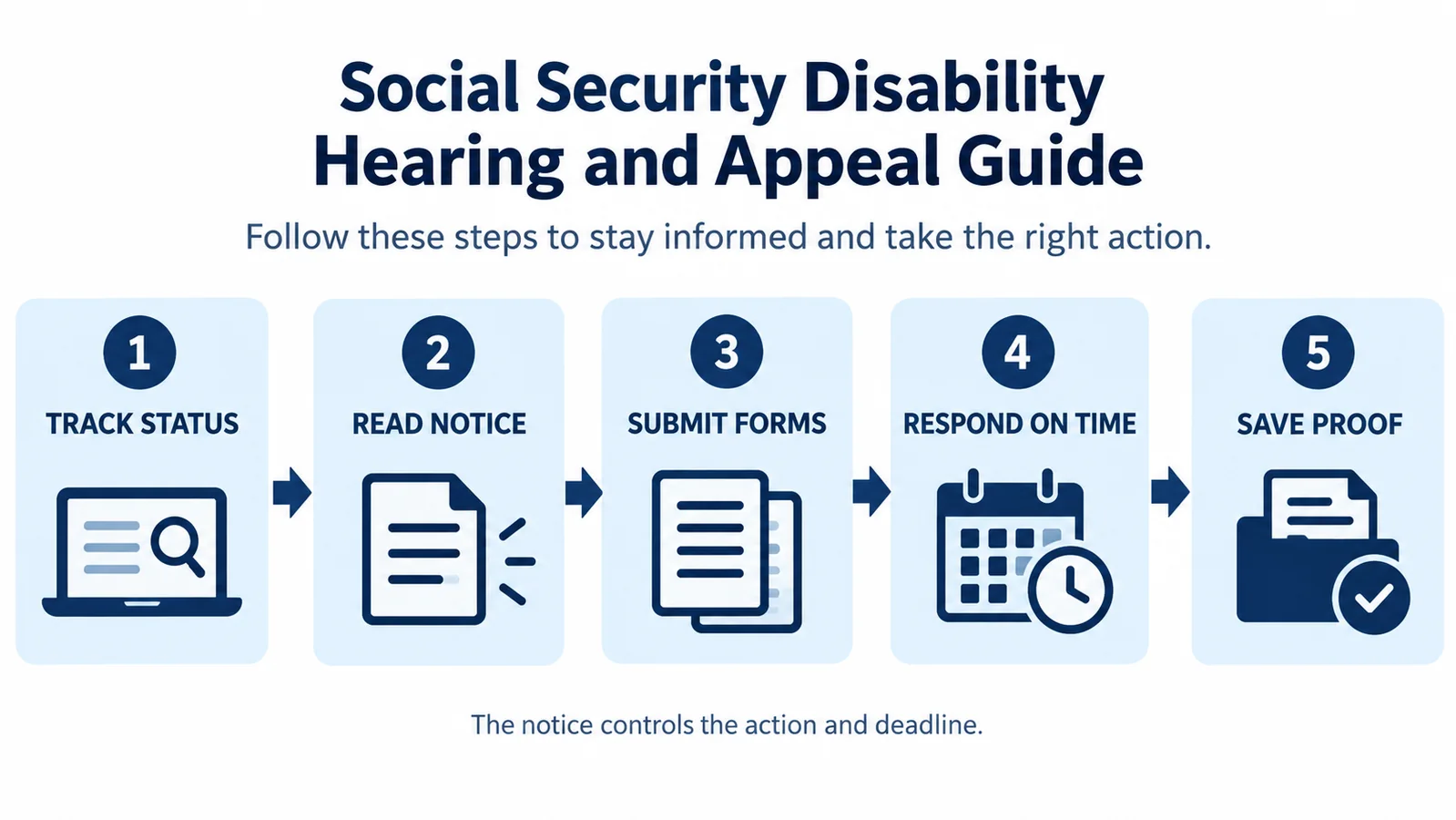
A disability appeal can be quiet for weeks and then produce a notice that needs prompt action. A routine works better than constant refreshing: check on a predictable schedule, open alerts immediately, and record each material event once.
Check the Message Center, paper mail, and contact details
Choose one or two days each week to sign in through SSA.gov and review the tracker and Message Center. Also open postal mail promptly. SSA says paper hearing notices continue, and its hearing page notes that centrally printed documents may take up to three business days to enter the mail after the date printed on them. The digital copy can therefore arrive first.
Keep the mailing address, telephone number, and email current with the hearing office. If you use email or text document alerts, treat them as prompts to sign in, not as the complete notice. Add the hearing-office number from an official notice to your contacts so a legitimate callback is easier to recognize, while remembering caller ID can still be spoofed.
Save submission receipts and a dated case log
Create one folder for notices, submitted forms, supporting evidence, confirmation pages, fax transmission reports, and representative messages. Name files with the date and document type. In a simple log, record the tracker status, notice date, response due date, what you sent, channel, confirmation, and next follow-up.
The receipt proves delivery activity, not that an adjudicator accepted every page or found it persuasive. Verify high-stakes submissions when the account or hearing office does not confirm them. SSA's hearing guidance generally requires written disability evidence to be submitted or disclosed no later than five business days before the hearing, subject to the governing rules and case circumstances. Follow the exact notice and do not wait for the tracker to ask.
Coordinate with an appointed representative
SSA says both the claimant and appointed representative continue to receive paper hearing notices. That redundancy helps only if the parties communicate. Agree who will monitor digital notices, who will submit each form, and how quickly a new notice must be shared. After a submission, send the representative the receipt instead of assuming the office copied them.
A representative is not required, but SSA recommends appointing one early enough to review the file and prepare. If you have one, ask before sending a substantive proffer response or duplicate evidence. If you do not, the hearing office can answer procedural questions, and SSA says some organizations may offer free legal services to people who qualify.
When to call SSA or the hearing office
Call when a missing detail could affect an action, not simply because the estimated completion date feels distant. Before dialing, write one question, collect the notice, and note the last online update. That makes it easier for the representative to identify the right system and office.
| Issue | Best starting point | Useful question |
|---|---|---|
| Cannot create or access my Social Security | SSA account support through the official SSA site or national line | What identity or access step is blocking the account? |
| Need a general application or appeal status | Online tracker or SSA automated phone status | What level is the case at and when was it last updated? |
| Hearing date, attendance method, interpreter, postponement, or local evidence receipt | Assigned hearing office shown on the notice | Was the request received and what action is still required? |
| Digital notice conflicts with mailed notice | Assigned hearing office for a hearing case | Which notice is current and what deadline applies? |
| Decision issued but no copy is accessible | Assigned hearing office or SSA, based on the notice and level | When and where was the decision sent, and how can a copy be obtained? |
| Approved claim but award amount or payment is missing | SSA benefit-payment servicing | Has the award been calculated and has a payment been released? |
The hearing-office telephone and fax numbers appear at the top of its notices. For the national line and local office locator, use SSA's official contact page; our SSA phone and office guide explains the current service channels. If the online account itself is the obstacle, see the my Social Security login guide.
After a call, add the date, office, representative or reference information, answer, and promised follow-up to the case log. If the answer affects a filing date, evidence duty, or appeal right, ask where that instruction appears in writing. A conversation can clarify the record, but it should not erase the deadline printed in a valid notice.
Because SSA can expand features or change the notices available online, recheck the official status page and your current case notice before relying on an older screenshot or article.
Loading comments...