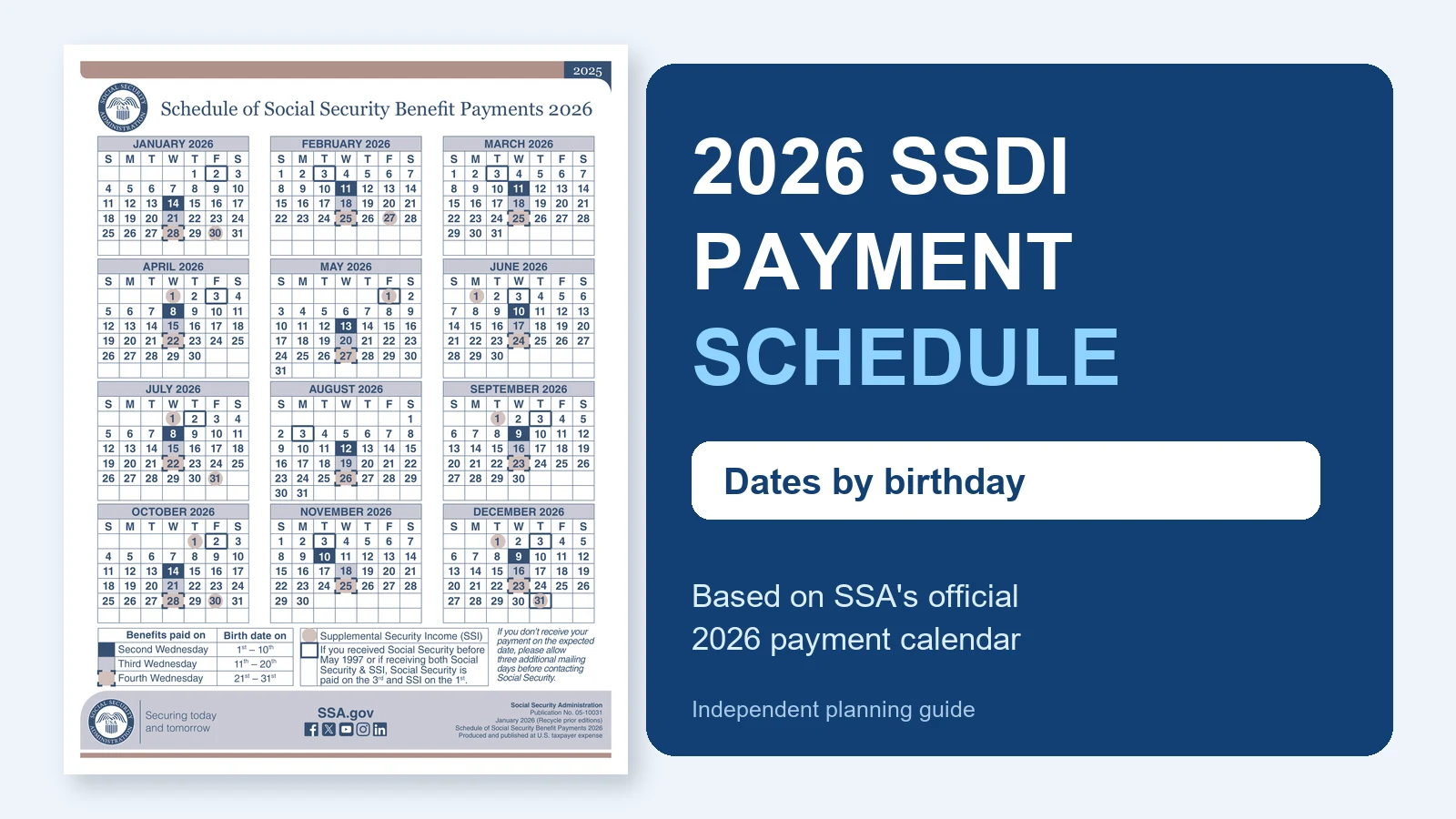
Updated August 25, 2026. Most people receiving Social Security Disability Insurance in 2026 are paid on the second, third, or fourth Wednesday of each month. The scheduled Wednesday depends on the day of the month of the insured worker's birthday: the 1st through 10th usually means the second Wednesday, the 11th through 20th the third Wednesday, and the 21st through 31st the fourth Wednesday.
That quick answer does not fit every SSDI record. People who started receiving Social Security before May 1997, people who receive both Social Security and Supplemental Security Income, and some other SSA-defined cases can be paid on the 3rd instead. When a scheduled date falls on a weekend or federal holiday, the payment may move to an earlier business day. The complete dates and the exceptions are separated below so you can identify the right row before planning around it.
This is an independent guide based on the published SSA calendar. It cannot access an SSA record, trace a deposit, or guarantee an account-specific date. Confirm your date in your SSA notice or secure my Social Security account.
If you need the broader calendar for retirement, survivor, spousal, and disability benefits together, use the site's 2026 Social Security payment schedule. This guide stays focused on SSDI, including first payments, concurrent SSI, direct deposit, and missing-payment steps.
2026 SSDI payment dates by birthday
The table below is the official 2026 birthday-cycle schedule used for most SSDI beneficiaries whose Social Security claim was filed on or after May 1, 1997. Match the day of the insured worker's birthday—not the birth month or current age—to the correct column. A birthday on September 7, for example, belongs in the 1st–10th column for every payment month.
| 2026 payment month | Birthday 1st–10th | Birthday 11th–20th | Birthday 21st–31st |
|---|---|---|---|
| January | January 14, 2026 | January 21, 2026 | January 28, 2026 |
| February | February 11, 2026 | February 18, 2026 | February 25, 2026 |
| March | March 11, 2026 | March 18, 2026 | March 25, 2026 |
| April | April 8, 2026 | April 15, 2026 | April 22, 2026 |
| May | May 13, 2026 | May 20, 2026 | May 27, 2026 |
| June | June 10, 2026 | June 17, 2026 | June 24, 2026 |
| July | July 8, 2026 | July 15, 2026 | July 22, 2026 |
| August | August 12, 2026 | August 19, 2026 | August 26, 2026 |
| September | September 9, 2026 | September 16, 2026 | September 23, 2026 |
| October | October 14, 2026 | October 21, 2026 | October 28, 2026 |
| November | November 10, 2026 | November 18, 2026 | November 25, 2026 |
| December | December 9, 2026 | December 16, 2026 | December 23, 2026 |
November is the easy date to copy incorrectly. November 11, 2026 is Veterans Day, so SSA's published calendar moves the first birthday group's scheduled payment to Tuesday, November 10, 2026. The other two November groups remain on November 18 and November 25. This is an official schedule adjustment, not an optional early-deposit date offered by a bank.
Do not use this table until you have checked whether the birthday cycle applies to your record. The SSA calendar has separate timing for people who received Social Security before May 1997 and for people receiving both Social Security and SSI. The site's general Social Security calendar shows all benefit types together; the next section narrows the SSDI exceptions.
Which SSDI payment schedule applies to you?
Start with the date your Social Security benefits began and the type of benefit shown on your SSA notice. SSDI is a Social Security program, while SSI is a separate needs-based program. The word “disability” by itself does not tell you whether to use the Wednesday schedule or the 3rd-of-month schedule.
| Your situation | Usual recurring Social Security payment cycle | What to verify |
|---|---|---|
| SSDI only; Social Security claim filed after April 30, 1997 | Second, third, or fourth Wednesday based on the insured worker's birthday | Birthday group and assigned date in the SSA account or notice |
| Receiving Social Security before May 1997 | Usually the 3rd of the month | Earlier date when the 3rd is a weekend or federal holiday |
| Receiving both SSDI and SSI | Social Security generally on the 3rd; SSI generally on the 1st | Both benefit records and any early calendar adjustment |
| Benefit paid on another person's earnings record | Birthday cycle generally uses that insured person's birthday | The earnings record named in the award notice |
| Another special payment-cycle case | May remain on the 3rd | The payment day assigned by SSA |
SSA's Handbook lists additional cases that may stay on the 3rd even when benefits began later. Examples include certain beneficiaries living outside the United States, some people whose Medicare premiums are paid by a state, and people entitled on the same record as another beneficiary in a third-of-month category. That is why a birthday alone cannot settle every case.
If you receive a benefit as a spouse, child, or another auxiliary beneficiary on a disabled worker's earnings record, the insured worker's birthday generally controls the cycle for everyone on that record. Do not switch to your own birthday unless the SSA record actually uses it. The site's payment-date calculator can organize the public rules, but the upcoming and past payment schedule in your secure SSA account is the better account-specific check.
Why the benefit month and deposit month are different
An SSDI payment is generally delivered in the month after the month for which the benefit is due. A benefit due for August 2026 is therefore normally deposited on the assigned September 2026 payment date. This month-after rule is easy to miss when an award notice uses an entitlement month while a bank statement shows the money in the next month.
The approval date is a third date, and it does not replace the payment schedule. SSA generally applies a five-full-calendar-month waiting period from the established disability onset date before SSDI entitlement begins. SSA then pays the benefit for the first entitlement month in the following month. Qualifying ALS claims and some prior-entitlement situations can have different waiting-period treatment, so use the dates in the award notice instead of counting forward from the day an online status changed to approved.
For example, suppose SSA says the first month for which a person is entitled is July 2026. The recurring benefit for July would generally be paid in August 2026 on the person's assigned birthday-cycle or third-of-month date. This example explains timing only; it does not determine anyone's onset date, eligibility, or payment amount.
Past-due benefits are also different from the regular monthly deposit. SSA may determine that benefits are payable for earlier months, subject to the applicable rules, but a back-payment transaction does not become the new monthly payday. Compare the award notice with the recurring schedule and review a pending claim through the site's guide to checking an SSI or SSDI application status. Only SSA can confirm the entitlement months and any past-due amount on a particular record.
SSDI and SSI together: two programs, two dates
Some people qualify for SSDI and SSI at the same time. SSA calls this concurrent eligibility. SSDI is Social Security insurance based on a worker's covered earnings record; SSI is a separate program based on financial need and other eligibility rules. A person can receive SSDI only, SSI only, both programs, or neither, so do not infer the benefit type from the word “disability” on an unofficial calendar.
For a person receiving both Social Security and SSI, SSA's published schedule generally places the Social Security payment on the 3rd and the SSI payment on the 1st. The two deposits represent different programs. If the 1st or 3rd is a weekend or applicable federal holiday, the corresponding payment moves to the preceding business day under the schedule rules.
- January 2026 SSI was scheduled for December 31, 2025 because January 1, 2026 was a federal holiday.
- February 2026 SSI was scheduled for January 30, 2026 because February 1, 2026 was a Sunday.
- August 2026 SSI was scheduled for July 31, 2026 because August 1, 2026 was a Saturday.
- November 2026 SSI is scheduled for October 30, 2026 because November 1, 2026 is a Sunday.
An SSI deposit at the end of the prior month is not an extra check. It is the regular payment for the next benefit month arriving early because of the calendar. That distinction matters when two deposits appear in one bank-statement month and the next month begins without another SSI deposit. The site's 2026 SSI payment schedule labels each early deposit by its benefit month.
Concurrent benefits can also interact when SSA calculates past-due amounts, but those calculations are not determined by this recurring date table. Use the award notices for each program to identify the benefit name, monthly amount, and effective month. A third-party calendar cannot calculate a windfall offset or confirm what an individual is owed.
Weekend and federal-holiday adjustments in 2026
When an SSDI payment date falls on a weekend or federal holiday, Social Security normally schedules the payment for the preceding business day. This rule matters most to people on the third-of-the-month cycle, but one birthday-based payment also moves in 2026. The adjusted date shown by SSA is the official payment date—it is not the same thing as a bank voluntarily making funds available early.
| Normal date | 2026 payment date | Why it moves | Who is affected |
|---|---|---|---|
| January 3 | Friday, January 2 | January 3 is a Saturday | People assigned to the third-of-the-month cycle |
| May 3 | Friday, May 1 | May 3 is a Sunday | People assigned to the third-of-the-month cycle |
| July 3 | Thursday, July 2 | July 3 is the observed federal holiday for Independence Day | People assigned to the third-of-the-month cycle |
| October 3 | Friday, October 2 | October 3 is a Saturday | People assigned to the third-of-the-month cycle |
| November 11 | Tuesday, November 10 | November 11 is Veterans Day | Birthday-based recipients born on the 1st through 10th |
The remaining regularly scheduled Wednesdays in the birthday table do not require a weekend or federal-holiday shift in 2026. A nearby holiday does not move a payment unless it actually conflicts with the scheduled payment day. That is why, for example, the November 18 and November 25 deposits remain on Wednesday even though Thanksgiving is November 26.
If you plan bills around an adjusted date, use the date in SSA's official calendar rather than an unofficial list that simply repeats the second, third and fourth Wednesdays. Our monthly guides for January, May, July and October provide additional month-specific context.
Direct deposit, Direct Express and early bank deposits
The dates in this guide are SSA's scheduled payment dates. For a domestic electronic SSDI payment, SSA's operating instructions call that date the settlement date and say the money is to be available by the opening of business on that date. The schedule does not promise a midnight posting, a particular time zone, or the exact moment an individual financial institution will update its customer-facing balance.
| Payment method or feature | What the official date means | What not to assume |
|---|---|---|
| Direct deposit to a bank or credit union | The electronic payment carries the SSA settlement date and should be available by opening of business on that date | SSA does not set the institution's app-refresh time |
| Direct Express card | Treasury says the benefit is automatically deposited to the card account on the payment date | The card does not create a different SSDI schedule |
| Early-pay feature | The institution may make an incoming deposit available before the official date under its own terms | An early appearance does not change the next official payment date |
If a bank sometimes releases deposits one or two days early, treat that as institution-specific access—not as the date SSA promises to pay. Early access can vary with the institution's policies, account status, transaction processing and calendar. It can also stop without changing a person's underlying SSDI eligibility. For essential bills, the safer planning date is the official date in the SSA schedule.
Use a personal my Social Security account or another channel listed by SSA when changing direct-deposit information. SSA's identity guidance says people who keep their existing bank information do not need to contact the agency merely to continue receiving scheduled benefits. It also says Social Security will not send a text asking someone to provide or confirm identity information.
Protect the account itself: do not give an unsolicited caller, text sender, email sender, or third-party “payment tracker” your Social Security number, bank-account number, password, one-time security code, or Direct Express PIN. This independent website does not need those details to explain a calendar. For a safe way to compare the scheduled date with account activity, use our guide to tracking a Social Security or SSI direct deposit.
What to do if an SSDI payment is late or missing
A deposit is not late merely because it did not arrive on a bank's previous early-pay date. Start with the official SSA date for the correct payment cycle. Then compare that date with the upcoming or past payment information in your personal my Social Security account and with the transaction history at the institution that receives the benefit.
- Confirm the assigned cycle. Check whether the record uses the 3rd, second Wednesday, third Wednesday, or fourth Wednesday. Also check the 2026 holiday adjustments above. If the payment is based on someone else's earnings record, verify that insured person's birthday rather than substituting your own.
- Check the benefit status. Review the SSA account and recent notices for the scheduled date, payment amount, withholding, suspension, overpayment recovery, or a change of bank information. A missing balance in a banking app does not by itself show whether SSA issued the payment.
- For an electronic payment, contact the receiving institution first. SSA's missing-payment FAQ says to contact the bank or financial institution when the payment is not present on the scheduled pay date. Ask whether an incoming federal payment is pending, delayed in posting, rejected, or returned. Direct Express cardholders should use the customer-service number on the back of the card.
- If the institution cannot resolve it, contact SSA. Use SSA's official toll-free number, 1-800-772-1213 (TTY 1-800-325-0778), or the local-office locator reached through SSA.gov. Explain that the scheduled payment is missing and identify the date and payment method. SSA says it will review the case and replace a payment if it is due, but the agency does not promise one universal replacement time.
- Document the inquiry without exposing credentials. Keep the scheduled date, call date, institution response, SSA notice, and any case reference in a private record. Do not post a Social Security number, full bank-account number, Direct Express card number, or one-time code in a comment, forum, email, or third-party form.
The waiting rule is different for the limited cases that still receive a mailed check. SSA's disability-benefits publication says to wait three workdays after the due date before reporting a missing check. That mailing allowance is not an instruction to postpone the bank-first inquiry for an electronic deposit that is absent on its scheduled date.
A third-party calendar cannot see an individual payment record or start a payment trace. If the checklist above does not resolve the issue, follow the more detailed steps in Social Security check not received, then use only SSA.gov or verified contact information from an SSA notice to reach the agency.
2026 SSDI payment questions answered
Can I choose a different SSDI payment date? No. SSA's public FAQ says beneficiaries cannot select a different recurring date. The assigned cycle follows the governing rules for the earnings record and benefit situation. Federal regulations generally keep that monthly payment day in place after assignment, although an applicable exception—such as concurrent SSI eligibility—or a weekend or holiday can change the date SSA uses.
Does my own birthday always determine the Wednesday? No. The ordinary birthday cycle uses the birthday of the insured worker whose earnings record supports the benefit. A disabled worker receiving benefits on their own record normally uses their own birthday. A spouse, child, or another beneficiary paid on that worker's record generally follows the worker's birthday and shares the payment day assigned to the record.
Does the SSDI approval date become the monthly payday? No. Approval is a claim milestone, not a new recurring payment cycle. The award notice identifies the entitlement information, while the regular payment day comes from the assigned cycle. Remember also that an SSDI benefit for one month is generally paid in the following month. The secure SSA account and award notice are the appropriate places to confirm a first account-specific payment.
Will a past-due SSDI payment arrive on the regular Wednesday? Do not assume that it will. SSA's electronic-payment instructions distinguish recurring monthly benefits from prior-month accrual, current-month accrual, and other payment types. A past-due or special transaction may therefore appear separately from the ordinary monthly deposit. Its amount and timing depend on the determination, withholding and any applicable offset, so check the award notice or ask SSA about the specific transaction.
Does the 2026 COLA change the SSDI payment date? The COLA changes the payable benefit amount, not the basic birthday groups or third-of-month rules. Social Security COLAs are effective for December and first payable in January, while the annual payment schedule still determines the delivery date. A net deposit can differ from the gross benefit when deductions or withholding apply, so the calendar alone cannot predict the amount that reaches a bank account.
Is the SSDI schedule different from the retirement-benefit schedule? Both are Title II Social Security benefits and generally use the same recurring payment-cycle framework: the 3rd for applicable exceptions or one of three Wednesdays for the ordinary post-April-1997 cycle. Eligibility, benefit calculations and work rules differ, but the calendar pattern is not an SSDI-only invention. For the broader calendar, see the 2026 Social Security payment schedule.
Should an SSI date be copied into an SSDI budget? Only if the person actually receives SSI as a separate benefit. SSI ordinarily follows its own first-of-the-month schedule, while concurrent recipients generally receive their Social Security benefit on the 3rd. Review the separate 2026 SSI payment schedule and label each deposit by program and benefit month to avoid counting an early SSI payment twice.
This calendar is a planning guide based on official public rules, not an individual benefit determination. When a date in an SSA notice or personal account differs from a general table, follow the account-specific SSA information and contact the agency if the discrepancy is unexplained.
Loading comments...