
Updated September 2, 2026. The Social Security earnings limit for 2026 is $24,480 if you stay below full retirement age for the entire year. If you reach full retirement age during 2026, a higher $65,160 limit applies only to earnings from the months before the month you reach that age. These limits affect certain retirement and survivor benefits; they are not general income caps for everyone who receives Social Security.
This guide provides a transparent planning worksheet, not an account decision. It cannot see your earnings record, benefit amount, or SSA notices. Use the result to understand the formula, then confirm it with the official SSA Retirement Earnings Test Calculator or Social Security.
2026 Social Security earnings limits at a glance
First, choose the row that describes where you are relative to your retirement-benefit full retirement age, or FRA. The test is based on age and earnings, not on whether you call yourself retired or how many hours you work in a regular wage job.
| Your situation in 2026 | Earnings used in the test | 2026 exempt amount | Basic withholding formula |
|---|---|---|---|
| Below FRA for all of 2026 | Countable earnings for the full calendar year | $24,480 | $1 withheld for every $2 above the limit |
| Reach FRA during 2026 | Only countable earnings before the FRA month | $65,160 | $1 withheld for every $3 above the limit |
| At FRA for the entire relevant period | None for this test | No limit | No benefits withheld under the retirement earnings test |
The $2,040 and $5,430 monthly figures shown in SSA's 2026 materials require care. They are most important for the special monthly rule that may apply for one year, usually the first year of retirement. They are not permission to replace the annual test with twelve independent monthly tests every year.
The earnings test is also separate from three other rules. Claiming retirement early can permanently reduce the starting rate; the earnings test may temporarily withhold payments while you work before FRA. Federal income taxation of benefits uses different income definitions. SSI and SSDI also have their own work and income rules. If you need the broader 2026 context, see our confirmed Social Security changes for 2026.
2026 earnings test calculator: a transparent worksheet
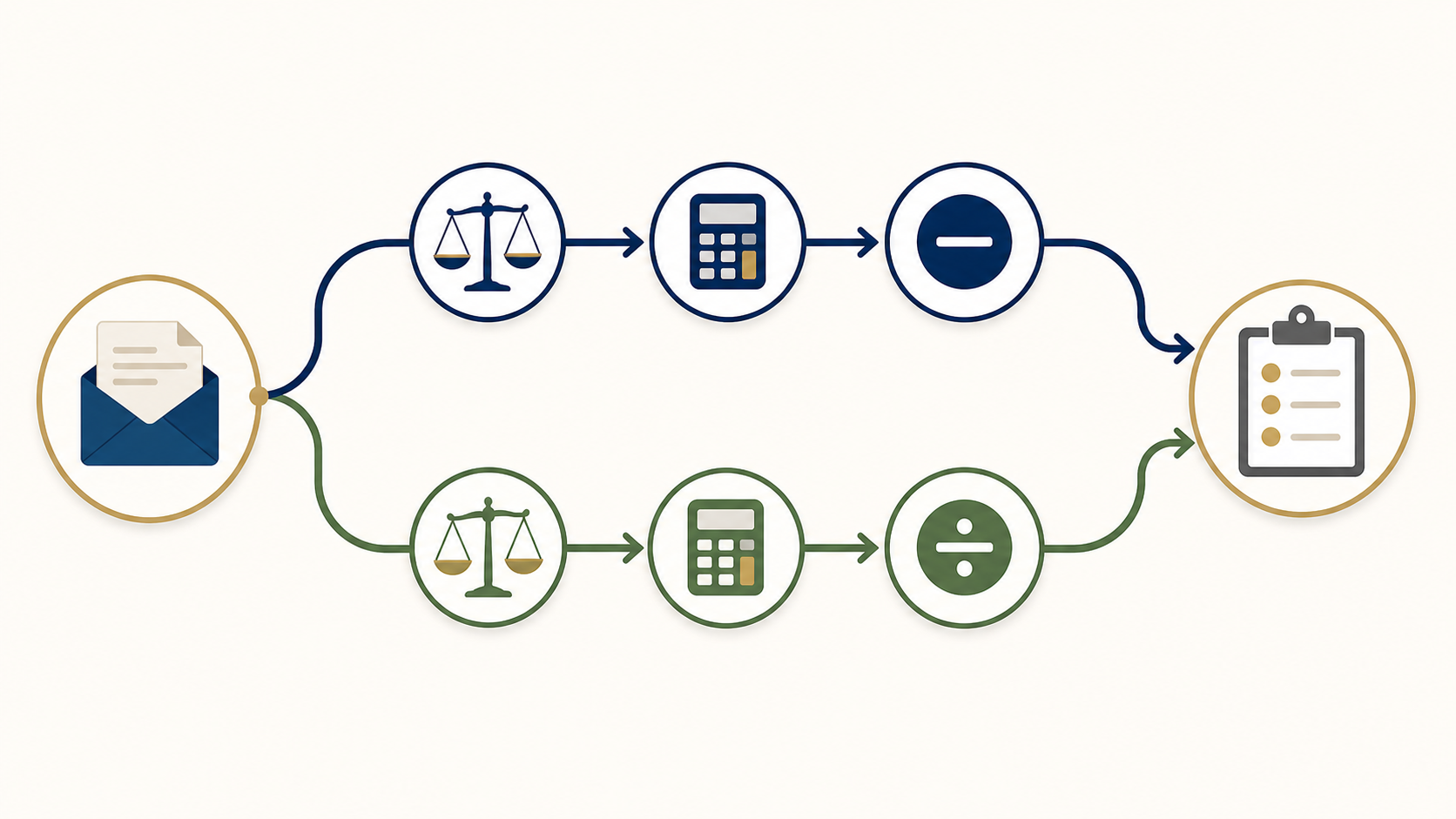
You can estimate the basic annual result with four steps. Keep the worksheet separate from your permanent claiming-age reduction: the monthly benefit input should be the amount scheduled before applying the earnings test.
- Choose the affected earnings period. Use all countable 2026 earnings if you remain below FRA throughout the year. If you reach FRA in 2026, total only countable earnings earned before the FRA month.
- Subtract the correct exempt amount. Calculate earnings minus $24,480 for the under-FRA-all-year case, or pre-FRA-month earnings minus $65,160 for the FRA-year case. If the answer is negative, use zero.
- Apply the ratio. Divide excess earnings by two under the lower limit, or by three under the higher limit. This is the preliminary amount of benefits subject to withholding.
- Compare it with scheduled benefits. The test cannot make annual benefits negative. Your planning result is scheduled benefits for affected entitlement months minus the smaller of preliminary withholding or those scheduled benefits.
Worksheet formula: Excess earnings = maximum of $0 or (applicable earnings − exempt amount). Preliminary withholding = excess earnings ÷ 2, or ÷ 3 in the year you reach FRA. Estimated benefits after the test = affected scheduled benefits − applicable withholding, with a $0 floor.
For example, someone below FRA all year who expects $32,000 of counted earnings first subtracts $24,480, leaving $7,520. Dividing by two gives a preliminary withholding estimate of $3,760. If that person's scheduled 2026 benefits for the affected months total $18,000, the simple planning estimate is $14,240 after the test. It does not mean SSA will remove exactly $313.33 from each check.
Before using the worksheet, collect four non-sensitive facts: your birth month and year, your benefit type, the monthly gross benefit shown in your SSA notice, and an honest estimate of wages or net self-employment earnings for the applicable months. Do not enter an SSN, bank account, claim number, or SSA password into this or any third-party worksheet.
SSA's own tool is the final calculator to use because it incorporates birth date, monthly benefit, and first-year status. Our SSA calculator comparison explains how the earnings-test tool differs from calculators that estimate your underlying retirement benefit. Even the official result remains an estimate if your actual earnings or entitlement months change.
Worked examples for three common 2026 situations
These examples isolate the retirement earnings test so the arithmetic is visible. They assume the person is entitled for every month stated, uses the regular annual test, and has no other deduction. SSA may deliver the result by withholding full checks and reconciling a partial balance, so the annual totals are more useful than predicting a particular deposit.
| Example | Counted earnings | Calculation | Planning result |
|---|---|---|---|
| A. Under FRA all year | $40,000 for all of 2026 | ($40,000 − $24,480) / 2 = $7,760 | $7,760 preliminary withholding |
| B. FRA in October | $72,000 from January–September; later earnings excluded | ($72,000 − $65,160) / 3 = $2,280 | $2,280 preliminary withholding before FRA |
| C. Formula exceeds benefits | $90,000 for all of 2026 | ($90,000 − $24,480) / 2 = $32,760 | Withholding is capped by benefits otherwise payable |
Example A: The worker's gross retirement benefit is $1,800 per month, or $21,600 for twelve months. After the $7,760 formula result, the simplified annual estimate is $13,840. This is a planning total, not a claim that SSA will divide $7,760 evenly across the year.
Example B: The worker reaches FRA in October and earns $72,000 from January through September, then another $30,000 from October through December. The later $30,000 does not enter the retirement earnings test. Nine pre-FRA monthly benefits at $2,500 total $22,500; subtracting $2,280 leaves a simplified $20,220 for that affected period. Benefits beginning with October are not reduced by this test, regardless of those later wages.
Example C: The worker is below FRA all year, earns $90,000, and has a $1,500 monthly benefit. The formula yields $32,760, but only $18,000 of retirement benefits were otherwise payable for the year. The worksheet therefore stops at $0 payable under the annual test; it never produces negative benefits. This does not turn excess earnings into a bill for an extra $14,760.
In this article, “withheld” means benefits held back under the retirement earnings test. It is not federal tax withholding from a Social Security payment. It also does not describe the permanent reduction created by starting retirement benefits before FRA.
What income counts toward the earnings limit?
The phrase “earnings limit” is literal: SSA generally tests earnings from work, not every dollar that appears on a tax return or in a bank account. Use gross wages before ordinary payroll deductions, not take-home pay. For self-employment, use net earnings rather than gross business receipts.
| Usually counts | Usually does not count | Timing rule to check |
|---|---|---|
| Gross wages from a job | Pensions and annuities | Wages generally count when earned |
| Net earnings from self-employment | Interest, dividends, investment income and capital gains | Self-employment income generally counts when received, subject to SSA's entitlement exception |
| Bonuses, commissions, and vacation pay attributable to work | IRA or 401(k) distributions and inheritances | Deferred bonus, sick, or vacation pay may belong to the year it was earned |
| Employee retirement-plan contributions included in gross wages | Veterans benefits and other government or military retirement benefits | Do not classify an unusual payment from its deposit date alone |
A common mistake is to use net pay from a checking-account deposit after taxes, insurance, and retirement contributions. SSA's test starts from gross wages, and an employee's retirement-plan contribution can still count when it is included in those gross wages. Your pay stubs and employer records are therefore more useful than a bank statement for building the estimate.
Timing can change a year-end calculation. Suppose an employee earns a performance bonus in December 2025 but receives it in January 2026. SSA's publication says wages count when earned, so properly documented prior-year earnings should not automatically become 2026 earnings merely because the employer paid them later. Self-employment generally follows receipt timing, but SSA describes an exception for income earned before benefit entitlement and received after entitlement. Ask SSA how to document an unusual payment rather than guessing.
“Does not count” here means only that the item is outside this retirement earnings test. A pension distribution or investment gain can still matter for federal taxes, Medicare income-related premiums, or an income-tested program. Conversely, the $184,500 2026 Social Security taxable wage maximum is not this article's $24,480 earnings-test exempt amount. The first caps wages subject to the Social Security payroll tax; the second can affect benefit payments before FRA.
How the rule changes in the year you reach full retirement age
The FRA-year calculation has a clean month boundary. Find the month you reach retirement FRA, total countable earnings earned from January through the preceding month, and compare that total with $65,160. Do not include earnings from the FRA month or later, and do not divide or prorate $65,160 because FRA arrives before December.
Imagine that FRA begins in July 2026. Wages earned January through June belong in the test; wages earned in July through December do not. If the pre-July total is $72,000, the excess is $6,840 and the basic result is $2,280 under the $1-for-$3 formula. A large year-end bonus earned in November would not enter this test, although it could have separate tax consequences.
Do not assume everyone's FRA is 67. SSA lists 66 years and 10 months for people born in 1959 and age 67 for people born in 1960 or later; earlier birth years have other ages. SSA also instructs a person born on January 1 to use the previous birth year in its retirement-age tool. Use our full retirement age chart by birth year as a guide, then confirm the exact month with SSA.
A survivor-benefit case requires one more safeguard. SSA says the annual earnings test for retirement or survivor benefits uses the person's FRA for retirement benefits. That can differ from the age used for an unreduced survivor benefit. Do not select the higher $65,160 row merely because a survivor-benefit document uses the phrase “full retirement age”; verify the retirement-benefit FRA used by the earnings test.
- If retirement FRA was reached before January 2026, this earnings test does not apply in 2026.
- If retirement FRA is reached during 2026, use $65,160 and pre-FRA-month earnings only.
- If retirement FRA will be reached after 2026, use the $24,480 full-year earnings figure for 2026.
The special monthly rule for the first year of retirement
The annual formula can look unfair to someone who earned a full salary early in 2026 and retired later. SSA has a special rule for one year, usually the first year of retirement. It can permit a full benefit for a whole month SSA considers the person retired, even though earlier earnings pushed the calendar-year total above the annual limit.
| 2026 situation | Monthly wage condition | Self-employment condition |
|---|---|---|
| Below FRA for all of 2026 | $2,040 or less in a month | No substantial services in that month |
| Reach FRA during 2026, for a month before FRA | $5,430 or less in a month | No substantial services in that month |
| Beginning with the FRA month | No retirement earnings test | No retirement earnings test |
Consider an employee below FRA for all of 2026 who earns $48,000 from January through August, stops full-time work, and starts benefits for September. A new part-time job pays $1,200 in each month from September through December. Total annual earnings are $52,800, well above $24,480. But if this is the qualifying one-year period, each of those four later months is at or below $2,040, so the special rule may allow a full check for each month. If October wages instead equal $2,500, October fails the monthly wage condition.
Self-employment cannot be evaluated by profit alone. SSA says more than 45 hours devoted to the business in a month generally means substantial services; less than 15 hours generally means the person is retired. Between 15 and 45 hours can still be substantial in a highly skilled occupation, and managing a sizable business can also matter. Keep a credible calendar of work activity and business records if this rule may apply.
Three cautions prevent misuse. First, “one year, usually the first year” does not mean you can choose the monthly test every year. Second, the rule operates month by month: one failed month does not rewrite whether another whole month meets the conditions. Third, the monthly wage number and the self-employment-services test work together; meeting only one is not enough for a self-employed person.
Tell SSA if you retired mid-year after already earning more than the annual amount. The official earnings-test calculator specifically asks whether this is your first year receiving benefits because that fact can change the result.
How SSA withholds checks—and what happens at full retirement age
Your formula result is not necessarily spread evenly across twelve deposits. In SSA's 2026 publication examples, the agency withholds complete monthly checks until it covers the required reduction, then resolves a remaining partial amount. That means a worksheet can correctly estimate annual withholding yet fail to predict which deposit will be absent.
If SSA's first estimate is too high or too low, actual wage records can produce a later reconciliation. That is why reporting a meaningful earnings change matters. A person whose job ends unexpectedly should not assume previously scheduled withholding will automatically stop before SSA receives updated information.
At FRA, SSA recalculates the retirement benefit to credit months in which payments were reduced or withheld under the earnings test. This generally raises the monthly amount from FRA forward. Saying the money is “not lost” is useful shorthand, but it does not mean SSA deposits every withheld dollar immediately, adds the exact withheld total to one check, or guarantees that every person reaches the same breakeven age.
Keep three adjustments separate:
- Early-claim reduction: starting retirement benefits before FRA produces a lower initial rate.
- Earnings-test withholding: excess work earnings can temporarily stop some payments before FRA; withheld months are considered in the FRA adjustment.
- New high-earnings-year recomputation: SSA reviews later covered work and may raise the underlying benefit if new earnings replace a lower year in the benefit formula.
Those mechanisms can occur in the same record, but they are not interchangeable. Use the annual formula to budget conservatively, then rely on SSA's notice for the actual months and amount. If a scheduled payment does not arrive and your notice does not explain withholding, follow the site's missing-payment checklist rather than assuming the earnings test caused it.
Report earnings changes and avoid common mix-ups
An estimate is only as useful as its inputs. If you receive retirement or survivor benefits below FRA and your expected earnings change from the amount you gave SSA, report the revision promptly. SSA's current retirement earnings FAQ says an earnings-estimate change cannot be reported online; it directs beneficiaries to call 1-800-772-1213 or contact a local Social Security office. Check the current official page before acting because service channels can change.
Prepare a clean record before contacting SSA:
- Estimate gross wages by month, not only annual take-home pay.
- Estimate net self-employment earnings and keep a monthly log of business hours.
- Identify deferred bonuses, sick pay, vacation pay, severance, or other special payments and when the work was performed.
- Note the month benefits began and the month retirement FRA begins.
- Keep the notice or confirmation showing the earnings estimate SSA used and what you later reported.
A worker's earnings can also affect benefits paid to some family members on that worker's record. A spouse's or child's earnings from their own job generally affect that person's own benefit instead. Because family records can combine several entitlements, do not multiply the worksheet result by the number of people receiving checks; ask SSA how the worker's revised estimate affects each payment.
Five common mix-ups can produce a bad estimate:
- Using total household income: the test focuses on the beneficiary's counted work earnings, not a spouse's unrelated pension or investment income.
- Using take-home pay: gross wages, not the net bank deposit, are the normal wage starting point.
- Applying $2,040 every month: the special monthly rule is generally a one-year exception, not the default annual method.
- Counting post-FRA wages: in the FRA year, stop before the FRA month.
- Calling the result an SSI or SSDI limit: those programs use separate income, work-incentive, trial-work, and disability standards.
Work outside the United States can trigger a different test, particularly when the employment is not covered by U.S. Social Security. Use SSA's international guidance instead of this domestic worksheet. Likewise, do not use this calculation to estimate whether Social Security benefits are taxable; tax rules use a different measure of combined income.
Bottom line: choose the correct age row, include only the earnings and months SSA counts, run the transparent formula, check the special monthly rule if you retired mid-year, and report a changed estimate. Then compare the planning result with the official SSA calculator and your notice. SocialSecurityPayment.net is independent and cannot access your record, change withholding, or provide individualized legal, tax, or financial advice.
Official sources: SSA's working-and-retirement FAQ, How Work Affects Your Benefits, Special Earnings Limit Rule, and official exempt amounts.
Loading comments...