
Updated August 12, 2026. Supplemental Security Income can provide a monthly payment to a child who is blind or has a qualifying disability and who meets SSI's financial rules. The key word is can: a diagnosis alone does not guarantee approval, and the 2026 federal maximum of $994 is not the amount every child receives.
For a child younger than 18, SSA examines both the child's functional limitations and the household finances that the program is allowed to count. This guide explains those two tests, parent-to-child deeming, the payment calculation, application evidence, and the transition at age 18. It is an independent explanation of public SSA rules and cannot determine a child's eligibility or access an SSA record.
What Child SSI Is and Who It Is For
SSI is a federal, needs-based program. A child does not need a work history or Social Security credits to qualify. Instead, SSA looks at disability or blindness, income, resources, living arrangements, citizenship or qualifying noncitizen status, and U.S. residence rules. For SSI purposes, a person generally remains a child until age 18. The child must also be unmarried.
This program is easy to confuse with Social Security family benefits. A child may receive a dependent or survivor benefit because a parent is retired, disabled, or deceased and insured under Social Security. That payment comes from the parent's earnings record. Child SSI, by contrast, is based on financial need and the child's own medical eligibility. A family should tell SSA about every benefit the child receives because another Social Security payment can be countable income for SSI.
The two programs can overlap in a family's questions without being interchangeable. A child who does not qualify for SSI because household income is too high might still have a possible claim on an insured parent's record. Likewise, a child receiving a small Social Security family benefit might still qualify for some SSI if all SSI requirements are met. Only SSA can evaluate both records and calculate any combined payment.
SSI also is not a diagnosis-specific grant. Autism, cerebral palsy, intellectual disability, cancer, blindness, or another condition may support a claim, but SSA decides whether the evidence meets its child disability standard. Parents should focus on the condition's effects on everyday functioning rather than assuming that a medical label automatically produces an award.
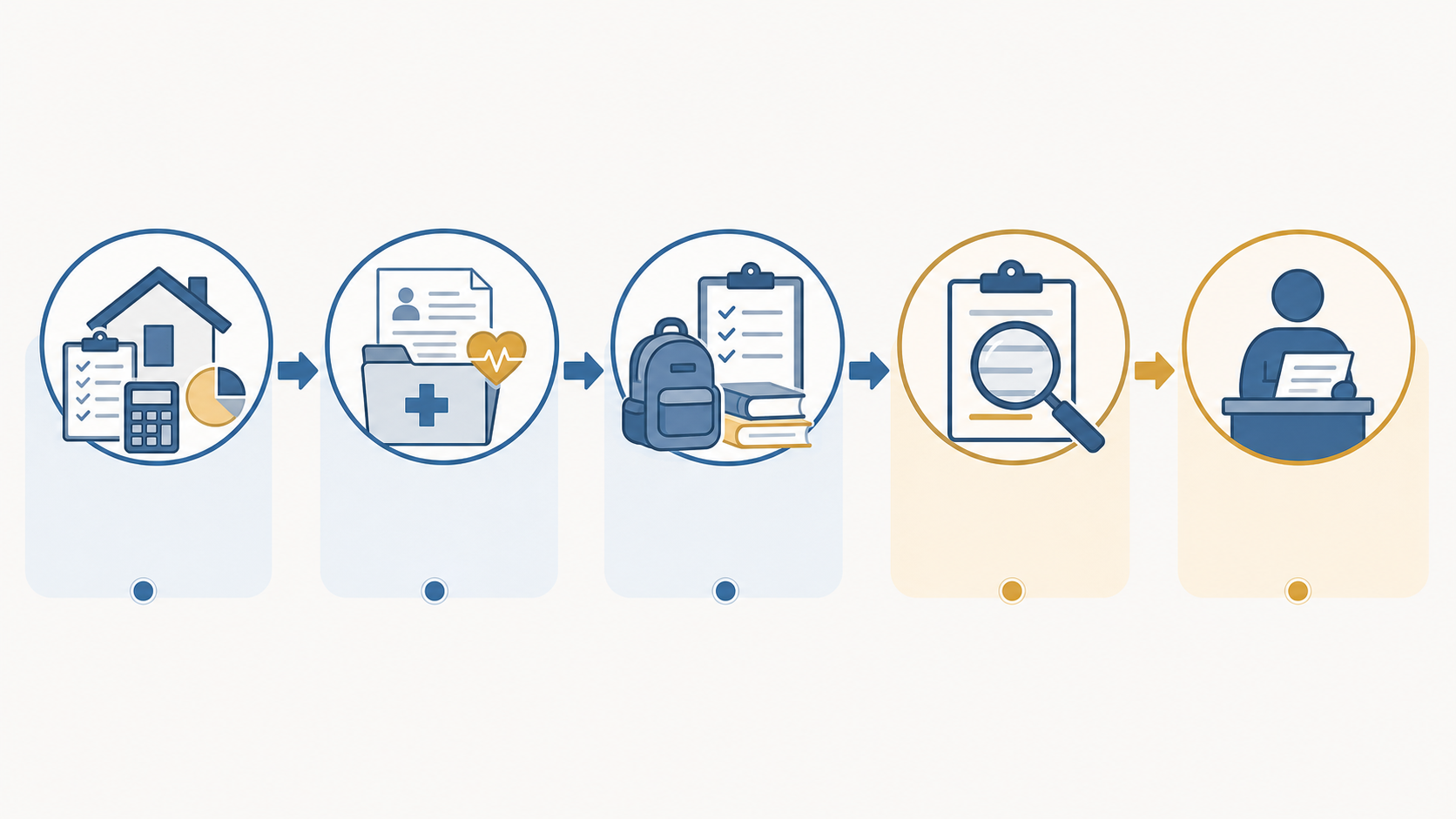
The Child Disability Standard
SSA uses a disability test designed for children, not the adult test based on ability to perform substantial gainful activity. A child must have a medically determinable physical or mental impairment, or combination of impairments, that causes “marked and severe functional limitations.” The condition must have lasted, or be expected to last, at least 12 months, or be expected to result in death.
SSA first asks whether the child is doing work that reaches the applicable substantial-gainful-activity level. It then considers whether the impairment is severe. At the final medical step, SSA decides whether the condition meets, medically equals, or functionally equals a childhood listing. Functional equivalence looks at how the child acquires and uses information, attends and completes tasks, interacts with others, moves and manipulates objects, cares for themself, and experiences health and physical well-being.
That comparison is age-sensitive. A limitation that is ordinary for an infant may be significant for an older child, while expectations for a teenager differ from those for an elementary-school student. Evidence should therefore describe what the child can and cannot do compared with other children of the same age who do not have impairments.
Medical records establish diagnoses, treatment, clinical findings, and prognosis. School and daily-life evidence can show function over time: evaluations, individualized education programs, attendance, special services, teacher observations, therapy reports, and descriptions of help the child needs at home. An IEP or special-education placement can be useful evidence, but it does not automatically establish SSI disability. SSA must apply its own legal standard to the complete record.
Financial Eligibility and Parent Income Deeming
Child SSI has a separate financial test. SSA counts the child's own income and resources, then may treat part of the income and resources of parents in the household as available to the child. This process is called deeming. It can apply to a natural or adoptive parent and, while that parent lives in the home, to a stepparent. It can also apply when a child is away at school but remains under parental control and returns home for weekends, holidays, or vacations.
Deeming does not mean SSA simply adds all gross household income to the child. SSA applies exclusions, sets aside allocations for parents and other ineligible children, distinguishes earned from unearned income, and then determines what portion is countable. Certain items—such as a home the beneficiary lives in, one vehicle used for transportation, and qualifying retirement funds—may be excluded from resources. Some payments, including foster-care payments for an ineligible child and certain needs-based assistance, may receive special treatment.
SSA publishes a 2026 screening chart for simple cases. With no other ineligible children in the home and all parental income earned, the chart begins with gross monthly income below $4,101 for one parent or $5,095 for two parents. Those figures rise when additional ineligible children live in the household. They are guidelines, not universal income limits.
Do not use the chart when parents have both earned and unearned income, the child has income, court-ordered support is involved, more than one disabled child is applying or receiving SSI, another child has income or leaves the home, a parent receives certain public income-maintenance payments, or the state supplements child SSI. In those situations, ask SSA for an individual deeming calculation.
The general SSI resource limit is $2,000 for an individual, but deeming can make the family calculation more complicated. A bank balance alone cannot settle eligibility because excluded resources and parental allocations matter. Report accounts and property accurately and let SSA apply the exclusions. Parent-to-child deeming generally stops beginning with the month after the child turns 18.
How Much Can a Child Receive From SSI in 2026?
The maximum federal SSI payment for one eligible person in 2026 is $994 per month. A child is treated as an eligible individual for this federal-rate purpose, not as half of an eligible couple. The figure is a ceiling before countable income and other adjustments; it is not an average and not a guaranteed child payment.
A simplified way to understand the calculation is: start with the applicable federal benefit rate, subtract countable income, then add any state supplementary payment for which the child qualifies. The real computation can include earned- and unearned-income exclusions, parental deeming, the child's own income, living-arrangement rules, and state-specific categories. That is why two children with the same diagnosis can receive different amounts.
Some states add a supplement, but not every state supplements children and the amount may depend on where and how the child lives. SSA itself warns that its general deeming chart should not be used when a state supplement applies. Use the award or change notice as the controlling statement of the child's federal and state amounts.
Payment timing is separate from payment amount. SSI is usually scheduled for the first day of the month. When the first is a weekend or federal holiday, SSA generally pays on the preceding business day. An end-of-month deposit can therefore belong to the next benefit month; it is not an extra SSI payment. The maintained 2026 SSI payment schedule shows those calendar adjustments.
Families should report income, resources, address, household, custody, school-away, and marital-status changes promptly. A later change in countable income can raise or lower a payment and may create an overpayment if it is not reported. Never rely on a third-party calculator as a final award figure.
How to Apply and Build the Evidence Record
A child SSI claim has both a financial application and a Child Disability Report. A parent, guardian, caregiver, or other appropriate representative can begin through SSA's child-disability application route or call SSA to schedule an appointment. Submitting the online report starts the process; an SSA representative may still need to contact the filer to complete the SSI application and financial interview.
Prepare basic identity and relationship information, the child's Social Security number and birth certificate, and records of household income and resources. SSA may ask about wages, other benefits, bank accounts, property, who lives in the home, and who pays shelter costs. Provide sensitive information only through official SSA channels—not in an email to an independent website or a public comment.
For the medical portion, list every condition, treatment source, medication, test, hospitalization, therapist, and relevant date. Describe how the impairments affect the child's day from waking through bedtime. Concrete examples—how long a task takes, how much prompting is required, how often an episode occurs, or what happens in a classroom—are usually more informative than broad labels such as “struggles a lot.”
School evidence can be central because it documents functioning across time and settings. Gather report cards, evaluations, attendance records, disciplinary records when relevant, IEP or 504 materials, therapy notes, and contact information for teachers or other professionals who know the child. SSA and the state Disability Determination Services can request records directly, so families do not need to pay a provider merely to create a special report. Copies already available can still help the reviewer understand the claim sooner.
Keep a private submission log with provider names, dates, forms sent, and SSA contacts. Do not store passwords, a full SSN, or bank credentials in an unsecured note. The site's guide to disability forms and medical evidence can help organize the clinical side of the file.
What Happens After a Child SSI Claim Is Filed?
SSA first develops the nonmedical part of the claim, including income, resources, residence, household composition, and other SSI factors. The medical file normally goes to the Disability Determination Services agency in the family's state. DDS examiners and medical or psychological consultants review records from doctors, hospitals, therapists, schools, and other sources.
If the existing evidence is not enough, DDS may ask for more records or schedule a consultative examination. SSA pays for an examination it requires. Attend the appointment or contact the agency promptly if the child cannot attend; simply missing it can leave the reviewer without evidence needed for a decision.
SSA's 2026 child-benefits publication says a state agency may take six to eight months to decide whether a child's condition meets the disability criteria. That is general guidance, not a deadline. Record collection, examinations, staffing, and the complexity of multiple conditions can change the timeline. The application-status guide explains the official online and phone routes without confusing claim status with payment status.
For certain severe conditions, SSA may make immediate SSI payments for up to six months while DDS completes the medical decision. Examples in the official publication include total blindness or deafness and several particularly serious diagnoses. This is often called presumptive disability or presumptive blindness. It is not available for every diagnosis, and SSA decides whether the evidence supports it.
If DDS later finds that the child does not meet the disability standard, SSA says the family generally does not have to repay properly issued presumptive-disability payments. That protection does not erase an overpayment caused by incorrect financial information or failure to report a change. Read every notice carefully.
An unfavorable decision explains appeal rights and the deadline. A request for reconsideration asks SSA to review the determination; later levels can include a hearing. Use the notice's instructions and preserve the submission confirmation. A new application is not automatically a substitute for a timely appeal of the period already decided.
Managing Child SSI After Approval
SSA usually appoints a representative payee to manage SSI for a minor. The payee must use the money for the child's current needs—such as food, shelter, clothing, medical care, education, and personal items—then save any remaining funds for the child. The payee should keep benefit money identifiable and maintain records of how it was used.
When a child's past-due SSI payment is large enough, SSA may require a dedicated account at a financial institution. The account must be separate from the regular monthly-benefit account and generally may be used only for expenses related to the child's impairment, including medical treatment, education, job-skills training, special equipment, personal assistance, therapy, rehabilitation, and certain approved related needs. Families should follow the award notice and ask SSA before using dedicated-account money for an uncertain expense.
Approval is not permanent without review. SSA conducts continuing disability reviews to decide whether the child's medical condition still meets its rules. For some infants awarded benefits because of low birth weight, an early review is required. At a review, families may need to show current treatment and how limitations continue to affect daily activities.
Financial eligibility is also reviewed through SSI redeterminations. Report changes that can affect the payment: parental or child income, resources, address, living arrangement, household members, custody, marital status, school absence, and admission to or discharge from an institution. A change may affect the federal amount, deeming, or a state supplement even when the child's medical condition is unchanged.
Keep notices, bank statements for benefit accounts, receipts for major purchases, and reporting confirmations. If a notice shows an amount or fact that appears wrong, contact SSA promptly through an official channel. The independent site cannot see the child's record, change the payee, approve a dedicated-account expense, or correct an overpayment.
What Changes When the Child Turns 18?
SSI changes its framework at age 18. SSA no longer uses the childhood disability standard and instead determines whether the young adult meets the adult definition of disability. SSA generally performs this age-18 redetermination during the one-year period that begins on the 18th birthday.
The adult decision focuses on whether medically determinable impairments prevent substantial gainful activity under SSA's rules. A young person who qualified because of serious limitations compared with same-age children does not automatically satisfy the adult standard. Current medical, school, vocational, and functional evidence remains important, especially records showing how the person handles work-like tasks, pace, attendance, interaction, adaptation, and independent self-care.
The financial change can help some households. Parent-to-child deeming generally stops beginning with the month after age 18. SSA then usually counts the young adult's own income and resources, and a spouse's if applicable, rather than the parents' finances. A child denied before 18 solely because of parental income or resources may therefore be financially eligible as an adult, but still must meet the adult medical and all other SSI rules.
Work does not always end SSI immediately. In 2026, a qualifying student under age 22 who regularly attends school can exclude up to $2,410 of earnings per month, subject to a $9,730 annual limit. Other work incentives may apply. These exclusions are not permission to stop reporting wages; the beneficiary or payee should report work and let SSA calculate countable income.
Plan before the birthday: update providers, collect transition and vocational records, review whose name is on financial accounts, and read the redetermination notice. If SSA finds the adult standard is not met, the notice explains appeal rights and whether benefit continuation can be requested during an appeal under applicable rules and deadlines.
A Practical Child SSI Checklist for 2026
- Screen both tests. Review the child disability standard and household financial rules rather than relying on diagnosis or gross wages alone.
- Start through SSA. Use SSA.gov or the official phone route; do not pay a third party merely to file a basic claim.
- Build a timeline. List conditions, treatment, school services, functional changes, and household financial changes with dates.
- Describe function. Explain the help, prompting, supervision, time, absences, and recovery the child needs in everyday settings.
- Track requests. Respond to SSA or DDS letters, examinations, and evidence requests by the stated deadline.
- Read the notice. Confirm the medical decision, countable income, state supplement, payment amount, representative payee, and appeal instructions.
- Report later changes. Keep confirmations for income, resources, household, custody, address, school, and institutional changes.
- Prepare for 18. Do not assume child eligibility automatically continues under adult rules.
For general help, the current SSA phone and status guide explains official contact routes. For payment timing after approval, use the SSI calendar. These tools provide public information only; the child's SSA notice is the source for eligibility and amount.
This independent guide is not affiliated with SSA and does not provide legal or individualized benefit advice. Do not send an SSN, medical record, bank account number, or SSA login credential to this site. Confirm the child's case through SSA.gov, official notices, or an authorized representative.
Official sources
Loading comments...