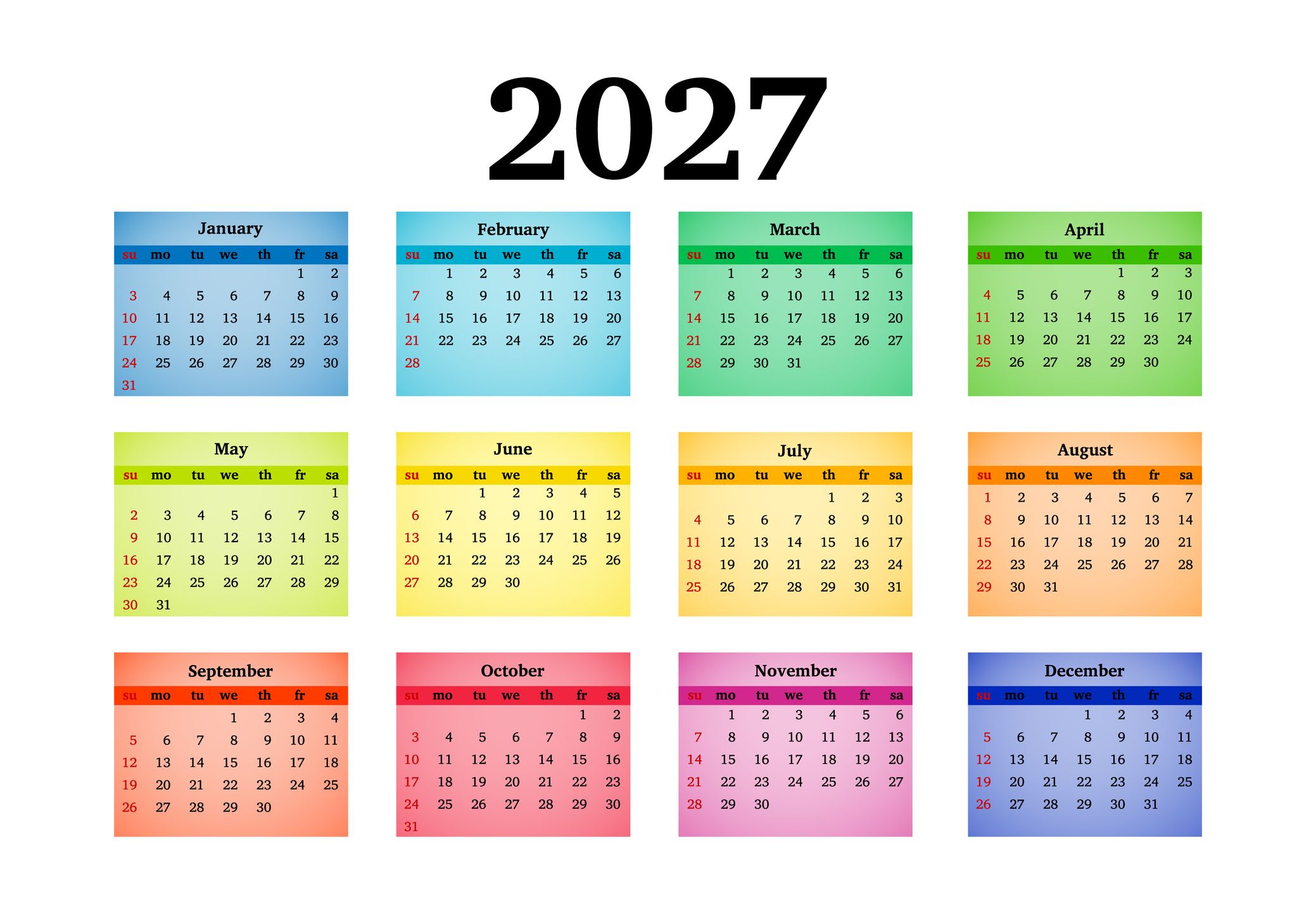
Updated October 17, 2026. SSI has two scheduled deposit dates in April, July and December 2027, while January, May and August have no new regularly scheduled SSI deposit. Those gaps are calendar shifts, not missing months of benefits. January 2027 SSI arrives on December 31, 2026; the later payment in each two-date month belongs to the following benefit month.
This guide focuses on allocating SSI to the month it covers. For retirement, SSDI and birthday-group dates together, use the complete 2027 Social Security calendar. SocialSecurityPayment.net is independent of SSA and cannot see or track a personal benefit deposit.
Match each 2027 SSI benefit month to its deposit date
SSI is normally scheduled for the first day of the benefit month. When that day falls on a weekend or federal holiday, payment moves to the preceding business day. SSA's official 2027 payment calendar uses this rule. Your birthday does not assign SSI to a second, third or fourth Wednesday.
| SSI benefit month | Scheduled payment date | Budget treatment |
|---|---|---|
| January 2027 | Thursday, December 31, 2026 | Reserve for January expenses |
| February 2027 | Monday, February 1, 2027 | Regular first-of-month date |
| March 2027 | Monday, March 1, 2027 | Regular first-of-month date |
| April 2027 | Thursday, April 1, 2027 | April's benefit |
| May 2027 | Friday, April 30, 2027 | Reserve for May expenses |
| June 2027 | Tuesday, June 1, 2027 | Regular first-of-month date |
| July 2027 | Thursday, July 1, 2027 | July's benefit |
| August 2027 | Friday, July 30, 2027 | Reserve for August expenses |
| September 2027 | Wednesday, September 1, 2027 | Regular first-of-month date |
| October 2027 | Friday, October 1, 2027 | Regular first-of-month date |
| November 2027 | Monday, November 1, 2027 | Regular first-of-month date |
| December 2027 | Wednesday, December 1, 2027 | December's benefit |
This table follows benefit months, so it begins with a date in the previous calendar year. A bank statement follows transaction dates instead. Both records can be correct while placing the same payment in different months. Writing the benefit month beside the transaction resolves that apparent mismatch.
The recurring calendar also assumes SSI remains payable. It does not establish eligibility or promise the date of an initial award, a past-due installment, a replacement payment or a correction. Those events require the individual's SSA notice. A new applicant should not treat the next first-of-month date as an approval deadline.
The January 2027 and January 2028 year-end shifts
January 1, 2027 is a Friday and New Year's Day, so January SSI is scheduled for Thursday, December 31, 2026. It is the first 2027 benefit-month payment even though the bank records it in 2026. There is no second regular January SSI deposit later in January.
The following year has a different adjustment. January 1, 2028 falls on Saturday, and the federal holiday is observed on Friday, December 31, 2027. January 2028 SSI is consequently scheduled for Thursday, December 30, 2027. The observed holiday is documented in OPM's holiday schedule; SSA's 2027 calendar marks the December 30 SSI date.
December 2027 therefore has two scheduled SSI payments: December 1 for December and December 30 for January 2028. The second date is outside the twelve 2027 benefit months listed above. Adding it as a thirteenth 2027 entitlement would count the January 2028 benefit in the wrong year.
When saving a calendar or setting a reminder, include the year on both the benefit month and deposit date. “January check in December” is too vague to distinguish these two shifts, especially when older schedules remain online.
Plan for two deposits without spending next month's SSI
A two-deposit month can make available cash look temporarily larger. The following month can then appear to have no income, even though its SSI was already paid. The reliable way to plan is to assign each deposit to the benefit month it covers before deciding how much is available for current spending.
April and July have two dates; May and August have none
April 2027 SSI is paid April 1. May's SSI is paid April 30 because May 1 is Saturday. A recipient therefore sees two scheduled SSI deposits during April but should not expect another regular SSI deposit during May. The next recurring date is June 1, assuming continued eligibility.
The summer pattern is similar. July's SSI arrives July 1, and August's SSI arrives July 30 because August 1 is Sunday. The next regular SSI date after July 30 is September 1. Spending the July 30 payment as extra July money would leave August expenses without the funds intended for them.
The shift itself is not a benefit cut or an overpayment. SSA's early-payment policy treats the payment according to the month it is due. However, that does not prove every unexpected deposit is correct. An unrelated duplicate or erroneous payment still needs an explanation from SSA.
Keep a benefit-month ledger alongside your bank balance
A simple record needs four columns: the date the deposit posts, the SSI benefit month, the actual amount received and the expenses assigned to that month. The bank date documents cash movement; the benefit-month column documents purpose. You can keep the record on paper without sharing any personal identifiers online.
For example, label an April 30, 2027 deposit “May SSI.” Then list May rent, utilities, food and other planned expenses against that amount. The example does not assume a particular benefit size. Use the amount on your own notice and account, since a federal maximum is not necessarily your payment.
If recurring bills debit the account automatically, check their scheduled withdrawal dates against the ledger. An early deposit does not require moving every bill earlier. What matters is that the money remains allocated to the expenses it must cover and that the account has available funds when an authorized debit occurs.
SSI resource rules also require care. SSA's checking and savings account policy recognizes payments made early because of a weekend or holiday and treats them according to the normal receipt month. Keep the deposit record and benefit notice if a month-end balance appears unusual. Do not assume that money left in an account is permanently excluded merely because the original payment arrived early.
A representative payee can use the same month labels when maintaining the beneficiary's spending records. The early date does not change whose money it is or turn January funds into discretionary December money. If the person has an account-specific resource or reporting question, SSA should evaluate the facts; a calendar alone cannot resolve that calculation.

If you also receive Social Security or SSDI
SSI and Social Security are separate programs even when SSA administers both payments. SSI is based on financial need and other eligibility conditions. Social Security retirement and SSDI depend on an insured earnings record and their respective rules. Receiving both does not place both payments on the SSI calendar.
The usual concurrent-benefit pattern is SSI on the first and Social Security on the third, adjusted for weekends and federal holidays. SSA's monthly-payment regulation explains the third-of-month exceptions. It also covers certain older benefit records and other circumstances, so your notice is more reliable than assuming every SSDI recipient uses a Wednesday.
Consider May 2027. May SSI is scheduled for April 30, while a Social Security payment assigned to the third is scheduled for Monday, May 3. A person receiving both may therefore have no new SSI deposit during May but still receive Social Security in May. Saying “no Social Security payment in May” would incorrectly combine two programs.
April provides another useful example. SSI is scheduled April 1, and the third-of-month Social Security date shifts to April 2 because April 3 is Saturday. April 30 then brings May's SSI. Three transactions may appear during April for someone receiving both programs, but their notices identify different programs and benefit periods. Transaction count alone is a poor measure of monthly entitlement.
Sometimes the dates coincide. January 2027's first and third are affected by New Year's Day and the weekend, moving the relevant scheduled payments to December 31, 2026. In October 2027, the first is Friday and the third is Sunday, so the applicable third-of-month Social Security payment also moves to October 1. Two benefits on the same date do not become one benefit program.
The month labels can differ as well. SSI generally pays for the current benefit month, while Social Security ordinarily pays the previous month's benefit. A bank transaction dated at the end of December may therefore require both a program label and a benefit-month label to understand it correctly. Read the notice rather than assigning every December transaction to December expenses.
Amounts interact through separate rules. SSA explains that countable income can reduce SSI, and Social Security is generally a type of unearned income for SSI purposes. Receiving both does not mean adding a full federal SSI maximum to a full Social Security amount without adjustment. A COLA can also change both sides of that calculation.
For a combined household budget, record each program separately, then total the actual amounts supported by the notices. Use the full 2027 calendar to check the Social Security date assigned to you. If one deposit arrives and the other does not, investigate the missing program specifically instead of treating the first payment as proof that both were issued.
What the 2027 COLA changes about the amount
The 2027 cost-of-living adjustment is confirmed at 3.6%. It changes the federal SSI payment standards, while the calendar determines when a payable monthly amount is issued. Those two pieces of information should be checked separately: the correct date does not prove the amount, and the correct amount does not identify the benefit month.
SSA's 2027 federal SSI table lists a maximum of $1,029 for an eligible individual and $1,544 for an eligible individual with an eligible spouse. These are monthly federal standards for 2027. They replace the 2026 standards of $994 and $1,491 respectively.
The new January 2027 amount is scheduled for December 31, 2026 because the benefit month controls the rate. It is not a late-December bonus on top of January SSI. A person reviewing December transactions may see an earlier December benefit at the 2026 rate and the January payment reflecting the new year's calculation.
Do not calculate the official standard by multiplying a rounded monthly amount and keeping cents. SSA increases the unrounded annual standard, divides by twelve and rounds the monthly result down to a whole dollar. Its published table supplies the official figure. A calculator result such as $1,029.78 is not the federal monthly standard.
The federal maximum is not everyone's payment
Countable income, living arrangements, certain family income and other circumstances can change the payable amount. Some states also provide a supplement. SSA's payment explanation describes these factors; the recipient's own notice determines how they apply in a particular case.
The eligible-couple standard is especially easy to misread. The $1,544 federal figure is not an amount promised separately to each spouse. It concerns an eligible individual with an eligible spouse, and the payable amount is subject to the couple's calculation. A household should not double it merely because two people receive SSI.
For recipients also receiving Social Security, a higher Social Security benefit may affect countable income in the SSI calculation. Applying 3.6% to both existing deposits independently can therefore produce the wrong combined estimate. Check both notices rather than using a shortcut that ignores the relationship between the programs.
Use the official notice to update the amount column in your benefit-month ledger. If the amount differs from your expectation, compare the income and living-arrangement information used by SSA and ask about the specific difference. The early deposit date itself does not explain a reduction.
Finally, the December 30, 2027 payment belongs to January 2028. Its date can be known before the 2028 federal payment standard is announced. As of this October 2026 guide, do not assume that January 2028's amount will equal the 2027 standard or insert an invented future COLA. Update that entry when SSA publishes the relevant year and personal notice.
When an early or missing deposit needs a follow-up
First decide whether the expected transaction is actually due. A missing May 1 SSI deposit is not automatically a problem when May's benefit was scheduled for April 30. By contrast, a payment that SSA says is due and issued but never reaches the account needs a payment inquiry. The benefit-month ledger helps distinguish those situations quickly.
Bank early access is different from SSA's scheduled date
Some financial institutions make funds available before the official date. That is separate from SSA moving a payment because of a weekend or holiday. A bank's early-access practice should not be copied into a national SSA calendar or treated as a guaranteed date for every customer using the same service.
For example, seeing money before April 30 would not change the fact that the scheduled payment covers May SSI. Conversely, not seeing a deposit on a date advertised by an unofficial banking calendar does not establish that SSA is late if its official date has not arrived.
Check whether an account entry is pending, posted or actually available for withdrawal. A notification may precede usable funds, and an institution may display abbreviated descriptions. Ask the institution about its own posting and availability rules rather than assuming that an alert guarantees the balance can fund an automatic payment.
Use the right contact for a payment or an application
If an electronic payment is absent on the scheduled pay date, SSA directs recipients to contact their bank or financial institution first. If the payment remains missing, contact SSA at 1-800-772-1213, TTY 1-800-325-0778, or the appropriate local office. A bank can explain posting; SSA must explain whether a benefit was issued or remains payable.
The printed calendar mentions additional mailing days. Do not use that wording to override SSA's specific instructions for an electronic payment. Identify your delivery method and follow the applicable guidance. Our missing-payment checklist can help organize the dates and questions before contacting the agency.
For an application still awaiting a decision, use SSA's application or appeal status service. A pending claim is not an overdue recurring deposit merely because the first of the month passed. The agency must establish eligibility and issue an award before the public recurring calendar can be applied to that person's payments.
Prepare a private record of the program, benefit month, scheduled date, expected amount from the notice and what the financial institution reported. Include any recent address, bank or eligibility changes when discussing the matter through official channels. Do not post the notice, SSN, account number, claim identifier or login credentials on this website.
If an unexplained deposit appears, keep it identifiable and ask what it covers before spending it. The calendar can explain a predictable early monthly payment, but it cannot classify every correction, state supplement or duplicate transaction. The goal is a clear match between the official benefit record and the bank entry, so the next month's money remains available when its expenses arrive.
Loading comments...