
Updated August 12, 2026. SSI and SSDI are different programs administered by the Social Security Administration. Disability-based claims use the same adult medical definition, but the financial and work-history tests, payment calculations, and health-coverage paths are not the same.
SSI vs SSDI at a glance
| Question | SSI | SSDI |
|---|---|---|
| Full name | Supplemental Security Income | Social Security Disability Insurance |
| Main nonmedical test | Limited income and resources plus program status rules | Sufficient recent/total covered work for insured status |
| Who can qualify | Eligible people who are disabled, blind, or age 65+ | Insured workers who meet SSA’s disability standard |
| Payment basis | Federal benefit rate minus countable income, with possible state supplement | Worker’s covered earnings record |
| Asset/resource test | Yes, with exclusions | No needs-based resource limit for SSDI entitlement |
| Health coverage | Medicaid connection varies by state | Medicare generally after the applicable 24-month entitlement period |
| Can both be paid? | Yes, in some concurrent cases when all rules for both programs are met | |
SSI is not “Social Security insurance.” It is funded from general revenues and is designed for people with limited income and resources. SSDI is insurance earned through covered work and payroll taxes. An applicant’s diagnosis does not choose the program; nonmedical facts determine which program or programs are available after the medical standard is considered.
The most reliable application strategy is not to self-deny based on a single chart. Ask SSA to screen for both programs when disability and work history are relevant. The site’s SSDI work-credit and recent-work guide explains insured status in more depth.
Eligibility: the same adult disability standard, different nonmedical tests
For adults applying on the basis of disability, SSA uses the same core medical definition for SSI and SSDI: a medically determinable condition must prevent substantial gainful activity and be expected to last at least 12 months or result in death. Neither program pays partial or short-term disability benefits under that federal definition.
The programs separate at the nonmedical stage.
SSDI insured status
SSDI generally requires enough Social Security work credits and enough recent covered work for the worker’s age when disability began. Credits reflect covered earnings, not the amount currently saved in a bank account. Younger workers may qualify with fewer credits than older workers, while some applicants lose disability insured status after being out of covered work for an extended period.
A person can meet the medical definition but be denied SSDI because insured status expired before the established onset date. Conversely, having many work credits does not prove medical disability.
SSI category and financial status
SSI does not require work credits. A qualifying applicant must be age 65 or older, blind, or disabled and also satisfy income, resource, residence, citizenship or qualifying noncitizen, and other program rules. An adult age 65+ can qualify on age without establishing disability. A child disability claim uses a child-specific functional standard rather than the adult work standard.
SSI may therefore provide a route for a disabled adult who never worked, worked too little for SSDI, or whose insured status expired—if all SSI requirements are met. It can also cover some periods in a concurrent claim while SSDI’s separate waiting-period and entitlement rules are applied.
SSI vs SSDI income limits and asset rules
There is no single shared “SSI/SSDI income limit.” SSI is means-tested. SSDI is not, but disability work rules can affect initial eligibility and continued payments. Combining those ideas into one dollar ceiling produces bad advice.
SSI income and resources
SSI considers countable earned and unearned income. Earned income can reduce a payment after exclusions are applied; unearned income such as another benefit can also reduce SSI under a different calculation. Income may be deemed from an ineligible spouse or, for a child, from parents. Because exclusions and household facts matter, gross monthly income alone does not always answer eligibility.
The federal countable-resource limit is $2,000 for an individual and $3,000 for a couple. That does not mean every asset counts. The home a person lives in, one vehicle used for transportation, certain burial arrangements, and qualifying ABLE or PASS funds are examples that may receive exclusions under applicable rules. Report resources and let SSA determine whether an exclusion applies.
SSDI income and assets
SSDI does not deny entitlement because a worker owns a home, has retirement savings, or has a spouse with wages. Unearned income generally is not an SSDI needs test. However, work activity is central: earnings and services can affect whether SSA finds disability at application and whether benefits continue after approval. Workers’ compensation and certain public disability benefits can also affect the SSDI payment under separate offset rules.
The practical distinction is this: SSI asks both “Do you meet the category/medical rule?” and “Do your countable finances fit?” SSDI asks both “Do you meet the medical rule?” and “Were you insured through covered work?” Work after approval then invokes different incentive and payment provisions for each program.
SSI vs SSDI work rules after approval
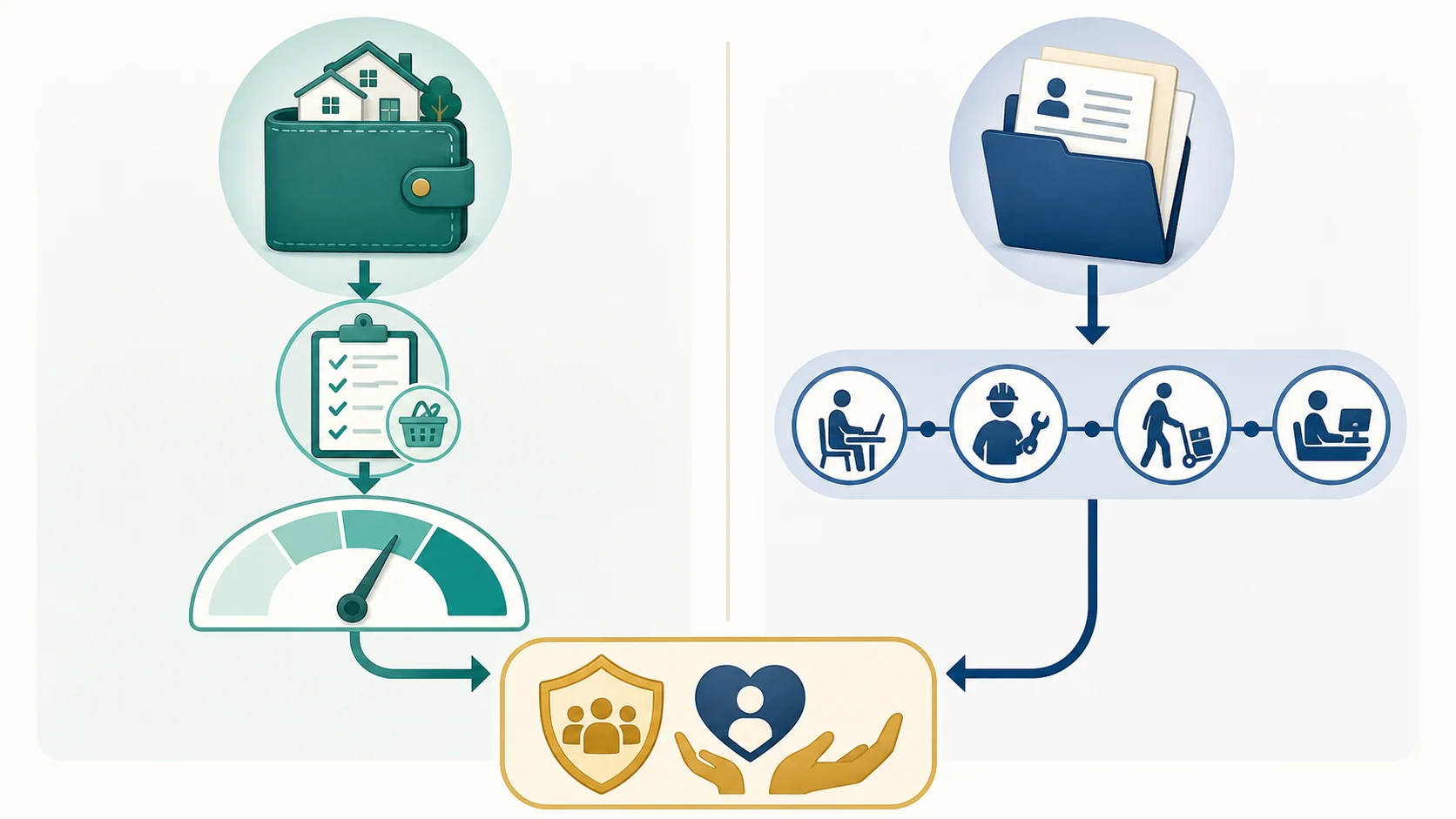
How work affects SSI
SSI does not give recipients the SSDI nine-month trial work period. Instead, SSA calculates countable earned income after applicable exclusions and adjusts the SSI payment. Because only part of wages may count after exclusions, a recipient’s combined wages and SSI can rise even while the SSI cash amount falls.
SSI has additional supports, including impairment-related work expenses, blind work expenses, plans to achieve self-support, and a student earned-income exclusion for qualifying students. Under Section 1619(b), some working recipients whose cash SSI reaches zero because of earnings may keep Medicaid if they meet the conditions, including state-specific threshold and continuing-need rules.
How work affects SSDI
SSDI uses staged work incentives. In 2026, a month with more than $1,210 in earnings generally counts as a trial work month; self-employment services can also count under separate tests. During the trial work period, an eligible beneficiary can test work while receiving SSDI for up to nine service months within the rolling period, provided disability continues.
After the trial work period, substantial gainful activity becomes central during the extended period of eligibility. The 2026 monthly SGA amounts are $1,690 for non-blind individuals and $2,830 for statutorily blind individuals. These are not SSI payment-income limits, and gross earnings alone may not settle a case because subsidies, impairment-related expenses, unsuccessful work attempts, and self-employment rules can matter.
Report work promptly under the program’s instructions and keep pay stubs. Before changing hours based on a general chart, request individualized benefits counseling through an authorized source.
Payment amounts, back pay, and payment dates
Monthly amount
SSI begins with the federal benefit rate and subtracts countable income. For 2026, the federal maximum is $994 for an eligible individual and $1,491 for an eligible couple, before reductions and possible state supplementation. These are not average or guaranteed payments.
SSDI is calculated from the disabled worker’s covered earnings record. It is not automatically equal to the SSI maximum, and a high past salary does not mean SSA replaces that salary. The official disability estimate in a personal Social Security Statement or SSA notice is the relevant starting point.
Past-due benefits
SSI generally cannot pay earlier than the month after the filing date or the month after all eligibility requirements are met, whichever is later. Large past-due SSI may be divided into installments.
SSDI applies a five-full-month waiting period for most disability insurance claims and can allow retroactive entitlement before the application date within statutory limits when onset and other requirements support it. SSDI past-due benefits are generally paid as a lump sum, although offsets, representative fees, or concurrent SSI calculations can affect the result. Do not estimate SSI back pay using the SSDI onset/waiting-period formula.
Regular payment dates
SSI is generally scheduled for the first of the month and moves to the prior business day when the first falls on a weekend or federal holiday. SSDI follows Social Security payment rules: many beneficiaries are paid on the second, third, or fourth Wednesday by birthday, while pre-May 1997 and combined-benefit situations can follow the third-of-month framework.
Use the site’s 2026 SSI payment schedule for the annual SSI calendar. A date calendar cannot determine entitlement or the amount of either benefit.
Medicaid, Medicare, and receiving SSI and SSDI together
Health coverage is a major practical difference. SSDI beneficiaries generally become entitled to Medicare after 24 months of disability-benefit entitlement, with special timing rules for certain conditions. The clock is an entitlement rule, not simply 24 months after the approval letter.
SSI is commonly connected with Medicaid, but administration varies. In many states, an SSI award establishes or supports Medicaid eligibility automatically; some states require a separate Medicaid application or apply their own eligibility procedures. Confirm coverage with the state Medicaid agency rather than assuming the cash-award date and health-coverage date are identical.
Concurrent SSI and SSDI benefits
A person can qualify for both programs at the same time. This often occurs when the SSDI benefit based on a limited earnings record is low enough that the person still meets SSI’s financial rules. SSA calls these concurrent benefits.
Concurrent does not usually mean receiving a full SSDI check plus the full federal SSI maximum. SSDI is generally counted as unearned income for SSI, after the applicable general exclusion. SSI may supplement the Social Security payment up to the amount determined under SSI rules, potentially including a state supplement. Other income and household facts can change the result.
Retroactive concurrent awards can also trigger windfall offset. SSA recalculates overlapping months so the combined past-due amount reflects what would have been paid if Social Security benefits had arrived on time. That can make the final back-pay notices more complicated than adding two gross totals.
A concurrent recipient may have Medicaid while waiting for Medicare and may later have both forms of health coverage, subject to state and federal rules. “Dual eligible” health coverage and “concurrent SSI/SSDI” cash benefits describe related but not identical concepts.
Which program should you apply for?
Start with SSA’s guided application rather than choosing from the acronym alone. For a disability claim, prepare these facts:
- the date the condition began limiting work;
- recent and lifetime covered-work history;
- current wages and self-employment activity;
- income from benefits, support, or other sources;
- bank accounts and other resources relevant to SSI;
- marital and household information; and
- medical providers, treatment, tests, medications, and functional limitations.
Ask SSA to screen for both SSI and SSDI when appropriate. Some adults can submit both through an online disability path, while others need an appointment to complete SSI. The site’s online disability application guide explains the adult medical-application route and evidence checklist.
SSI vs SSDI FAQs
Which program pays more?
Neither always pays more. SSI uses a federal maximum reduced by countable income, with possible state supplementation. SSDI depends on the worker’s covered earnings. Only SSA records can provide a personal comparison.
Does SSDI have a $2,000 asset limit?
No. The $2,000 federal countable-resource limit is an SSI rule for an individual. SSDI entitlement is not needs-tested, although work and certain benefit offsets can affect SSDI.
Can someone age 65 receive SSI without SSDI?
Yes. A person age 65+ may qualify for aged SSI without disability or SSDI insured status if all SSI requirements are met. SSA also checks whether other benefits must be pursued.
Can I work while receiving either benefit?
Potentially, but the rules differ. SSI adjusts for countable earnings and has work incentives; SSDI uses trial-work and subsequent SGA-related rules. Report work and get individualized benefits counseling before relying on a threshold.
Official comparison sources
- SSA Red Book: overview of disability programs
- SSA Red Book: 2026 amounts
- SSA FAQ: Social Security benefits and SSI
- SSA Apply for Benefits
Independent-site disclaimer: SocialSecurityPayment.net is not affiliated with SSA. This comparison is general education, not an eligibility decision, benefits calculation, legal opinion, or work-planning recommendation. Confirm personal work credits, income/resource treatment, payment, and health coverage with SSA and the relevant state agency.
Loading comments...