
Updated August 26, 2026. SSI direct deposits should be available on the official payment date, but there is no single guaranteed clock time when every recipient will see the money. Some financial institutions update balances overnight; others complete posting when their business day opens or during a later processing cycle. The reliable rule is about the date, not “12:01 a.m.” or another universal hour.
The Social Security Administration sets the SSI payment date and sends the electronic payment through the federal payment system. Your bank, credit union, or Direct Express card provider controls how and when that transaction appears in its app, phone system, available balance, or pending-transaction list. That is why two people with the same SSI payment date can see their deposits at different times.
This guide explains what SSA’s official language means, how to confirm that you are checking the right date, why optional early-deposit services are different from an official early SSI payment, and what to do if the money is not available when expected. It provides general information only and cannot view your SSA record or bank account. Never send a third-party website your Social Security number, bank account number, Direct Express PIN, or SSA login credentials.
What Time Does SSI Direct Deposit Hit?
The most accurate answer is: your SSI payment should be available when your financial institution opens for business on the official payment date, but SSA does not guarantee a universal clock time. SSA’s direct-deposit guidance uses an opening-of-business standard. It does not say that every SSI deposit must appear at midnight, at 12:01 a.m., or according to Eastern Time.
Many banks process incoming ACH deposits overnight, so some recipients see their available balance change before they wake up. That experience is real for those accounts, but it is not a rule that can be applied to every bank or every month. Another institution may update the available balance near the start of its business day. Its app may show nothing pending and then show a fully posted deposit after an internal batch finishes.
- Safe expectation: availability on the official SSI payment date under the federal payment process.
- Not a safe promise: a particular minute, an overnight time window, or the same time in every U.S. time zone.
- Best account-specific source: your bank, credit union, or card provider’s transaction record and customer service.
- Best date source: SSA’s calendar and your personal SSA notice or account information.
Also distinguish “posted” from “available.” A transaction can appear in an app as pending before the money can be spent, or an institution can make the funds available without showing a long pending stage. The label and refresh time are features of the receiving institution, not a second SSI schedule.
If the official date has not arrived, an absent deposit is not late just because another customer using an early-pay account received money sooner. If the official date has arrived, check the correct account and available balance, refresh after the institution begins its business day, and contact the financial institution if the payment still does not appear. Later in this guide, the missing-payment section explains when to involve SSA.
What SSA Controls—and What Your Bank Controls
An SSI direct deposit crosses several systems. SSA creates the payment information and establishes the payment date under program rules. The Department of the Treasury transmits the payment through its payment operation to a Federal Reserve Bank. The Federal Reserve system sends the electronic funds transfer through the Automated Clearing House network to the receiving financial institution. The bank, credit union, or card provider then posts the payment to the designated account.
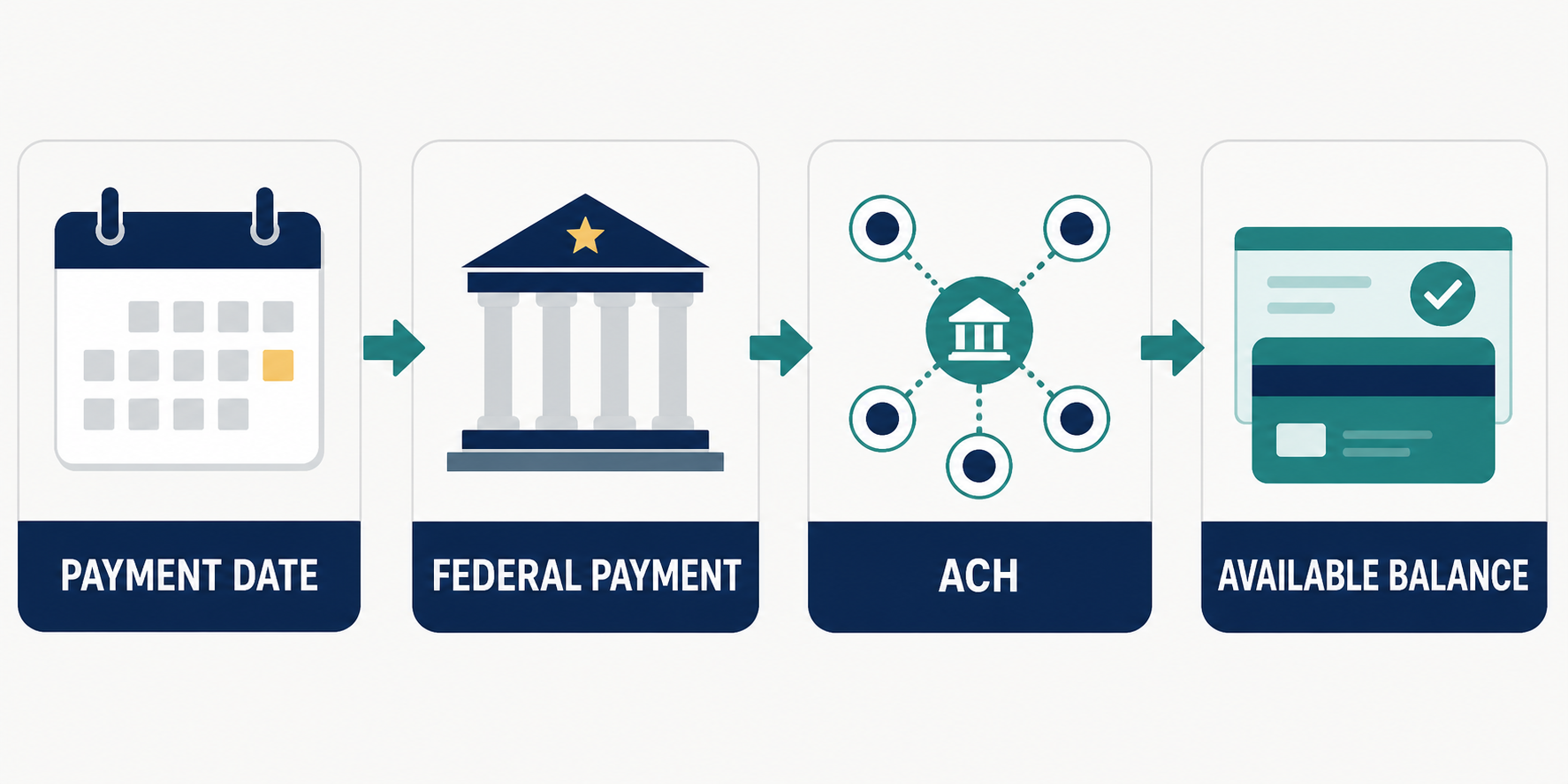
That chain explains the division of responsibility. SSA can confirm whether a payment was due or issued. It cannot control when a particular banking app refreshes, whether an institution displays an incoming ACH credit as pending, or when that institution sends a deposit alert. Your financial institution can explain its posting process and whether it sees a pending, rejected, or returned payment, but it cannot change your SSI eligibility or official benefit amount.
| Question | Best source | Why |
|---|---|---|
| What is my official payment date? | SSA calendar, notice, or account | SSA applies the SSI schedule and account-specific benefit rules. |
| What time does this institution post federal ACH deposits? | Bank, credit union, or card provider | The receiving institution controls its posting and balance-display process. |
| Was the deposit rejected or returned? | Financial institution first, then SSA if needed | The institution can check its own records; SSA can address payment issuance after that check. |
| Why did my benefit amount or eligibility change? | SSA notice or SSA representative | A bank cannot explain an SSI program decision. |
When asking the bank for help, use a narrow question: “Do you see a federal benefit ACH deposit for my account’s official payment date, and is it pending, rejected, or returned?” Use the bank’s authenticated app, the telephone number printed on your card, or an official branch. Do not post transaction screenshots or identifying numbers in social-media groups. If the bank does not see the payment and the due date has arrived, follow the SSA escalation steps described below.
First Confirm the Correct SSI Payment Date
Before watching the clock, verify the date. Regular SSI payments are generally due on the first day of the month for which they are paid. When the first is a Saturday, Sunday, or federal holiday, SSA moves the payment date to the preceding business day. That adjustment can put a payment in the prior calendar month.
For example, November 2026 SSI is scheduled for Friday, October 30, 2026, because November 1 is a Sunday. The October 30 deposit belongs to November; it is not a bonus and it does not create a second November payment. Likewise, the SSI benefit for January 2027 is scheduled for Thursday, December 31, 2026, because January 1 is a federal holiday.
| Benefit month | Official payment date | Timing note |
|---|---|---|
| September 2026 | September 1, 2026 | Regular first-of-month date |
| October 2026 | October 1, 2026 | Regular first-of-month date |
| November 2026 | October 30, 2026 | November 1 is a Sunday |
| December 2026 | December 1, 2026 | Regular first-of-month date |
| January 2027 | December 31, 2026 | January 1 is a federal holiday |
The table is a focused checkpoint for the period after this article’s update date. Use the complete 2026 SSI payment schedule for all benefit months and explanations of two-deposit calendar months. Always use your SSA notice or account information for a personal payment.
Do not substitute the Social Security birthday schedule for SSI. Retirement, survivor, and SSDI payments often use the second, third, or fourth Wednesday, while SSI generally uses the first. People receiving both SSI and Social Security commonly receive SSI on the first and Social Security on the third, with weekend and holiday adjustments. The full 2026 Social Security payment schedule explains those separate groups.
Finally, separate an official early date from bank marketing. If SSA’s calendar moves a Sunday payment to Friday, Friday is the official payment date. If a bank voluntarily releases a future-dated deposit before SSA’s listed date, that is the institution’s early-access feature. Another customer’s early release does not mean your payment is overdue.
Why SSI Posting Times Differ Between Accounts
The ACH payment can carry the same official settlement date to many institutions, yet the customer experience can look different. Each receiving institution operates account ledgers, available-balance calculations, mobile apps, alerts, and customer-service systems. Those systems do not necessarily update in one visible step.
Posting and availability are related, but not identical
A bank may receive payment information before the settlement date and wait to make it spendable on that date. Another may offer early access by advancing funds under its own policy. An app might show a pending transaction before availability, while another institution may skip a visible pending stage. A delayed push notification also does not prove that the available balance is delayed; check the authenticated account balance itself.
Institution policies can change
A deposit time observed last month is not a contractual SSI schedule. Processing maintenance, a new account platform, an institution holiday calendar, or a changed early-pay policy can alter what the customer sees. Even when friends use the same brand, their account products or status may differ. Treat crowd-sourced “deposit hit” reports as anecdotes, not confirmation that SSA owes your account at the same minute.
Local clock comparisons can mislead
Online discussions often compare Eastern, Central, Mountain, or Pacific times without identifying the financial institution’s processing standard. SSA’s useful promise is tied to the payment date and opening of business at the receiving institution, not a social-media countdown in one time zone. Ask your institution whether its stated posting policy uses local time and whether “posted” means available for withdrawal.
Industry ACH rules also evolve. A broader Nacha funds-availability rule is scheduled to change on September 18, 2026, after this article’s update date. That future network rule should not be confused with an SSA announcement of a new SSI deposit hour. It is another reason a static bank-by-bank timetable would be misleading.
For planning, use the official date as the dependable boundary and avoid scheduling an essential automatic debit for a rumored midnight arrival. If a bill must be paid that morning, ask the biller about grace periods and ask your financial institution how available balances work. This reduces the risk of an overdraft or declined transaction caused by relying on a non-guaranteed early posting.
Bank, Credit Union, Direct Express, and Early-Pay Differences
The official SSI date applies whether the benefit goes to a checking account, savings account, eligible credit-union account, or Direct Express card. What differs is the receiving channel’s account interface and any optional policy for making an incoming payment available before settlement.
| Receiving method | What you can safely expect | Where to ask about exact display time |
|---|---|---|
| Bank account | Funds available under the official payment-date process; an optional early-pay feature may release them sooner | The bank’s official support channel and deposit policy |
| Credit-union account | The same federal payment date; posting labels and notification timing can differ by institution | The credit union’s official support channel |
| Direct Express | Official sources say benefits are loaded and available on the payment date; no universal hour is published | The number on the back of the current card or the official Direct Express app/site |
| Account advertising early access | Possible release before the settlement date under the provider’s terms, not a new SSA payment date | The provider’s current early-deposit terms |
Direct Express uses the payment date, not a public midnight promise
Treasury and SSA describe Direct Express benefits as automatically deposited or available on the payment day. The official materials reviewed for this guide do not guarantee midnight or a fixed morning hour. Cardholders can enable deposit alerts where offered, but an alert is a notification—not the legal definition of the payment date. Check the card balance through the official app, website, or telephone service.
Direct Express is also in a financial-agent transition during 2026. New cards and existing cards may have different issuers or support paths. Follow the notice sent for your card, keep your contact information current, and use the telephone number printed on the back of that card. Do not replace a working card or change payment instructions based on an unsolicited call, text, or social-media message.
“Early” is conditional
An institution may advertise that qualifying direct deposits can arrive “up to” a certain number of days early. “Up to” means the release depends on when the institution receives usable payment information and on its policy; it is not a monthly guarantee. SSA has not changed your payment date merely because the institution lets you spend funds sooner.
If early access is important, compare the provider’s official terms, fees, account protections, and support—not crowd-sourced calendars alone. The separate guide to official SSI dates versus early bank deposits explains this distinction in more detail.
What to Do If SSI Is Not There on the Payment Date
A missing balance at midnight does not prove that a payment is late. Once the official payment date arrives, use a short, documented sequence. SSA’s electronic-payment guidance puts the financial institution first because it may be experiencing a posting delay.
- Confirm the date and benefit type. Check the official SSI schedule, including any prior-business-day adjustment. Make sure you are looking for SSI rather than a separate Social Security or SSDI payment.
- Check the correct available balance. Use the authenticated bank or Direct Express app, official website, ATM, or automated telephone service. A push notification or pending list alone may not show the current spendable balance.
- Contact the receiving institution. Use a phone number from the back of your card, a statement, or the institution’s official website. Ask whether it sees a federal benefit ACH credit and whether the item is pending, rejected, returned, or posted to another account status.
- Review recent account changes. If you changed institutions, confirm which account was supposed to receive this payment. Do not close the old account until an authorized change is effective and a payment reaches the new account.
- Contact SSA if the institution cannot resolve it. SSA’s missing-payment FAQ lists 1-800-772-1213 and the local-office option. Verify contact details at SSA.gov before calling. SSA can review whether the payment was due and issued.
Do not assume that SSA stopped SSI solely because a banking app has not refreshed. A posting delay is one possibility; a returned deposit, changed financial information, suspension, eligibility review, or payment adjustment is another. Only the institution and SSA can identify which explanation applies to an individual account.
SSA’s printed calendar includes a general note about allowing three additional mailing days before contacting Social Security. For an electronic payment, however, SSA’s specific FAQ says to contact the bank or financial institution first on the scheduled pay date and then report the unresolved late or missing payment to SSA. Following the electronic-payment sequence avoids waiting to ask the institution about a same-day posting problem.
Keep a simple record of the official date, when you checked the account, the institution’s response, and when you contacted SSA. Do not record a PIN or password in those notes. If a caller says a missing deposit can be released only after you buy gift cards, transfer money, reveal a verification code, or pay a fee, stop: that is not a legitimate way to release an SSI payment.
For a fuller decision tree, use the site’s Social Security and SSI missing-payment checklist. It covers date verification, bank and Direct Express checks, SSA notices, and safe escalation paths.
Special Cases That Can Change What You See
The opening-of-business guidance describes a normal domestic electronic payment. Some situations require a different question than “What hour will it hit?” If one of the cases below applies, use the relevant SSA notice and an authenticated account record.
You recently changed the deposit account
SSA advises SSI recipients not to close the old account until they have confirmed a payment in the new account. A change may not affect the same payment cycle in which it was requested. Check the effective information through official SSA channels and both institutions as appropriate. The guide to changing SSI direct deposit explains the approved options and safety checks.
A representative payee receives the payment
When SSA appoints a representative payee, the payment remains for the recipient, but it goes to an appropriately titled account managed by the approved payee. The recipient may not have direct access to that account’s app or alerts. In that case, the payee should verify the deposit and keep records under SSA’s representative-payee rules. A generic bank-posting estimate cannot substitute for that verification.
You receive SSI and Social Security
The programs can generate separate payments. SSI generally uses the first-of-month rule, while Social Security for a person receiving both programs is commonly paid on the third, adjusted when required. Seeing the SSI deposit does not mean the Social Security payment should be in the same transaction, and the reverse is also true.
The payment is an underpayment or one-time payment
SSA’s electronic-payment procedures include recurring monthly SSI, underpayments, automated or manual one-time payments, and certain other payment types. A payment issued outside the regular monthly cycle may have an account-specific issue and settlement date. Use the SSA notice or direct confirmation instead of applying the first-of-month timetable automatically.
The institution returned or rejected the deposit
An incorrect or closed account can prevent normal posting. The institution may be able to confirm a return or rejection, while SSA can explain the next payment action. Do not ask a stranger to “reroute” the benefit, and do not use banking instructions from an unsolicited message. Only update financial information through SSA and the authorized institution.
These cases are reasons to gather accurate information, not reasons to assume the benefit is permanently lost. Keep official notices, protect credentials, and note the dates of contacts so SSA and the institution can follow the same timeline.
SSI Direct Deposit Time FAQs
Does SSI direct deposit hit at midnight?
It can appear around midnight at some institutions, but SSA does not guarantee midnight or 12:01 a.m. for every account. The official guidance is that funds should be available at opening of business on the payment date. Your institution controls its exact posting and balance-display process.
What happens when the first of the month is a weekend?
SSA moves the SSI payment to the preceding business day when the first is a Saturday, Sunday, or federal holiday. That earlier business day becomes the official payment date. Check the annual SSI calendar because the deposit may fall in the prior calendar month.
Why does my bank show the SSI deposit as pending?
“Pending” is an institution-specific status. It may mean the bank has payment information but has not made the credit part of the available balance. Ask the institution what the label means for that account and when pending federal ACH credits become available. SSA cannot control the label in a banking app.
Can SSI arrive before the official date?
A financial institution with an early-deposit feature may make funds available before the settlement date under its own terms. That is optional and conditional. Do not treat another customer’s early release, or an unofficial social-media calendar, as your due date.
Does my time zone determine when SSI appears?
SSA does not publish a universal time-zone countdown for SSI. The relevant official standard refers to the payment date and the receiving financial institution. Ask that institution whether any quoted availability time is local to the account, the processing center, or another time zone.
What time does SSI load onto Direct Express?
Official SSA, Treasury, and Direct Express materials say federal benefits are loaded or available on the payment date. They do not give a guaranteed universal hour. Use the current card’s official app, site, or number on the back of the card, especially during the 2026 issuer transition.
Are two SSI deposits in one calendar month extra money?
Usually not. When the next month’s first falls on a weekend or holiday, that next month’s SSI is paid on the preceding business day. The second deposit in the earlier calendar month belongs to the next benefit month, so there may be no SSI deposit during that following calendar month.
Bottom line: use SSA to determine the payment date, use the financial institution to understand the account’s posting time, and use both when a scheduled electronic payment remains missing. A precise hour found in a forum or a prior month’s transaction history is an observation—not an SSA guarantee.
Official Sources Used
This guide was checked against the following government sources on August 26, 2026:
- SSA POMS GN 02402.002 for the Title XVI electronic-payment route, payment-date rule, and opening-of-business availability language.
- SSA’s 2026–2027 benefit payment calendar for official SSI dates and combined-benefit schedule notes.
- SSA’s direct-deposit guidance for payment-day availability and official electronic-payment options.
- What You Need to Know When You Get SSI for electronic-payment, account-change, and missing-payment guidance.
- SSA’s missing-payment FAQ for the bank-first reporting sequence.
- Treasury’s Go Direct FAQ for Direct Express payment-date information.
Personal payment details can differ from a public schedule. Treat your SSA notice, authenticated my Social Security information, and the receiving institution’s official records as the final sources for your account.
Loading comments...