
Updated September 19, 2026
Direct Express is moving from Comerica to Fifth Third Bank in phases. If you already have a Comerica-issued card, the safest immediate action is simple: keep using it, keep your contact details current, and wait for advance communication tied to your own account.
The change has produced understandable anxiety because the card may be the only way a household receives Social Security, SSI, veterans benefits, or another federal payment. This guide separates confirmed program rules from assumptions, explains how two issuers can coexist during the transition, and gives you a practical way to verify any letter, card, call, text, or email before acting.
What changed in the Direct Express program
The U.S. Treasury's Bureau of the Fiscal Service selected Fifth Third Bank as the new financial agent for Direct Express. The key date applies to new enrollments: SSA's operating guidance says requests beginning May 18, 2026 went to Fifth Third. That does not mean every older card changed on that date.
New enrollments and existing accounts are on different timelines
A person signing up after the cutover can receive a Fifth Third-issued Direct Express card. Someone who already had a Comerica-issued card enters a phased account transition and is supposed to receive advance communication before a change directly affects the account. Direct Express's current FAQ tells existing users to keep the Comerica card because it remains functional until a new Fifth Third card arrives.
There is no single publicly stated delivery day for all replacement cards. The phased approach means two people in the same neighborhood may receive different communications at different times. It can also mean a family sees different issuer names on cards held by different beneficiaries. Use the instructions tied to the specific card and account.
The card transition does not change your benefit schedule or amount
Direct Express is the destination for a federal payment; it does not decide whether a person qualifies or calculate the benefit. The program FAQ says the Fifth Third card change does not alter the amount or timing of federal benefits. Social Security, SSI, veterans, or another paying agency keeps the schedule it already set.
That distinction helps diagnose a problem. If the agency says it issued the correct payment but the deposit is missing from the card account, start with Direct Express. If the payment was never issued, the amount changed, or the benefit record is wrong, the paying agency is the place to investigate. For Social Security and SSI, our guide to tracking a benefit payment explains what to check before calling.
The transition also does not promise a bonus, stimulus, fee refund, or early Social Security deposit. Treat any message that connects the bank change to “extra benefits” as an unsupported claim until the paying agency confirms it on an official site.
What existing Comerica cardholders should do now
The most useful preparation is administrative, not technical. You do not need to apply again for Social Security, ask for an early transition, or replace a working Comerica card simply because Fifth Third is now the program's financial agent. SSA's staff guidance says existing customers cannot move ahead of the phased schedule.
Keep the card, confirm contact details, and wait for advance notice
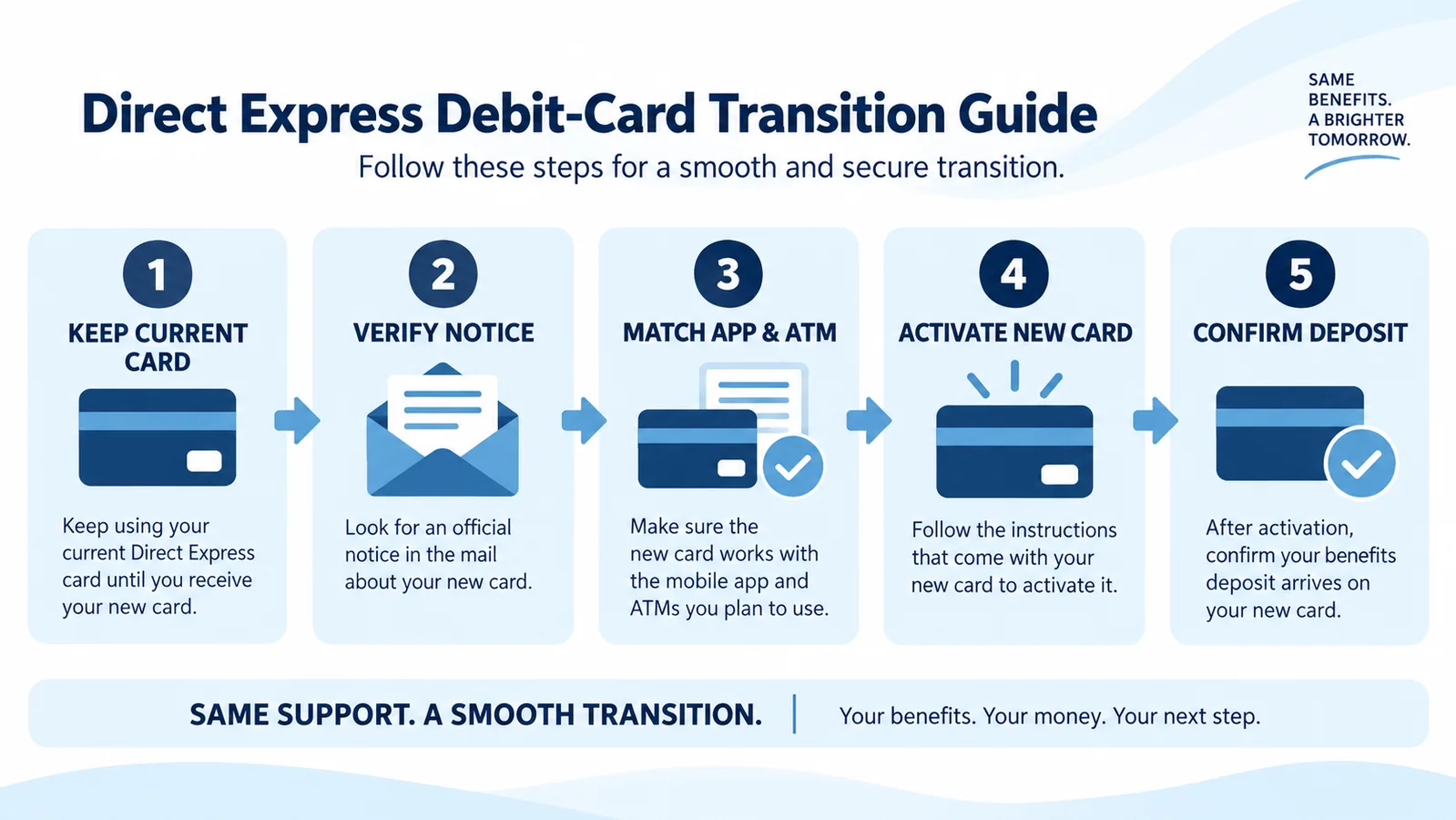
- Keep the existing card active. Store it safely and use it as usual until verified instructions say the new card is ready for your account.
- Check the contact details held by Direct Express. Use the official site or the number on the back of the card. An out-of-date mailing address could send a replacement card or notice to the wrong place.
- Check SSA separately. SSA's PolicyNet guidance warns that changing an address or telephone number with SSA does not automatically update the financial agent. The reverse is also true in practice: card-account servicing does not replace a required report to SSA.
- Save transition mail. Keep the envelope and instructions until the new card is activated, the expected deposit appears, and you can reach the correct account portal.
If you recently moved, correct both records through channels you start yourself. The my Social Security account guide can help with SSA online access, but Direct Express contact information still has to be handled through Direct Express. Avoid sending a Social Security number, PIN, full card number, or password by ordinary email.
Also review who helps with the account. A representative payee, caregiver, or trusted family member may need to recognize the notice, but the person should use the authority already established for the benefit or card account. The transition does not give an informal helper permission to impersonate the cardholder or disclose credentials.
How to manage two issuers during the transition
During a phased conversion, “Direct Express” no longer identifies a single set of digital tools. The issuer printed on the card determines which login route, app, ATM filter, and customer-service number applies. Start with the card in your hand.
Identify which bank issued your card
Direct Express gives a simple visual test. A Comerica-issued card has the Comerica logo on the front. A Fifth Third card has issuer language on the back stating that Fifth Third Bank issued it. Do not decide based only on the month you enrolled, the color of a mailer, or a caller's description.
When you contact support, have the card available but do not post or send an image of it. Use only the minimum information requested through the official authenticated channel. The issuer check is also useful when helping a household with more than one beneficiary, because each card can be at a different stage.
Use the login, mobile app, and ATM network that match the card
A Comerica cardholder continues to use the existing online account and the legacy Direct Express app. The newer Direct Express app is for Fifth Third-issued cards. The official website routes login users by the first six digits; enter those digits only on the verified Direct Express page, never through a link in an unexpected text.
ATM access also depends on the issuer. Direct Express's finder lets users filter for the bank connected to the card. Treasury says the program includes one free ATM cash withdrawal for each posted deposit each month, while an ATM owner can still impose a separate out-of-network surcharge. Check the current Direct Express FAQ and finder before withdrawing rather than assuming the old network remains free.
| Card in hand | Account access | ATM check |
|---|---|---|
| Comerica-issued Direct Express | Existing portal and legacy app | Filter the official finder for the Comerica-linked network |
| Fifth Third-issued Direct Express | New-card portal and new Direct Express app | Filter for the Fifth Third-linked network |
Know when two active cards can be legitimate
SSA's transition instructions describe one unusual but legitimate case. If an existing Direct Express user adds a second entitlement after May 18, 2026, the new benefit may be enrolled on a Fifth Third card while the older benefit stays on the Comerica card. The user could temporarily have two cards, each tied to a different benefit.
SSA says the person may call Treasury's Electronic Payment Solution Center at the official enrollment number to ask about consolidating the benefit onto the Fifth Third card. If the benefits are not consolidated, keep both cards and track which deposit appears on each. A surprise second card still deserves verification, but two cards alone do not prove fraud.
What to expect when a Fifth Third card arrives
A new card is the point where generic transition news becomes an account-specific event. Slow down. A legitimate package should be consistent with the advance communication and should identify Direct Express and Fifth Third as issuer. You can verify it without trusting the phone number, QR code, or web link printed in an unexpected message.
Verify the package before activating or discarding anything
Go to the Direct Express website by typing the address yourself, or call the number on the back of your currently working card. The official contact page separates Fifth Third and Comerica support so each user reaches the team connected to the physical card. Ask whether the replacement was issued and whether the activation instructions match your account.
- Compare the name and mailing address with the benefit recipient's correct record.
- Look on the back for the statement that Fifth Third Bank issued the card.
- Do not activate through a shortened URL or provide a PIN to a caller.
- Keep the old card and the mailer until the transition instructions say it is safe to dispose of them.
Follow the activation process included with the verified card because it can change as the rollout develops. Do not let a helper choose or record the PIN unless that person has proper authority and the cardholder needs that assistance.
Check the balance, deposits, fees, and recurring payments after activation
After you can access the new account, reconcile it like a bank statement. Confirm the available balance, recent benefit deposit, and transaction history. The paying agency's schedule should be unchanged, but the account view and alerts can look different. If the benefit is due later, note the scheduled date and check again before treating the deposit as missing.
Then review optional services. Direct Express publishes issuer-specific terms and fees; open the schedule for the issuer printed on your card. Check which ATM network is surcharge-free, how many fee waivers apply, and whether alerts or paper statements need to be selected again. Current terms control if a fee shown in an older article or screenshot differs.
A benefit deposit is not the same as a recurring merchant charge. If you used the old card number for utilities, subscriptions, or other card-on-file payments, check whether each merchant requires updated credentials. Do not assume the issuer automatically updates every company. Keep a short list and verify the next billing cycle.
Switching from Direct Express to a bank or credit union
You have a choice about the payment method, but the choice has to be framed correctly. If you remain in Direct Express, you cannot choose Comerica instead of Fifth Third after your account's transition. You can leave the card program by directing the federal benefit to an eligible bank or credit-union account.
Opting out means changing the payment destination
For Social Security benefits, SSA's current direct-deposit page allows many recipients to update bank information through a personal my Social Security account. It also lists help by telephone or appointment. A participating bank can submit an Automated Enrollment request, although SSA warns that not every institution offers that service and some benefit types follow different steps.
Use a route you initiate. Sign in by navigating to SSA.gov yourself, call the published SSA number, make an appointment through SSA, or ask a known bank representative whether it supports Automated Enrollment. Our detailed Social Security direct-deposit change guide compares those channels and identity checks.
Before changing anything, verify that the destination account accepts the type of federal payment and that the beneficiary is properly named on it. Compare monthly fees, minimum balances, ATM access, overdraft settings, caregiver access, and customer support with the card program. A checking account is not automatically cheaper or easier for every recipient.
Protect the next payment while the change is processing
Do not close, empty, or discard the current card the moment you submit a direct-deposit request. Record the confirmation and the effective date shown by SSA or the financial institution. Then monitor both destinations on the next scheduled payment day. SSA says payments continue to the information in its records until an authorized change is completed.
- Take a screenshot or save the confirmation without sharing it publicly.
- Keep enough access to the old card to retrieve a deposit that arrives there.
- Check the benefit record before rerouting automatic bills.
- After the first correct bank deposit, reconcile and properly dispose of any inactive card under the issuer's instructions.
If an unexpected change alert arrives, sign in through SSA.gov and contact SSA promptly. An unauthorized payment-destination change is a security problem, not a normal side effect of the Direct Express issuer transition.
How to recognize transition scams
The bank change is real, which makes it useful material for an impostor. A scammer can repeat accurate public facts, copy a logo, and still send a false activation link. Verify the action being requested, not merely whether the message knows that Fifth Third became the new agent.
Treat urgent requests for credentials, PINs, or fees as warning signs
SSA says common scams create a problem or prize, pressure the recipient to act immediately, and demand payment in a particular hard-to-reverse form. During this transition, that can appear as a threat that benefits will be frozen tonight, a fee to release a new card, or a request for the old card's PIN “to transfer the balance.” Pause on all three.
Neither an email nor a text should be treated as a secure place to send a full card number, Social Security number, password, one-time code, or PIN. A genuine notice may tell you that a change is coming. You can then verify it independently without replying or opening an attachment.
Start from a trusted address or the number printed on the card
End an unexpected call and start over. Type the official Direct Express address into the browser or use the number on the back of the physical card. Direct Express lists different support lines for Comerica and Fifth Third cards, so matching the issuer matters. Do not call a replacement number supplied by the suspicious caller.
Caller ID can be spoofed and a search advertisement can lead to an imitation site. Fifth Third's fraud guidance recommends checking the sender and spelling and navigating directly. Look for the secure official domain before entering account information. A polished design or a photo of an employee badge does not authenticate the contact.
Respond quickly if card information or money may be compromised
If you disclosed credentials, see an unauthorized transaction, or lose a card, contact the issuer immediately through the card or official site. Tell the representative exactly what was exposed and when. Ask how to lock or replace the card, dispute transactions, and secure online access. Save the case number and copies of the suspicious message.
Change a reused password anywhere else it appears and enable stronger sign-in protection where available. If a Social Security number or broader identity data was exposed, follow the recovery plan at IdentityTheft.gov. Report Social Security impersonation to SSA OIG and other fraud to the FTC. Reporting does not guarantee the money will return, but fast contact gives the issuer the best chance to limit further loss.
Who to contact for each Direct Express problem
The issuer and the paying agency solve different problems. Calling the wrong one can add days of transfers and repeated identity checks. Match the symptom to the organization before sharing account details.
| Problem | Start here | What to have ready |
|---|---|---|
| Lost, stolen, locked, damaged, or declined card | Direct Express number on the back of the card or official contact page | Card issuer, recent legitimate transactions, safe callback details |
| Unauthorized card transaction or exposed PIN | Direct Express immediately; then follow issuer dispute instructions | Date, amount, merchant, when the card or data was compromised |
| Wrong benefit amount, suspension, eligibility change, or payment not issued | SSA for Social Security or SSI; the relevant federal paying agency for other benefits | Benefit notice, scheduled date, account-safe deposit history |
| Payment issued but absent from the card account | Direct Express first, then the paying agency if the issuer cannot locate it | Scheduled payment date, issuer, last posted deposit |
| New enrollment in Direct Express | Treasury's Electronic Payment Solutions Center or the paying agency | Identity and benefit information through the verified channel |
| Change Social Security payment to a bank account | SSA online services, SSA, or a participating bank's Automated Enrollment process | Verified routing and account numbers; identity-verification method |
For card help, the most durable instruction is to use the number printed on the card you actually possess. Treasury and Direct Express also publish the current issuer-specific numbers on their official pages. For Social Security and SSI payment questions, SSA publishes its national line and local-office locator; our SSA contact guide explains the available channels.
Keep a small case log: date and time, organization called, number you independently verified, representative or case identifier, summary of what was promised, and the follow-up date. Do not write a PIN or full card number in that log. If one office refers you elsewhere, note why; that history helps the next representative understand whether the issue is with issuance, delivery, or card-account posting.
Transition details can change as the phased rollout continues. Recheck the SSA transition update and the Direct Express FAQ before acting on instructions saved months earlier.
Loading comments...