
Updated August 12, 2026. Supplemental Security Income can provide a monthly payment to an adult who is disabled or blind and has limited income and resources. Eligibility is not based on one diagnosis, and financial need by itself is not enough for a disability claim. Social Security applies separate medical, work, financial, residency, and status rules before it decides whether someone qualifies.
For 2026, the maximum federal SSI payment is $994 a month for an eligible individual and $1,491 for an eligible couple. Those are ceilings, not promises. Countable income, a spouse's income, support with food or housing, and a state supplement can all change the amount. This independent guide explains the public rules; it cannot access an SSA account, decide a claim, or estimate a person's exact payment. Use an official SSA notice and SSA.gov for an account-specific answer.
SSI eligibility for disabled adults: four tests at a glance
A useful way to screen a possible SSI claim is to separate four questions. Passing one does not automatically satisfy the others:
- Medical or blindness test: If you are 18 through 64 and apply because of disability, SSA must find that your medically determinable condition meets its adult definition. A person who is 65 or older may pursue age-based SSI without proving disability, but still faces the financial and status tests.
- Work test: For a non-blind adult's initial disability claim, current work above SSA's substantial gainful activity level will generally end the medical evaluation at the first step. Earnings are evidence of work activity; they are not the only financial number SSA reviews.
- Financial test: SSI is means-tested. SSA looks at countable income and resources, including some income or resources belonging to a spouse. Not every dollar or item counts, so a bank balance or gross paycheck alone cannot settle the question.
- Residency and status test: An applicant generally must live in the United States or Northern Mariana Islands and meet citizenship or a qualifying noncitizen rule. Noncitizen rules contain multiple categories and time limits, so an applicant should let SSA evaluate the actual immigration documents.
These are continuing rules, not just application-day questions. A recipient must report relevant changes in income, resources, marital status, address, and living arrangement. SSA can later conduct a nonmedical redetermination or medical continuing disability review. The safest “am I eligible?” answer is therefore a screening result, followed by a formal SSA application and written decision.
How SSA decides whether an adult is disabled
SSA's adult definition focuses on work-related function, not the name of a condition. The impairment must be medically determinable, prevent substantial gainful activity, and be expected to result in death or to have lasted—or be expected to last—for at least 12 continuous months. Short-term limitations can be serious without meeting this specific federal definition.
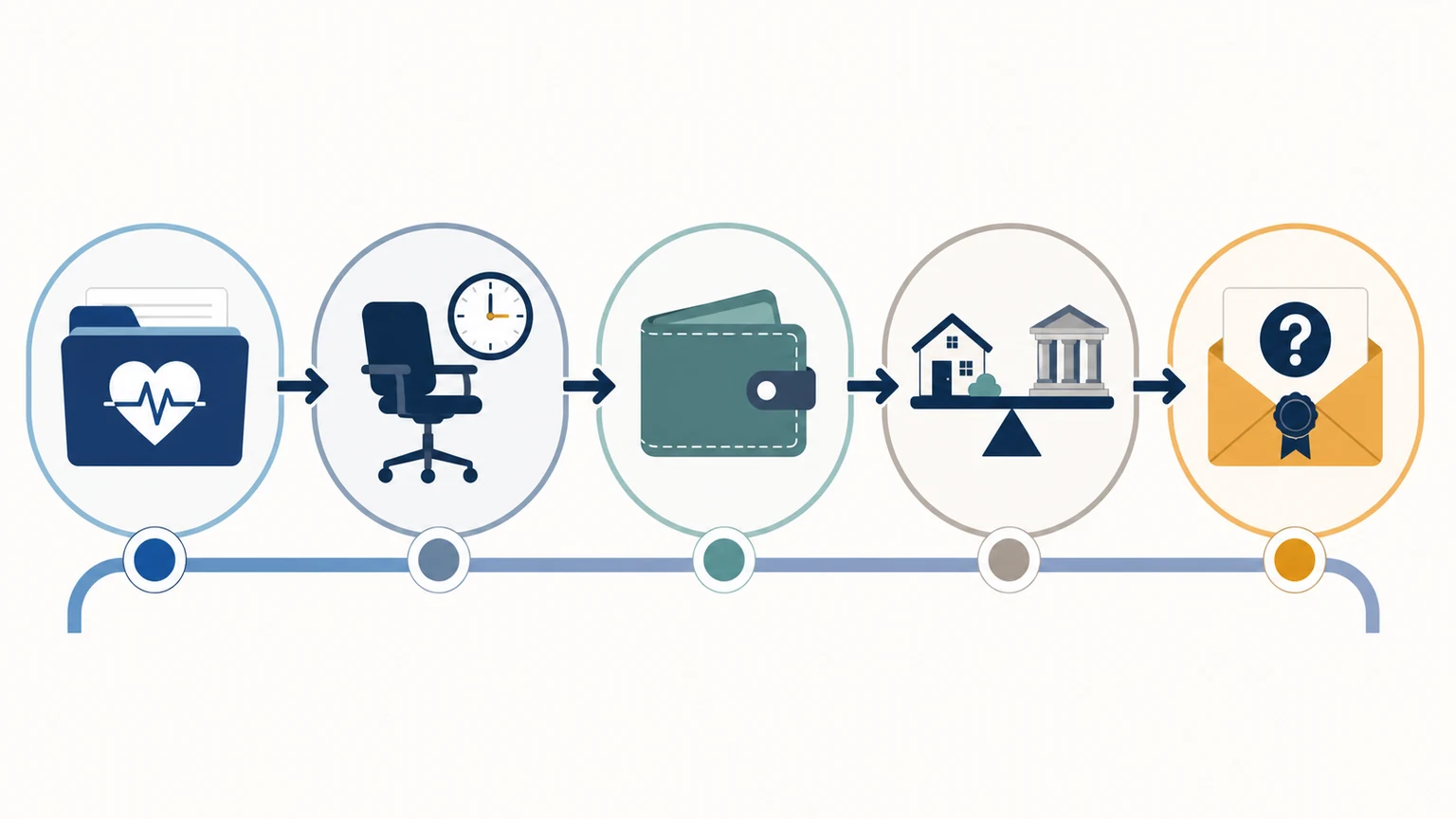
For an initial adult claim, the five-step sequence works like this:
- Are you doing substantial gainful activity? A non-blind applicant doing SGA is generally found not disabled at this step.
- Is the impairment severe and long-lasting? It must significantly limit basic work activity and satisfy the duration rule.
- Does it meet or medically equal a listing? Meeting every required criterion in SSA's Listing of Impairments can establish disability here. Not meeting a listing does not automatically end the claim.
- Can you perform past relevant work? SSA develops a residual functional capacity, or RFC, describing what you can still do despite documented limitations, then compares it with relevant work generally performed in the prior five years.
- Can you adjust to other work? SSA considers the RFC along with age, education, and work experience and whether suitable work exists in significant numbers in the national economy.
A medical condition does not “automatically qualify” merely because it appears in a diagnosis list. The evidence must satisfy the program's criteria. Our guide to conditions and SSA disability evaluation explains listings and faster Compassionate Allowances without promising approval. Also, the five steps above describe an initial adult claim; SSA uses a different process for a child claim or a later continuing disability review.
Working while applying: the 2026 SGA screen
For a non-blind adult applying in 2026, earnings averaging more than $1,690 a month generally indicate substantial gainful activity. “Substantial” does not require a full-time schedule: part-time activity can count if it involves significant physical or mental duties. “Gainful” broadly means work done, normally done, or intended for pay or profit.
The $1,690 figure is not the SSI income limit and not a general permission to earn that amount without affecting a payment. It is a step-one disability screen for a non-blind initial claim. If an applicant gets through that screen, SSA separately applies SSI's countable-income formula, which can reduce or eliminate a payment at a different earnings level. Conversely, a month below $1,690 does not prove disability; the claim must still pass steps two through five.
Gross wages also may not be the final SGA figure in every case. SSA can consider items such as a subsidy, an unsuccessful work attempt, and reasonable out-of-pocket impairment-related work expenses needed to work. Self-employment is evaluated under additional rules. Applicants should report the work accurately and provide pay stubs, dates, duties, hours, and documentation of relevant expenses rather than trying to classify the work themselves.
Blindness needs careful wording. SSA publishes a 2026 blind SGA amount of $2,830 for disability programs, but its SSI guidance says SGA is not used as an initial eligibility factor once a person meets the SSI definition of blindness. Income still matters to SSI eligibility and payment. After a person begins receiving disability-based SSI, work incentives and countable-income rules may permit continued eligibility even when work changes; those post-eligibility rules are not the same as the initial non-blind SGA test.
Income and asset rules are a separate eligibility gate
SSI does not use one universal gross-income ceiling. SSA first identifies the type of income, applies exclusions, and considers household circumstances. Earned income includes wages and net self-employment income. Unearned income can include Social Security benefits, pensions, unemployment, interest, and cash gifts. Shelter received free or below fair value can be in-kind support. Some income from an ineligible spouse who lives with the applicant may be “deemed” available even if the spouse does not hand it over directly.
The rough public explanation is that SSI falls by about $1 for every $2 of countable earnings from work and about $1 for every $1 of countable unearned income. That shorthand comes after exclusions; it is not a complete calculator. For example, SSA generally excludes the first $20 of many kinds of income and, when earned income is involved, the first $65 of earnings plus half the remainder. Other exclusions may apply to students, impairment-related work expenses, a Plan to Achieve Self-Support, certain public assistance, and state supplements.
Resources are different from monthly income. In 2026, countable resources must generally be no more than $2,000 for one person or $3,000 for a couple. Cash, bank accounts, stocks, bonds, and property that can be converted to cash may count. Common exclusions include:
- the home you live in and the land it sits on;
- one vehicle used for transportation by you or a household member;
- most household goods and personal effects;
- qualifying burial spaces and limited burial funds; and
- certain property needed for self-support, approved PASS funds, and up to the applicable ABLE-account exclusion.
Do not give away money or property merely to get below the limit. A transfer for less than fair market value can cause SSI ineligibility for up to 36 months, and trust and ownership rules are complex. Instead, disclose the item and let SSA decide whether it is countable. The same principle applies to a joint bank account, a spouse's retirement funds, an inheritance, or a valid loan: the label alone does not produce a reliable answer.
What evidence helps SSA evaluate an adult claim
The local SSA field office and the state Disability Determination Services have different jobs. The field office develops the application and verifies nonmedical SSI facts such as income, resources, living arrangement, citizenship, and residency. It sends a financially eligible disability claim to DDS, the state agency funded by the federal government to develop medical evidence and make the initial medical determination.
Objective medical evidence from an acceptable medical source is needed to establish a medically determinable impairment. A useful application identifies every relevant doctor, clinic, hospital, therapist, test, medication, and treatment date. Records should show not only a diagnosis but also clinical findings, treatment response, prognosis, and limits on activities such as sitting, standing, walking, lifting, concentrating, following instructions, interacting, or maintaining a reliable schedule.
Work and daily-activity information matters too. Describe former jobs accurately: duties, physical demands, tools, hours, supervision, and why the work ended or changed. Explain functioning with concrete frequency and duration rather than broad conclusions. “I need to lie down three times during a six-hour day” gives a different kind of information from “I cannot work.” A treating professional can describe supported functional limits, but the professional is not responsible for deciding whether the legal definition is met.
DDS usually requests records from the sources identified by the applicant. If the file remains insufficient, it may arrange and pay for a consultative examination or test. Attend the appointment or promptly contact the number on the notice if there is a genuine barrier. A consultative exam is evidence gathering, not a sign of approval or denial. Applicants should not postpone filing simply because a record is missing; SSA says it can help obtain evidence after receiving complete source information and permission.
For a preparation list covering medical and work details, see the site's disability application and medical checklist. Submit account-specific material only through official SSA channels. Never post medical records, a Social Security number, banking information, or login credentials in comments or on a third-party payment site.
SSI is not the same as SSDI—and some adults may qualify for both
| Question | SSI | SSDI |
|---|---|---|
| What supports eligibility? | Limited countable income and resources plus age, blindness, or disability | Insured status from covered work, plus blindness or disability |
| Is the payment based on prior earnings? | No; it begins with a federal benefit rate and subtracts countable income | Yes; the worker's covered earnings record affects the insurance benefit |
| Does SSI's $2,000/$3,000 resource limit apply? | Yes | No, though resources can matter to other assistance programs |
| Adult medical standard | The same core SSA adult disability definition is used, although program and work-incentive rules differ | |
An adult does not need work credits to qualify for SSI. That is important for someone who has never worked, worked only briefly, or is no longer insured for SSDI. But SSA may still check whether the person qualifies on an earnings record. A worker with enough recent credits may qualify for SSDI, and a relatively low SSDI benefit may leave room for a partial SSI payment if all SSI rules are met.
SSA calls eligibility for both programs “concurrent.” The payments are not simply added at their maximums. SSDI generally counts as unearned income in the SSI calculation after applicable exclusions, so it can reduce or eliminate the SSI cash amount. Back-pay timing can also trigger a windfall-offset calculation. Only SSA can compute that interaction from the record.
Do not decline to apply merely because you are unsure which program fits. Use SSA's application selector or speak with SSA about both. Existing work-credit questions are explained separately in the site's SSDI eligibility and five-year-rule guide; that work-credit rule should not be imported into an SSI-only screening decision.
How to apply and what happens after filing
- Start at SSA.gov. Use SSA's benefit application selector. Some adults can complete a simplified SSI/disability application online; others must arrange an appointment by phone. Online availability depends on facts such as age, prior claims, marital history, citizenship or noncitizen status, and whether the person is applying for SSI and SSDI together.
- Protect the filing date. Contact SSA promptly if you want to apply. SSI generally cannot pay for periods before the effective application date, and an inquiry may establish a protective filing only when SSA's requirements and follow-up deadline are met.
- Complete both sides of the claim. Respond to financial questions and the disability report. Return authorizations and follow-up forms, report changes, and keep copies or confirmation numbers.
- Monitor official messages. A personal my Social Security account may show application or appeal status. Read mailed notices as well; a generic online status does not replace the written decision.
The site's application-status guide explains the official account and phone routes. This site cannot look up a pending file. Do not share an SSN, claim number, login code, or medical document with anyone claiming in comments or social media that they can “speed up” approval.
If SSA denies the claim, read whether the reason is medical or nonmedical and use the appeal instructions in the notice. A request for reconsideration is generally due in writing within 60 days after receipt. Do not simply submit a new application as a substitute for a timely appeal without understanding the effect. Add missing or updated evidence that addresses the stated reason, and ask SSA promptly about good cause if the deadline may have passed. Representation is optional; SSA explains how an appointed representative can act on a claimant's behalf and how fees are authorized.
A final SSI eligibility checklist for 2026
Before contacting SSA, organize the questions—not a self-diagnosis:
- Are you age 18–64 and applying because a physical or mental impairment prevents sustained work, or do SSA's blindness rules apply?
- Has the impairment lasted or is it expected to last at least 12 continuous months, or is it expected to result in death?
- If you are not blind, are you working, and what were your gross earnings, hours, duties, subsidies, and impairment-related expenses in each month?
- What earned, unearned, in-kind, and potentially deemed income is present in the household?
- What cash, accounts, investments, property, vehicles, insurance, trusts, or other resources do you own or share, and which exclusions might apply?
- Can you identify treatment sources, dates, tests, medications, functional limits, and the demands of work performed in the prior five years?
- Do you meet the U.S. residence and citizenship or qualifying noncitizen rules?
Can a disabled adult qualify with no work history?
Possibly. SSI does not require insured work credits. The adult must still meet SSA's disability or blindness rules and all financial, residence, and status requirements. SSA should also check whether another benefit record may apply.
Does a doctor saying “disabled” guarantee SSI?
No. A doctor's medical findings and functional opinion can be important evidence, but SSA applies the legal five-step test to the complete record. A diagnosis or conclusory statement alone does not decide eligibility.
Can someone own a home or car and receive SSI?
Yes, in some circumstances. SSA generally excludes the home a person lives in and one vehicle used for household transportation. Other real estate, additional vehicles, proceeds, co-ownership, or a home the person does not live in may be treated differently.
Once approved, is eligibility permanent?
No. SSA may review medical disability and will redetermine nonmedical eligibility. Recipients must report relevant changes promptly—generally by no later than the tenth day after the month in which a change occurred—to reduce the risk of overpayment or underpayment.
Eligibility determines whether SSI can be paid; the deposit calendar is a separate question. After approval, use the site's 2026 SSI payment schedule for public dates and the payment-date calculator for schedule orientation. Confirm the actual amount, eligibility month, and payment method in the SSA award notice.
Loading comments...