
Updated August 26, 2026. Social Security checks do not automatically come early every month. An official payment moves earlier only when its scheduled date falls on a Saturday, Sunday, or legal public holiday. A bank may also make a direct deposit available before the official date, but that is a separate, optional service and is never a promise from the Social Security Administration (SSA).
The answer therefore depends on which benefit you receive and which payment group applies to you. “Social Security check” is used here in the everyday sense; most federal benefit payments are now delivered electronically. Use the dates below as general schedule information, then confirm an account-specific date in your SSA notice or personal my Social Security account.
Will Social Security checks come early this month? The August 2026 answer
Only one major August group had an official early payment: the August 2026 Supplemental Security Income (SSI) payment was scheduled for Friday, July 31, 2026, because August 1 fell on a Saturday. It was August’s benefit even though it appeared in July. The regular Social Security dates for the third-of-month and birthday groups were not moved earlier.
| Payment group | Official August 2026 date | Was it officially early? |
|---|---|---|
| SSI | Friday, July 31, 2026 | Yes; August 1 was Saturday |
| Third-of-month group | Monday, August 3, 2026 | No |
| Birth date 1st–10th | Wednesday, August 12, 2026 | No |
| Birth date 11th–20th | Wednesday, August 19, 2026 | No |
| Birth date 21st–31st | Wednesday, August 26, 2026 | No |
If you receive both SSI and Social Security, do not combine the two schedules. Your August SSI was due July 31, while your Social Security benefit was generally due August 3 under the combined-benefits rule. If you receive retirement, survivor, or disability benefits on a birthday Wednesday, your listed Wednesday remained the official date. A deposit that your bank exposed before one of those dates may feel early, but SSA did not move the official date.
For the complete source calendar, see the site’s 2026 Social Security payment schedule and 2026 SSI payment schedule. The August 2026 payment-date page provides the month-specific view.
The official rule for weekend and federal holiday shifts
SSA’s rule is straightforward: if the regularly scheduled payment date falls on a Saturday, Sunday, or legal public holiday, benefits are paid on the business day before the due date. The direction matters. The payment does not wait until the next business day. It moves backward to the first preceding day that is not a weekend or legal holiday.
This rule applies after you identify the normal date for your benefit group. For example, SSI normally uses the first day of the month. If the first is Sunday, the official date usually becomes the preceding Friday, assuming Friday is not itself a legal holiday. A person in the third-of-month Social Security group uses the same logic with the third. A birthday-group payment normally stays on its assigned Wednesday, unless that Wednesday is a federal legal holiday; then SSA lists the preceding eligible day.
An official shift has three practical features:
- SSA’s calendar shows the earlier date for the affected benefit group.
- The deposit still belongs to the same benefit month or payment cycle; it is not an extra benefit.
- The rule applies to the scheduled payment, regardless of whether a bank separately advertises early access.
Do not infer an early payment merely because a federal holiday occurs somewhere in the month. The holiday or weekend must conflict with your group’s scheduled date. A Monday holiday, for instance, does not automatically move a Wednesday birthday-group payment. Conversely, a Wednesday holiday can affect one birthday group without changing the other groups in that month.
The safest check is therefore calendar-based: find your normal group, look at SSA’s official date, and compare that date with the weekend and holiday rule. News headlines and social-media calendars can be useful clues, but the official SSA calendar controls the schedule described here.
Find your payment group before deciding whether it is early
The words “Social Security check” can refer to several programs and payment cycles. Your neighbor’s deposit date is not evidence of your date, even if you use the same bank. Start with the benefit type and the payment rule shown on your SSA notice.
SSI normally uses the first of the month
SSI is normally due on the first day of the month for which it is paid. When the first is a weekend or federal legal holiday, SSA schedules it for the preceding business day. That earlier date can fall in the prior calendar month. This is why SSI recipients are more likely to see a deposit that appears “early” at the end of a month.
The third-of-month group includes pre-May 1997 and combined benefits
If you were receiving or applied for Social Security on or before April 30, 1997, your Social Security payment is generally scheduled for the third. The third also generally applies when you receive both Social Security and SSI: SSI follows the first-of-month rule, while the Social Security benefit follows the third-of-month rule.
SSA has additional administrative exceptions that can place someone in the third-of-month group, including some beneficiaries living outside the United States and some whose Medicare premiums are paid by a state. Do not switch yourself to a birthday group based only on a general article. Your SSA notice is the better source for your assigned cycle. The site’s guide to payments on the third of the month explains that group in more detail.
Most later filers use a birthday Wednesday
- Birth date 1st–10th: second Wednesday.
- Birth date 11th–20th: third Wednesday.
- Birth date 21st–31st: fourth Wednesday.
These groups generally apply when the claim was filed after April 30, 1997 and no exception applies. The relevant birthday can be the birthday of the insured worker whose record supports the benefit, not necessarily the person receiving an auxiliary, spousal, or survivor payment. Retirement, survivor, and Social Security Disability Insurance (SSDI) payments can all follow this cycle; SSDI is not automatically paid on one universal date.
Once you know the group, ask only whether that group’s listed date conflicts with a weekend or federal holiday. That two-step check is more reliable than counting back from another person’s deposit.
Official early payment versus a bank’s early direct deposit
Two different events are often described with the same word—“early.” Keeping them separate prevents most payment-date confusion.
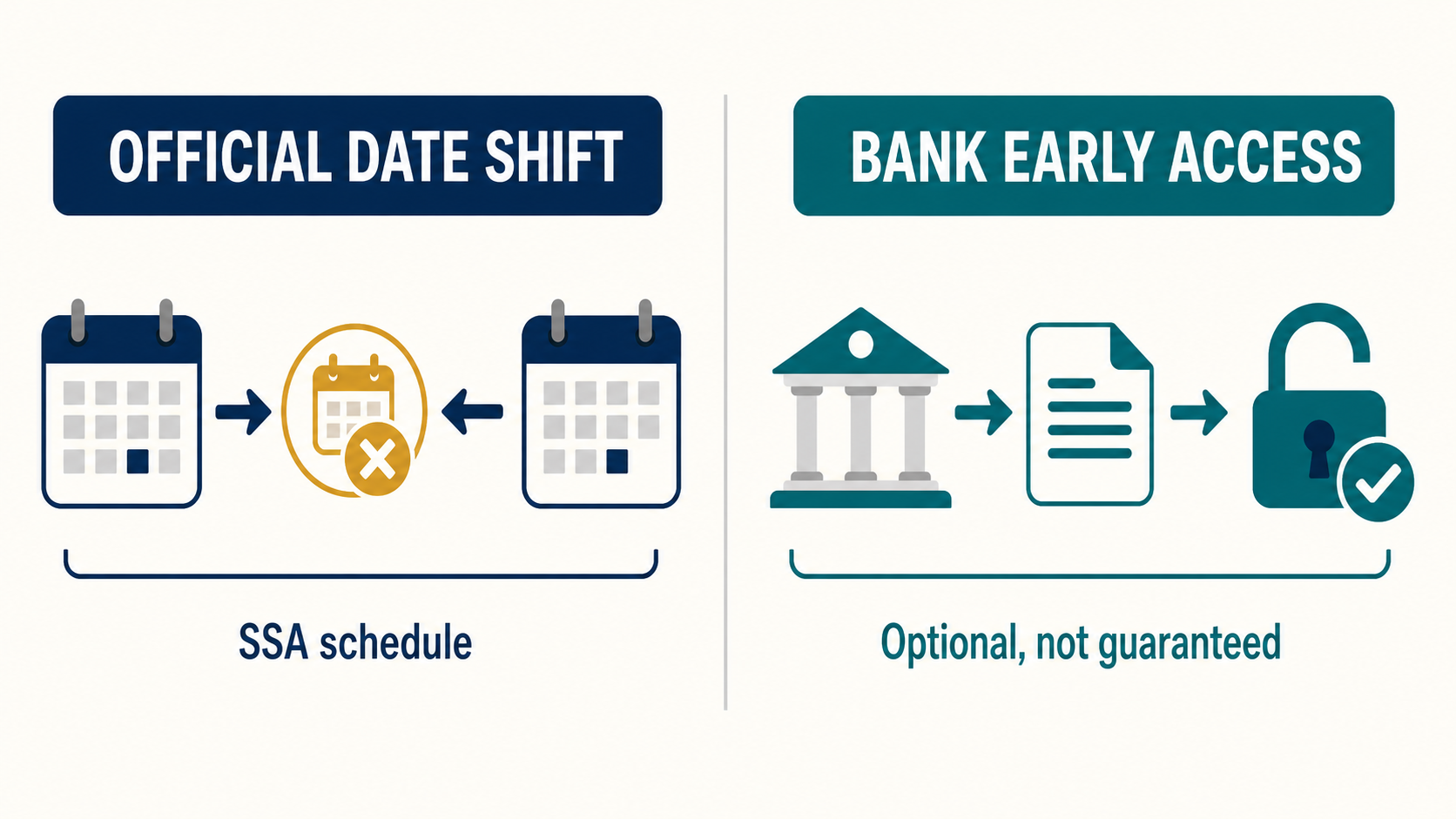
| Question | Official date shift | Bank early access |
|---|---|---|
| Who controls it? | SSA’s payment calendar and federal timing rule | Your bank, credit union, or prepaid-card provider |
| Why can it happen? | The normal date conflicts with a weekend or legal public holiday | The institution receives payment information and chooses to release funds before the effective date |
| Is it guaranteed? | The official calendar lists the adjusted date for the affected group | No; eligibility and timing can vary by account and deposit |
| Does it change next month’s SSA date? | No; the group continues under its normal rule | No; it does not rewrite SSA’s schedule |
Several institutions advertise eligible direct deposits “up to” a stated number of days early. Their own disclosures commonly say availability depends on when payment instructions arrive and may differ from one deposit to the next. “Up to” is a maximum possibility, not a fixed payment date. A pattern in your account history is useful for personal planning, but it is not a commitment that the next deposit will appear on the same weekday or at the same hour.
For that reason, avoid scheduling a bill against an estimated early-access date unless you have confirmed that the money is actually in your available balance. The official date remains the safer planning baseline. If a bank does not expose the funds early, that alone does not mean SSA is late.
SSA can confirm the benefit cycle and scheduled date. Your financial institution can explain its posting and available-balance rules. Neither a public article nor another customer can see the payment file for your account, so no responsible source can promise a midnight deposit or a specific time of day.
The remaining 2026 dates that officially move earlier
As of August 26, the next month—September 2026—has no official early shift for the standard groups. SSI is listed for Tuesday, September 1; the third-of-month group for Thursday, September 3; and the three birthday groups for September 9, 16, and 23. A bank could still offer early access, but SSA’s dates themselves are not moved.
The remaining official shifts affecting 2026 benefit dates are concentrated in October and November:
| Benefit/group | Normal date | Official earlier date | Reason |
|---|---|---|---|
| October Social Security, third-of-month group | Saturday, October 3, 2026 | Friday, October 2, 2026 | Weekend |
| November SSI | Sunday, November 1, 2026 | Friday, October 30, 2026 | Weekend |
| November Social Security, birth date 1st–10th | Wednesday, November 11, 2026 | Tuesday, November 10, 2026 | Veterans Day |
The October 30 deposit belongs to November SSI. A concurrent beneficiary may then receive a separate Social Security payment on Tuesday, November 3. Those are two programs and two scheduled payments, not duplicate copies of the same benefit.
The November 18 and November 25 birthday-group payments are not moved, and the normal December 2026 SSI, third-of-month, and Wednesday dates remain on their listed days. At year-end, dates for January 2027 can appear in December 2026 because of the same rule; use the official 2027 calendar instead of assuming that a 2026 pattern repeats.
For a continuously updated lookup rather than a shortened exception list, use the payment-date calculator. The September 2026 payment page is the next monthly reference.
Why an early SSI payment is not an extra check
When next month’s SSI payment moves into the current month, a bank statement can show two SSI deposits in one calendar month. The first belongs to the current month; the second belongs to the following month. SSA has explained that the second deposit is not a duplicate payment, bonus, stimulus, or extra month of benefits.
July 2026 is a clear example. July SSI was paid on July 1. August SSI was paid on July 31 because August 1 was Saturday. That produced two SSI dates in July and no SSI deposit dated in August. The same pattern returns in October: October SSI is listed on October 1, and November SSI is listed on October 30 because November 1 is Sunday. There is then no separately dated November SSI payment.
Label the second deposit by the month it is for, not just the date it entered the account. A simple budget note such as “October 30 = November SSI” can prevent spending next month’s rent, food, or utility money as though it were extra cash. Receiving both SSI and Social Security can add another deposit on or around the third, but that Social Security benefit is a separate program payment, not proof that SSI was duplicated.
You generally do not need to report a correctly scheduled early SSI payment as an unexplained duplicate simply because it arrived in the prior calendar month. If the amount is unfamiliar, the description does not match your usual federal payment, or SSA sent a notice about a correction, rely on the notice and contact SSA rather than guessing. The related guide, why extra-looking Social Security money is not a bonus check, covers other common explanations.
What to do if the early or regular payment does not arrive
First, compare your expectation with the official date, not the date a bank posted last month. A missing estimated early-access deposit is not yet a missing SSA payment if the scheduled date has not arrived.
- Confirm the benefit and group. Check whether you are looking for SSI, a third-of-month Social Security payment, or a birthday-Wednesday payment. If SSI appears absent this month, verify whether it was already paid at the end of the prior month.
- Check the official adjustment. Make sure a weekend or legal holiday did not move the scheduled date to the preceding business day.
- For electronic payment, contact the financial institution first. SSA says the bank or financial institution may be experiencing a posting delay. Ask about the expected federal deposit without sharing credentials in a public forum.
- If it is still missing, contact SSA. Call 1-800-772-1213 (TTY 1-800-325-0778) or contact a local Social Security office. SSA can review whether a due payment needs replacement.
For a physical check, SSA publications generally say to allow three workdays after the due date before reporting a missing check; report one known to be lost or stolen promptly. SSA’s calendar also uses “three additional mailing days” guidance. Electronic and mailed-payment instructions differ, which is another reason not to apply a paper-check waiting rule blindly to a direct deposit.
Use the site’s missing Social Security payment checklist for a focused troubleshooting path. This site cannot view an SSA record or trace a deposit. Never post or send your Social Security number, claim number, bank account, Direct Express PIN, or SSA sign-in credentials to get a public payment-date answer.
Frequently asked questions about early Social Security payments
Does every bank pay Social Security early?
No. Early availability is an institution feature, not an SSA benefit. Even banks that offer it usually use conditional terms such as “eligible,” “may,” and “up to.” Availability can depend on when payment information reaches the institution, the account type, and its internal rules. A bank that posted three prior deposits early is not required by SSA to do the same with the fourth.
Does an early Friday deposit change next month’s payment date?
No. A weekend or holiday adjustment changes one affected date; it does not permanently move your payment group. After an official Friday shift, use the normal first, third, or assigned Wednesday rule for the next month and check that month for its own conflicts. A bank’s voluntary Friday release likewise does not change SSA’s future dates.
Can SSI and Social Security arrive on different dates?
Yes. People receiving both programs generally have SSI scheduled on the first and Social Security on the third. Either date can move to the preceding business day when required. An end-of-month SSI payment and a Social Security payment a few days later are two separate benefits following separate cycles.
Are paper checks on the same payment schedule?
The assigned SSA payment date still comes from the same program and group rules, but mail delivery and missing-check procedures differ from electronic posting. Paper federal-benefit checks are being phased out in most cases, and SSA has encouraged electronic delivery through direct deposit or Direct Express. Some people may qualify for a Treasury waiver. If you still receive a paper check, follow the instructions in your notice and SSA’s current mailed-check guidance rather than expecting a bank-style early-access feature.
Can SSA tell me what time the deposit will appear?
SSA can identify the scheduled date, but the financial institution controls when the transaction appears in an online ledger and when funds become available. There is no universal midnight rule for every bank, time zone, or card account. Check the available balance and ask the institution about its own posting policy.
The bottom line for this month
For August 2026, SSI was officially early on July 31 because August 1 was Saturday. The August 3 Social Security group and the August 12, 19, and 26 birthday groups stayed on their official listed dates. That answer does not automatically carry into September or any later month.
Use the same three questions each time a headline says checks are coming early:
- Which benefit and payment group applies to me?
- Does that group’s normal date fall on a weekend or legal public holiday?
- Am I looking at an SSA calendar change, or only my financial institution’s optional early-access estimate?
If SSA’s date moves, plan around the preceding business day and remember that the payment still belongs to its normal benefit month. If only the bank may post early, plan around SSA’s official date until the funds are actually available.
Primary references for this guide are SSA’s 2026 Schedule of Social Security Benefit Payments, its weekend and holiday payment FAQ, and Handbook §121 on payment dates. This independent site provides general information, not access to your SSA or bank account and not individualized financial or legal advice.
Loading comments...