
Updated September 2, 2026. The maximum federal SSI payment in 2026 is $994 per month for an eligible individual and $1,491 per month for an eligible couple. Those are starting maximums, not a promise that every recipient will receive that amount. Social Security Administration rules can lower the federal payment when a person has countable wages, Social Security or other non-work income, income deemed from certain family members, or shelter help that SSA counts. A state supplement can increase the total in some cases.
Supplemental Security Income is a needs-based program for qualifying people who are age 65 or older, blind, or disabled and who meet financial and other eligibility rules. It is different from Social Security retirement and Social Security Disability Insurance (SSDI), which are based mainly on a worker’s covered earnings record. That distinction matters: there is no earnings-history formula that tells everyone what their SSI check will be.
This guide provides a transparent, federal-only worksheet for a rough 2026 estimate. It can illustrate common earned- and unearned-income calculations, but it cannot determine eligibility or reproduce every SSA rule. Deeming, living arrangements, state supplements, special work incentives, payment timing, and changes under review can all require an individual SSA calculation. Use your award or change notice and your official my Social Security account as the final sources for your amount. Do not enter an SSN, bank details, claim number, or SSA login credentials into a third-party calculator.
2026 SSI maximum monthly payment amounts
SSA increased SSI through the confirmed 2.8% cost-of-living adjustment for 2026. The table below shows the federal payment standards before countable-income reductions and before any state supplement. “Maximum” means the highest starting federal rate for the listed category under ordinary rules; it does not mean every eligible person receives the full rate.
| 2026 category | Maximum federal monthly amount | What it means |
|---|---|---|
| Eligible individual | $994 | The individual federal benefit rate before reductions. |
| Eligible individual with an eligible spouse | $1,491 total | The combined eligible-couple rate, divided between the two spouses for payment purposes. |
| Essential person | $498 increment | A narrow grandfathered category; it is not a general caregiver payment. |
The couple figure is frequently misunderstood. It is not $1,491 for each spouse, and it is not two individual maximums added together. Likewise, the essential-person amount applies only when SSA recognizes that legacy status. Most readers should begin with the individual or eligible-couple line.
These are federal figures. Some states add a supplement, and state rules can vary by living arrangement or eligibility category. Conversely, countable income or shelter help may lower the federal portion. For a state-specific check, use the site’s 2026 SSI state supplement guide and then confirm the administering agency and current amount. The figures above describe 2026 only; they should not be reused as a 2027 estimate.
Use this 2026 SSI payment calculator worksheet
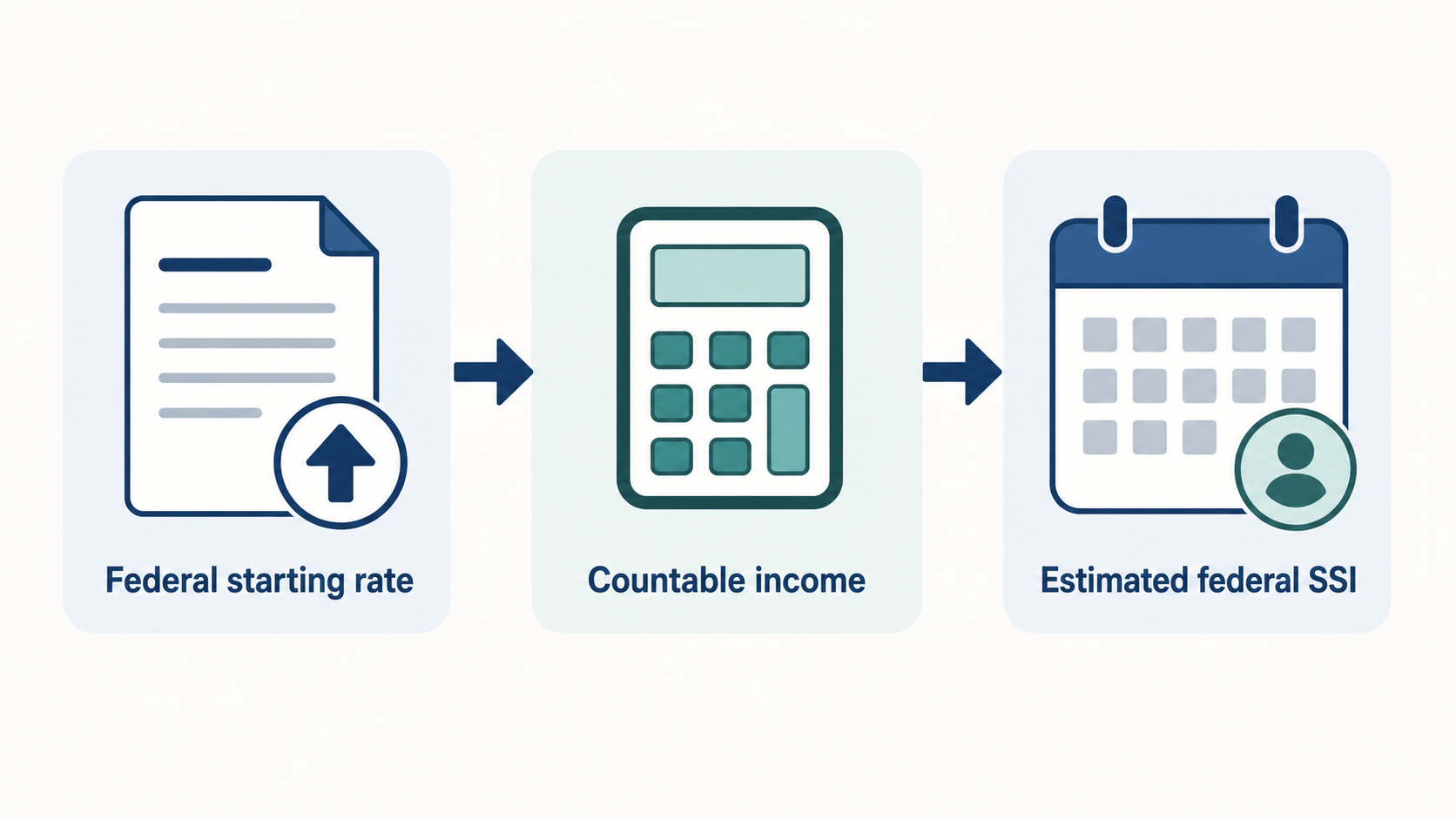
The simplest way to estimate an individual federal SSI payment is to identify countable income, not merely total cash received. Under SSA’s basic formula:
2026 federal benefit rate − countable income = estimated federal SSI payment
For an eligible individual, begin with $994. Then work through this worksheet for a common, uncomplicated month:
- Write down gross unearned income, such as a Social Security benefit, pension, or unemployment benefit.
- Subtract up to $20 under the general income exclusion. Do not carry the unearned-income result below zero.
- Write down gross earned income from wages or net earnings from self-employment.
- If unearned income did not use all of the $20 general exclusion, subtract the unused part from earned income.
- Subtract the $65 earned-income exclusion from the remaining earnings, stopping at zero.
- Divide the remaining earned income by two. This is the basic countable earned-income estimate.
- Add countable unearned income and countable earned income.
- Subtract that total from $994. Do not treat a result below zero as a negative check; it signals that this simple federal worksheet cannot produce a payable federal amount for the example.
This sequence explains the shorthand that SSI often falls by about $1 for each $1 of non-work income after exclusions and by about $1 for every $2 of earnings after exclusions. “About” is important. The actual computation may include deemed income, in-kind shelter support, a state supplement, or special exclusions for qualifying students and workers with disabilities.
This worksheet is intentionally limited. It does not decide whether someone meets SSI’s age, disability, blindness, citizenship, residency, income, or resource rules. It also does not calculate eligible-couple allocation, spouse or parent deeming, the student earned income exclusion, impairment-related work expenses (IRWE), blind work expenses (BWE), a Plan to Achieve Self-Support (PASS), institutional rates, overpayment collection, or payment timing. If any of those apply, use the estimate only to understand the vocabulary and check the official SSA calculation.
For more detail on what SSA counts and excludes, see the site’s SSI income limits for 2026. The following examples keep the facts narrow so each line of arithmetic can be checked.
Example 1: SSI with only unearned income
Assume an eligible individual receives $300 per month in Social Security benefits and has no wages or other income. For SSI purposes, the Social Security benefit is unearned income. In SSA’s published 2026 example, the ordinary calculation is:
| Step | Calculation | Result |
|---|---|---|
| Start with unearned income | Social Security benefit | $300 |
| Apply general income exclusion | $300 − $20 | $280 countable unearned income |
| Subtract countable income from 2026 FBR | $994 − $280 | $714 estimated federal SSI |
The combined gross monthly total in this narrow example would be $1,014: the $300 Social Security benefit plus $714 in federal SSI. The extra $20 over the federal SSI rate reflects the general income exclusion; it is not an extra SSI bonus. The calculation also does not subtract rent, groceries, debt payments, or ordinary personal expenses from the Social Security income.
This result assumes the person otherwise remains eligible and has no countable shelter support, deemed income, state supplement, or other adjustment. SSA may use income from a prior month when computing a later payment, so the deposit amount may not change in the same month that income changes.
Example 2: SSI with wages from work
Now assume an eligible individual earns $317 in gross wages during a month and has no unearned income. Because the $20 general income exclusion was not used against unearned income, it can be applied to the wages before the earned-income rules:
| Step | Calculation | Result |
|---|---|---|
| Start with gross wages | Monthly earnings | $317 |
| Apply unused general exclusion | $317 − $20 | $297 |
| Apply earned-income exclusion | $297 − $65 | $232 |
| Exclude half of the remainder | $232 ÷ 2 | $116 countable earned income |
| Subtract from the 2026 individual FBR | $994 − $116 | $878 estimated federal SSI |
The example’s combined gross monthly amount is $1,195: $317 in wages plus $878 in federal SSI, before payroll deductions and any other program effects. This demonstrates why earning $317 does not ordinarily reduce SSI by the full $317. After the common exclusions, only $116 is countable in this fact pattern.
Use gross wages for the starting number, not the amount deposited after tax withholding. A qualifying student earned income exclusion, IRWE, BWE, or PASS can change the computation, while other income or deemed income can lower the result. Report wages to SSA even when a rough worksheet suggests that some or all will be excluded.
Example 3: both earned and unearned income
When both types of income are present, do not subtract the $20 general income exclusion twice. It is a single monthly exclusion in this ordinary calculation and is generally used against unearned income first. Consider an illustrative individual with $200 in unearned income and $600 in gross wages:
| Income component | Calculation | Countable amount |
|---|---|---|
| Unearned income | $200 − $20 general exclusion | $180 |
| Earned income | ($600 − $65 earned-income exclusion) ÷ 2 | $267.50 |
| Total countable income | $180 + $267.50 | $447.50 |
| Rough federal SSI estimate | $994 − $447.50 | $546.50 |
The combined gross cash in this teaching example would be $1,346.50: $200 unearned income, $600 wages, and the $546.50 federal SSI estimate. That total should not be copied into a personal budget until SSA confirms the relevant income month and the official payment. A special exclusion, deemed family income, countable shelter support, or state supplement would change the arithmetic.
A common calculator error is to deduct $20 from the unearned income and then deduct another $20 from wages. That would overstate the estimated SSI payment. Another error is to divide all income by two; only the remaining earned-income portion receives the ordinary 50% exclusion in this simplified example.
Living arrangements and shelter help can reduce SSI
Income is not the only reason a payment may be below $994. SSA also asks where a recipient lives and who pays shelter costs. If someone else pays all or part of rent, mortgage, property taxes, heating fuel, gas, electricity, water, sewer, or garbage removal, SSA may count in-kind support and maintenance (ISM). Paying a fair share of household shelter costs can lead to a different result from living rent-free.
For 2026, SSA’s presumed maximum value (PMV) is $351.33: one-third of the $994 federal rate, or $331.33, plus $20. In SSA’s example of an individual whose only income is SSI and whose sibling pays $800 rent, SSA counts $351.33 as ISM, applies the $20 general income exclusion, and reduces the federal payment by $331.33. The example payment is $662.67. This does not mean everyone receiving shelter help automatically loses $351.33 or receives $662.67; SSA evaluates the actual arrangement and applicable rule.
Food is treated differently from older online explanations. Effective September 30, 2024, food itself is no longer included in ISM calculations. Shelter help can still affect SSI, and cash or a gift card given to buy food can count as unearned income. Readers should therefore avoid using a calculator that still treats every shared meal as ISM.
Institutional living can invoke still other rules. For example, SSA says the federal benefit can be limited to $30, plus any state supplement, when a person is in a medical treatment facility for a full month and Medicaid pays more than half the cost, subject to exceptions and other facts. A general online worksheet cannot decide that case.
If rent, utilities, a shared household, or an institution is involved, read the full SSI living-arrangement guide and confirm SSA’s finding. Keep records of what each household member pays, but submit personal documents only through official SSA channels.
Spouse or parent income and state supplements change the result
A person can have little income personally and still receive less than the individual maximum because SSA may “deem” part of someone else’s income available. Deeming can apply when an eligible person lives with a spouse who does not receive SSI, when an eligible child under 18 lives with a parent or parents who do not receive SSI, and in some sponsored-noncitizen cases. SSA applies allocations and exclusions before deciding how much is deemed, so adding every dollar of household income to the worksheet would be wrong.
If both spouses are eligible for SSI, begin with the 2026 eligible-couple federal rate of $1,491, not two separate $994 rates. SSA determines the couple amount and divides the amount payable between the two spouses. If only one spouse is eligible, spouse-deeming rules may apply instead. Because household composition, other children, income type, and living arrangements matter, there is no one spouse-income cutoff that works for every family. The 2026 SSI spouse income guide explains those moving parts in more detail.
State supplements work in the other direction: they may add to the federal payment. Some are administered by SSA and others by the state, and rates can depend on eligibility category or living arrangement. A state supplement does not reduce the federal SSI payment merely because it is a supplement, but state-specific rules determine the addition. Do not choose a generic “state amount” from an unverified calculator. Consult the state supplement guide and the agency responsible for the payment.
The practical calculator rule is simple: stop the basic worksheet when deeming or a state supplement applies. Use it to understand the federal starting rate and countable-income concept, then use SSA’s notice or the administering state agency’s determination for the actual total.
Why your actual 2026 SSI check may differ
A correct subtraction exercise is not the same as an eligibility decision. SSI also has a countable-resource test. In 2026, the general limits are $2,000 for an individual and $3,000 for a couple, although a home you live in, one vehicle used for transportation, and other specified items may be excluded. If countable resources exceed the applicable limit, a positive result from the income worksheet does not establish that a payment is due. See the SSI asset-limits guide for the separate resource analysis.
A basic calculator can also underestimate a payment when a special exclusion applies. In 2026, a qualifying student under age 22 who regularly attends school may exclude up to $2,410 of earnings per month, subject to a $9,730 annual maximum. Approved impairment-related work expenses, blind work expenses, or income set aside in a PASS may also change countable income. Each has conditions and documentation rules; entering the number without determining that it qualifies would make the estimate unreliable.
Timing is another source of apparent mismatch. SSI is computed month by month, but SSA generally uses countable income from two months earlier to compute the current payment. This is retrospective monthly accounting. Initial or regained eligibility, current-month ineligibility, COLA coordination, and certain income types follow exceptions. Therefore, a wage increase in one month does not always produce a matching deposit change immediately, and “two months later” is not a guarantee for every case.
Finally, the payment shown in a notice can reflect facts that this worksheet never sees: an overpayment recovery, a prior estimate corrected after wage reporting, an institutional rate, a state-administered payment, or another case-specific action. SSA also applies formal rounding rules at the final computation stage. A rough worksheet should preserve cents so you can follow the arithmetic, but it should not claim to reproduce SSA’s payment system to the penny.
If you are estimating retroactive benefits rather than the current monthly rate, use the separate SSI back-pay calculator guide. Back pay requires a month-by-month analysis and cannot be found by multiplying today’s maximum by the number of months.
How to confirm and keep your SSI amount accurate
Treat the latest SSA award or change notice as the explanation of the official amount. Compare the notice’s benefit month, income entries, living-arrangement finding, state supplement, and any recovery or withholding with the facts you reported. Your official my Social Security account may also show benefit and notice information. If the number differs from this worksheet, do not assume either that SSA made an error or that the estimate is complete; identify which input or special rule explains the gap.
Timely reporting helps SSA calculate payments from current information. SSA’s general 2026 guidance says to report monthly wages by the sixth day of the next month. Changes in self-employment and other income generally should be reported by the tenth day of the month after the change. Recipients may also need to report changes involving a spouse’s income, resources, marital status, household or shelter arrangement, and entry to or discharge from a medical facility. Follow any more specific instructions in your notice.
- Keep pay stubs and records of non-work income and shelter contributions.
- Use an SSA-approved reporting method and save the receipt or confirmation.
- Review the next notice or benefit display for the month SSA used.
- Contact SSA through an official channel if an input is missing or incorrect.
An amount question is different from a date question. Use the 2026 SSI payment schedule to see when each benefit month is normally paid. An early deposit at the end of the prior month is not an extra SSI check, and it does not change the amount for that benefit month. If an expected payment does not arrive, follow the missing payment checklist rather than recalculating the benefit.
SocialSecurityPayment.net is an independent information site and cannot access or change an SSA record. Never post or send your SSN, claim number, bank-account information, Direct Express PIN, or SSA password here. Use only ssa.gov for account access, and verify that the browser address is correct before signing in.
Bottom line
How much is SSI in 2026? The confirmed maximum federal monthly payment is $994 for an eligible individual and $1,491 for an eligible couple. A real payment may be lower after countable income, deemed income, or shelter-related rules, while a state supplement may make the total higher. That is why the maximum is a starting rate, not a universal check amount.
For a straightforward individual example, subtract ordinary exclusions from unearned and earned income, add the remaining countable amounts, and subtract the total from the $994 federal rate. Stop when deeming, a state supplement, a special work exclusion, an institutional rule, or another complex factor applies. In every case, the amount in the current SSA notice or official account record controls over an online estimate.
Loading comments...